By KT Reporter
The Petroleum Authority of Uganda (PAU) has urged fishing communities on the shores of Lake Albert, near the Kingfisher Oil Development Area in Kikuube District, to embrace modern agriculture so they can actively and sustainably supply Uganda’s growing oil and gas sector.
Peninah Aheebwa, the Director of Technical Support Services at PAU, explained that the fishing community should not rely solely on fishing activities, yet they possess great potential to engage in productive agriculture — a key driver of food security and rural transformation.

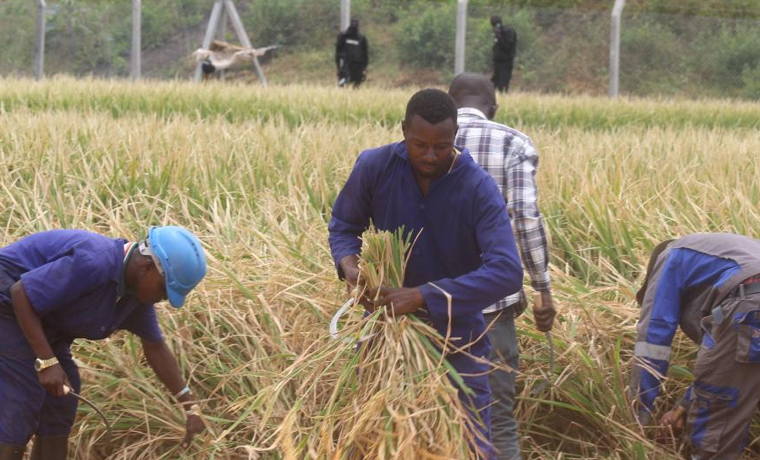
Speaking during the first harvest ceremony of the high-yielding WDR-73 rice variety, held on Tuesday in Buhuka Village, Kyangwali Sub-county, Aheebwa encouraged the fishing community and other farmers in the region to adopt modern farming practices to effectively meet the supply needs of the oil and gas industry.
To promote agriculture among fishing communities, CNOOC Uganda Limited partnered with the Hoima Caritas Development Organisation (HOCADEO), with technical support from the FAO–China–Uganda South–South Cooperation Project, to introduce the cultivation of the WDR-73 rice and millet varieties along the shores of Lake Albert. The initiative, which began in March this year, has now yielded its first harvest.
The WDR-73 rice variety is a water-saving and drought-resistant hybrid developed through collaboration among Chinese researchers, the Shanghai Agro-Biological Gene Center (SAGC), Uganda’s National Agricultural Research Organisation (NARO), and the Food and Agriculture Organization (FAO). It is known for significantly increasing yields compared to traditional varieties, conserving water, and performing well in upland environments — helping improve food security and farmer incomes.
Under the project, CNOOC Uganda established two demonstration gardens for rice and millet in Buhuka to promote modern farming practices. More than 300 fishermen and farmers have been trained and are now cultivating rice and millet using quality seeds, fertilizers, and improved agronomic techniques. Projected harvests indicate that the WDR-73 rice variety can yield between 2.5 and 3 tons per acre, while millet is expected to produce between 1.5 and 2 tons per acre.
The rice variety matures within just four months, highlighting its potential to boost food production and household incomes. Aheebwa emphasized that by adopting modern and commercial agricultural practices, the fishing community can tap into emerging market opportunities created by Uganda’s oil and gas industry. “Currently, along the Lake Albert shores, especially in Buhuka, where CNOOC is undertaking major oil activities, the soil is fertile and favorable for agriculture.
The fishing community should embrace farming to boost crop production, improve food security, create jobs, and enhance economic growth by integrating improved inputs and techniques such as irrigation and quality seeds,” she said. Aheebwa added that the fishing community should not depend solely on fishing for survival but should diversify its income sources.
“By embracing modern agricultural practices, the fishing community will be better positioned to tap into the vast opportunities within Uganda’s oil and gas sector, particularly in the supply of food,” she said. She noted that commercial farming and the adoption of modern technologies are key to revitalizing Uganda’s agricultural sector, creating jobs, and increasing incomes for rural communities.
Peter Banura, the Kikuube District Chairperson (LC5), called on oil companies operating in the Albertine Graben to support farmers in accessing improved inputs such as quality seeds, fertilizers, and modern processing facilities to enhance productivity and incomes. “The development of oil and gas infrastructure in the Bunyoro sub-region creates demand for various supplies, opening up new markets for agricultural products and services,” Banura said.
Ma Peixin, the Vice President of CNOOC Uganda Limited, said the first rice harvest demonstrates what communities can achieve when equipped with the right training and resources. “CNOOC Uganda is committed to a holistic approach to green and ecological oilfield development. As we develop Uganda’s oil resources, we are equally focused on strengthening local livelihoods and creating sustainable community benefits,” Peixin said.
Zhang Xiaoqiang, the Team Leader of the FAO–China–Uganda South–South Cooperation Project, emphasized the importance of technology transfer in improving yields and noted that the program complements government efforts to modernize agriculture. Peter Muyimbo, the Assistant Program Officer for the FAO–China–Uganda South–South Cooperation Project (Phase III) at the Ministry of Agriculture, highlighted the importance of adopting smart agricultural technologies and irrigation to boost productivity and resilience to climate change.
“Employing modern techniques like smart agriculture and irrigation is crucial for enhancing productivity and ensuring farmers in the region can increase yields,” Muyimbo explained. Emmanuel Balijwaha, a resident of Kaseeta Village, appealed to oil companies operating in the region to support communities living near oil fields with training and resources for commercial agriculture so they can benefit from the sector.
Reginal Okumu, the Buhuka Parish LC2 Chairperson, said many fishermen are willing to venture into modern agriculture but face challenges such as limited land, inadequate technical skills, and lack of quality farm inputs. “We need continuous training of fishermen on better farming techniques to help them fully engage in agricultural production, improve their income, and be ready to supply the oil and gas sector,” Okumu said.
-URN. Give us feedback on this story through our email: kamwokyatimes@gmail.com