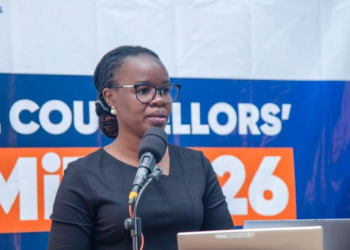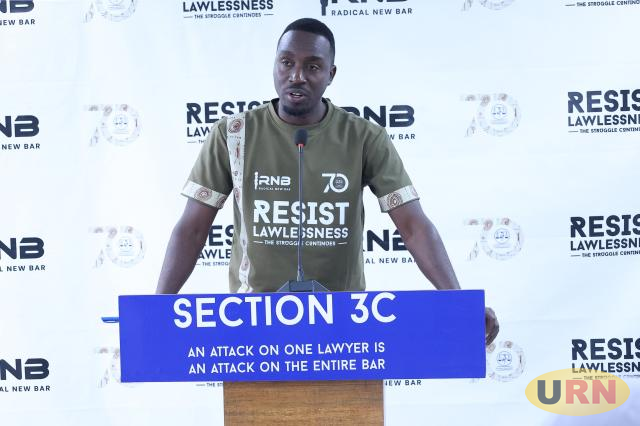
The Uganda Law Society (ULS) says it plans to petition the Supreme Court to appeal against the Constitutional Court ruling that struck down a key provision of the Human Rights Enforcement Act. Asiimwe Anthony, the Society’s Vice President, says the judgment weakened the country’s constitutional safeguards against torture and risks entrenching impunity.
Apart from the appeal at the Supreme Court, the lawyer’s body says it will seek intervention from the East African Court of Justice, and petition regional and international human rights bodies over what it describes as one of the most consequential judicial decisions affecting the protection of fundamental rights in recent years. It says it will also engage the African Commission on Human and Peoples’ Rights, the UN Human Rights Committee, the Special Rapporteur on Torture, and other mechanisms through urgent communications.
The announcement was made during the Society’s weekly Rule of Law and Public Engagement Forum, where Asiimwe also confirmed that lawyers across the country will hold a nationwide strike on Friday to protest what they describe as increasing attacks on constitutionalism and the rule of law.

Asiimwe said the Constitutional Court’s decision to invalidate Section 11(2) of the Human Rights Enforcement Act, 2019, undermines the absolute prohibition against torture by allowing criminal proceedings to continue even where evidence may have been obtained through torture or other violations of non-derogable rights.
The Constitutional Court judges, Oscar Kihika, Margaret Tibulya, Moses Kazibwe Kawumi, Dr. Asa Mugenyi,and Justice Musa Ssekaana, early this month, made a ruling in Faruku Muhamed and Others v Attorney General and Others, Constitutional Petition No. 17 of 2024, consolidated with Constitutional Reference No. 2 of 2024, on 2 June 2026. The petition concerned Section 11(2)(a), (b), and (c) of the Human Rights (Enforcement) Act, 2019.
That provision required courts to nullify criminal proceedings and acquit an accused person where the court found that the accused’s non-derogable rights, particularly freedom from torture and the right to a fair hearing, had been violated during investigation or prosecution. The court unanimously declared Section 11(2)(a), (b), and (c) unconstitutional.
The judges held that criminal liability should not automatically disappear because a suspect’s rights were violated. They said an acquittal should only follow a full trial on the substantive charges. “The Constitutional Court, which should be the bedrock of justice, is removing all the necessary shields that protect citizens. No wonder we have seen intensified abuse of these rights and an increase in impunity shortly after this decision was delivered. The institutions that should be protecting constitutionalism are instead abdicating their duty.” Said Asiimwe.
“This judgment weakens judicial independence and emboldens Executive overreach contrary to the oaths of office and public expectation of impartial justice. Coerced confessions distort truth-seeking and poison the administration of justice,” He argued that the exclusionary rule contained in the law was never a mere procedural requirement, but a constitutional safeguard intended to ensure that courts do not legitimise torture or rely on evidence obtained through coercion.
According to the Society, the judgment contradicts the 195 Constitution, the Prevention and Prohibition of Torture Act, the African Charter on Human and Peoples’ Rights, the UN Convention Against Torture, and several other international human rights instruments that Uganda has ratified. “Torture is never a legitimate investigative tool. Excusing it by allowing tainted proceedings to continue creates a dangerous moral hazard. Security agencies will know that violations may no longer lead to automatic nullification of proceedings, reducing deterrence against torture.”
The Society accused the Constitutional Court of failing to adequately consider Uganda’s constitutional history, particularly recommendations contained in past commissions of inquiry that informed the strong anti-torture provisions in the 1995 Constitution. “This ruling prioritises the completion of criminal trials over the absolute prohibition of torture-tainted processes. It is fundamentally flawed, internally inconsistent, and incompatible with Uganda’s legal obligations. Torture is never a legitimate investigative tool. Excusing it by allowing tainted proceedings to continue creates a dangerous moral hazard.” Asiimwe explained.
ULS said it has already constituted a special committee to coordinate legal efforts challenging the judgment. Among the planned actions are supporting an appeal to the Supreme Court, seeking interim orders preserving the protection previously offered under Section 11(2), filing additional public interest litigation, documenting alleged violations, and pursuing remedies before the East African Court of Justice.
The Society also intends to engage the African Commission on Human and Peoples’ Rights, the UN Human Rights Committee, and the UN Special Rapporteur on Torture if domestic remedies fail. The lawyers’ body linked the Constitutional Court decision to what it says is a broader deterioration in respect for constitutionalism, citing recent cases involving alleged abductions, torture, and the prosecution of lawyers. It referred to the recent arrest and prosecution of former Lord Mayor and advocate Erias Lukwago, describing it as an attack on the legal profession and warning that no Ugandan is immune from abuses of power.
“This is beyond political affiliation. It is beyond ideology. It affects every Ugandan. Whoever imagined they were safe should know that no one is actually safe. It is the duty of every citizen, not just lawyers or politicians, to defend constitutionalism.”
As part of the campaign, the Uganda Law Society confirmed that advocates will observe a nationwide strike on Friday, saying the industrial action is intended to raise public awareness about the dangers posed by the Constitutional Court ruling and the continued erosion of constitutional protections. The announcement coincided with the launch of a committee established under Section 3C of the Uganda Law Society Act to strengthen the protection of advocates’ welfare and professional interests.
ULS also used the occasion to launch activities marking its 70th anniversary under the theme “ULS at 70: Upholding Constitutionalism in Changing Times.” Rather than celebrating with ceremonial events, the Society said the milestone should serve as a moment of reflection on the state of the rule of law in Uganda. “We asked ourselves whether this was a time for parties and celebrations,” the Society said. “We concluded that this is not a time to party. It is a time to stand with citizens and fulfil our statutory duty to defend the Constitution, protect the rule of law and promote access to justice.”-URN. Give us feedback on this story through our email: kamwokyatimes@gmail.com