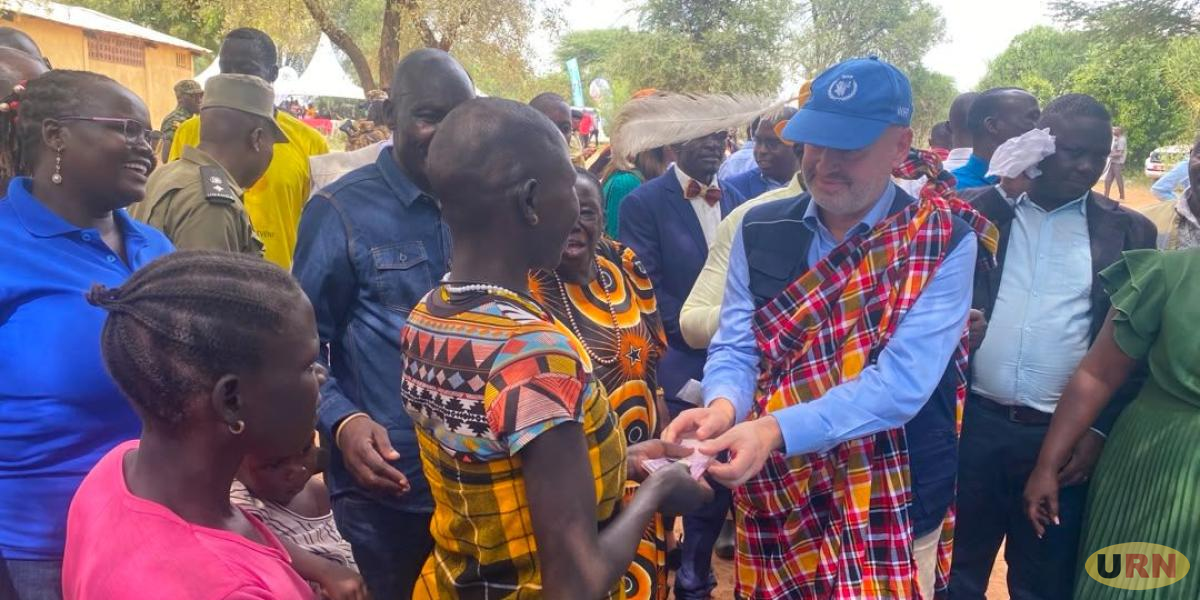
Over 7,298 vulnerable households in Kotido and Kaabong districts have started receiving one-off unconditional anticipatory cash transfers of about four hundred thousand shillings (UGX 396,860) per household per month for two months. The Anticipatory Cash Transfer was launched on Wednesday in Rengen Sub-County in Kotido district to help families prepare for drought before conditions worsen.
The project is funded by the Government of Ireland through the World Food Programme. It targets families most vulnerable to food insecurity and aims to protect livelihoods while reducing reliance on negative coping strategies like selling assets. It will also generate operational lessons to institutionalize anticipatory action within Uganda’s national social protection systems.
Marcus Prior, Acting Country Director for WFP Uganda, said Karamoja households continue to face recurrent shocks that are becoming more frequent and severe. This year, pressure has been compounded by El Niño, resulting in hotter and drier conditions. “Anticipatory action allows us to use forecasts and early warning information to intervene before the worst impacts are felt, protecting livelihoods, reducing losses and preserving people’s ability to cope,” Prior said.

He noted this is the first full-fledged anticipatory action plan with the government. The support will reach over 35,000 people with cash transfers and early warning at a moment when it can make the greatest difference. Prior added that as the cash transfers were launched, WFP also celebrated the completion of a shock-responsive social protection top-up to over 10,000 elderly citizens in Karamoja, delivered through the government’s Senior Citizens Grant with support from Ireland.
Prior said the model is highly cost-efficient and leverages existing government systems for social protection, early warning, disaster management, and local government delivery. The intervention builds on long-term platforms like Nutricash, school feeding, and integrated nutrition programs.
H.E. Mags Gaynor, Ireland’s Ambassador to Uganda, said the financial support is intended to help families access food during the drought period and prevent communities from selling assets to buy food when the situation worsens. “We also want to ensure communities get weather information and advanced early warning so they can prepare to manage the situation,” Gaynor said.
Gaynor reiterated that Ireland is working with the WFP, Office of the Prime Minister, Ministry of Gender, and local government to design programs that save communities from the “devastating scorching sun that has destroyed food crops.”
Charles Ichogor, Kotido Resident District Commissioner, said the timely intervention will partially address the crisis. “Communities are in dire need of food, and this has frustrated my efforts to monitor government programs. Climate change is real and has devastated Karamojong livelihoods. It is no longer just an environmental issue but a development issue because the population is becoming weaker,” Ichogor said.
He urged partners and the government to sensitize people on early warning systems and train communities to understand weather patterns. He also warned beneficiaries against misusing cash for alcohol: “Stock food for the family.” Gabriel Lokiru Achia, MP for Jie County, said food insecurity is worsened by unpredictable weather, and leaders are under pressure from communities demanding food support.
“All households are affected, and the project should consider all households rather than taking a selective group,” Achia said. He appealed for more help and urged beneficiaries to share food with others not in the program. Paul Lote Komol, LC5 Chairperson of Kotido, said that although WFP has provided financial support, the project targets only specific identified households, yet the majority still struggle to get a meal a day.
“The entire district is severely hit by food insecurity, and already people have started dying as a result of hunger,” Lote said. He called on the Office of the Prime Minister to provide more food support.
Muhofa Titas, Senior Disaster Management Officer at OPM, said June, July, and August are characterized by a prolonged dry spell that has put more stress on Karamoja. Rains are expected in September, but by then, the crops will be completely damaged. Muhofa said government agencies and partners are coordinating to ensure vulnerable communities receive support without duplication and that all communities affected by the dry spell get food aid.
The Integrated Food Security Phase Classification conducted between March and April 2026 confirms Karamoja continues to face significant food insecurity and nutrition challenges during the lean season. As of May 2026, 32% of Karamoja’s population was classified in IPC Phase 3 Crisis, while a further 3% – 41,000 people – were classified in IPC Phase 4 Emergency-URN. Give us feedback on this story through our email: kamwokyatimes@gmail.com