President Museveni says the expanding export basket is one of the clearest indicators of the country’s economic transformation. Museveni said the growth reflects Uganda’s gradual shift from dependence on traditional agricultural commodities to a more industrialised and value-added economy. In his State of the Nation Address, Museveni cited export diversification as evidence that Uganda is gradually moving beyond dependence on traditional agricultural commodities to a more industrialized and value-added economy.
“The country has added 31 new products to the export basket in the last 15 years,” Museveni told Parliament, arguing that the development demonstrates the success of government efforts to promote manufacturing, industrialization, and value addition. The President said Uganda now exports a growing range of products, including pharmaceuticals, refined gold, steel products, ceramics, plastics, ICT products, and processed agricultural commodities.
According to Museveni, the country’s export earnings have risen to approximately Shillings 18 billion in the year ending March 2026, driven by increased production and the emergence of new export industries. He contrasted the current export profile with that of the past, when Uganda largely depended on a narrow range of primary commodities such as coffee, cotton, and tea.

Museveni attributed the diversification to deliberate government investments in infrastructure, electricity generation, industrial parks, and policies aimed at attracting private sector investment. The President said the National Resistance Movement (NRM) government has, over the years, identified all the requirements necessary for building a prosperous Uganda, including peace, security, infrastructure, access to capital, regional markets, and wealth creation programmes.
“The NRM identified all the requirements for building a prosperous Uganda,” he said, adding that the challenge now lies in implementation and ensuring that every household participates in the money economy. While acknowledging that poverty still exists in parts of the country, Museveni said Uganda is also witnessing the growth of a wealthy and expanding middle class.
“There is poverty in Uganda, but there is also wealth,” he said, citing successful entrepreneurs, farmers, and investors who have benefited from government programmes and market opportunities. The President urged political leaders to focus on serving citizens rather than pursuing personal interests.
“Leadership is not for egos but for people and the country,” Museveni said, warning against corruption, poor service delivery, and self-serving leadership. He further argued that one of Uganda’s biggest challenges remains ignorance and a failure by many people to identify and exploit available economic opportunities.
“The major problem is ignorance,” Museveni said, adding that many Ugandans still do not know what to do despite the opportunities available in agriculture, manufacturing, services, and ICT.
Museveni said the growth of local manufacturing has not only created jobs but also reduced Uganda’s dependence on imported goods. He cited expansion in sectors such as pharmaceuticals, construction materials, and agro-processing as examples of industries increasingly supplying both domestic and regional markets.
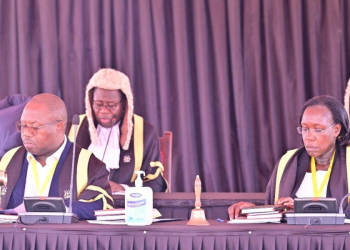
The President also highlighted growth in agricultural production, saying increased output of milk, coffee, maize, sugar, cocoa, and fish has strengthened Uganda’s position as a regional supplier of food and agricultural products. Meanwhile, the Speaker of Parliament, Jacob Marksons Oboth-Oboth, challenged Members of Parliament to translate Museveni’s “No More Sleep” message into action.
Oboth-Oboth urged legislators to become generational leaders by embracing hard work, accountability, and commitment to national development. “We should wake up and embrace the ‘No More Sleep’ slogan in action so that we become generational leaders,” the Speaker said. Oboth-Oboth adjourned Parliament until June 11, 2026, when the Minister of Finance is expected to present the national budget for the 2026/27 financial year-URN. Give us feedback on this story through our email: kamwokyatimes@gmail.com