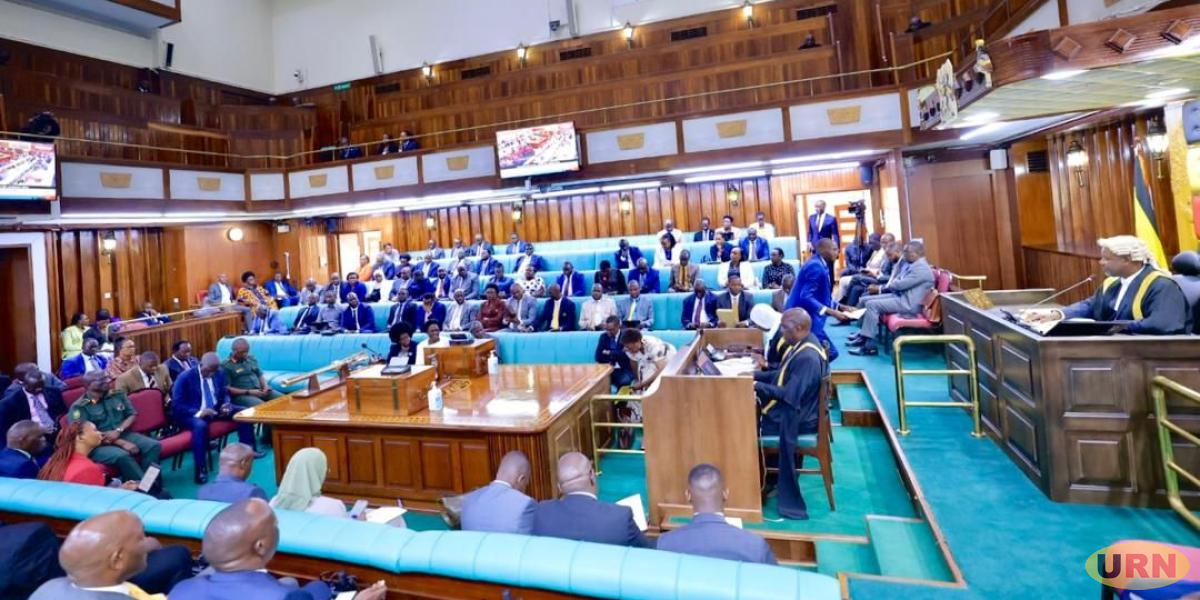
The Deputy Speaker of Parliament, Thomas Tayebwa, has asked the Minister of Finance to present a comprehensive explanation next week on the continued depreciation of the Ugandan shilling against the US dollar.
The call comes amid growing concerns over its impact on the cost of doing business and the prices of essential commodities.
Tayebwa, during his communication to the Wednesday afternoon plenary session, said the Finance Minister, Henry Musasizi, is already consulting key stakeholders, including the Bank of Uganda and the Uganda Bureau of Statistics (UBOS), to ensure that the statement presented to Parliament is based on facts and reflects a common position among institutions responsible for economic management.

The Minister of Finance had been scheduled to make a statement on the rising dollar rate on Wednesday afternoon.
However, Deputy Speaker Tayebwa said he had held a lengthy discussion with Minister Musasizi on Wednesday morning on the nature of the statement Parliament expects from government.
“I told him that we want a comprehensive statement and we discussed and came to a conclusion that he needs to consult deeply with other stakeholders, especially the Central Bank, UBOS and other critical players, so that he brings a statement that is clearly based on facts, well researched and agreed upon by all critical players,” Tayebwa said.
The Deputy Speaker cautioned that a poorly prepared statement on the volatile exchange rate could further unsettle the market instead of reassuring businesses and the public.
“A Minister of Finance can come here and make a statement, and it causes more trouble in the market than what we would have expected, or it is also very insufficient considering what we want,” Tayebwa said.
Tayebwa explained that Musasizi was absent from the House because he was engaged in consultations with the relevant institutions.
He stated that the Minister is expected to return to Parliament with the statement next week.
The Leader of the Opposition, Joel Ssenyonyi, had expressed concern over the continued weakening of the Shilling against the Dollar.The Shilling touched an all-time low at the beginning of the week.
Some have blamed the slide on the importation of goods by the major manufacturers. The shilling was trading at 4,025 per dollar at the time of filing this report. Ssenyonyi warned that the depreciation was increasing the cost of doing business, particularly for importers who depend on foreign exchange to pay for goods and services.
He also referred to remarks attributed to Bank of Uganda Governor Michael Atingi-Ego during the parliamentary consideration of the Protection of Sovereignty law, in which the Governor reportedly warned of substantial depreciation of the local currency due to possible disruption to Uganda’s balance of payments.
“We are going to have a substantial depreciation of the Ugandan currency because of our balance of payments, which is to be greatly destabilised by the Sovereignty Bill,” Ssenyonyi quoted the Governor as saying while appearing before the joint committee.
The Leader of Opposition urged government to explain the measures it was taking to address the situation, saying the effects of the weakening currency were already being felt by businesses and consumers.
“It is important that government tells us what they are doing about this situation because it is biting hard,” he said.
The Shilling depreciation also drew concern over the implications for traders whose goods were purchased or shipped when the exchange rate was lower.
Karim Masaba, the Mbale City Industrial Division MP, urged government to suspend the monthly adjustment of taxes on imports based on the prevailing cost, insurance and freight (CIF) exchange rate.
He said traders were concerned that the rising value of the dollar would increase the taxes assessed by the Uganda Revenue Authority (URA) on imported goods, including consignments that had been purchased when the Shilling was stronger.
“Some of these goods have just arrived, and some others are still in transit. The prayer of these traders is that URA and the Ministry of Finance hold on to the previous rate, because their goods were purchased at the older lower rate,” Masaba said.
He also questioned the decision by the Central Bank to increase the cash reserve requirement for commercial banks instead of using part of the country’s foreign exchange reserves to support the Shilling.
Masaba noted that Uganda’s reserves had risen to about US Dollars 6.5 billion, arguing that the government should explain why these reserves were not being deployed to help stabilise the currency.
“The Minister for Finance can explain to us why this move has been taken, because we would expect in such a situation that these reserves would be used to stabilise the Shilling such that many of our traders do not lose out,” he said.
Cohen Amanya, the Igara County West MP, said traders were also concerned that URA could assess their imports using the current exchange rate despite the goods having been purchased when the Dollar was cheaper.
“Yesterday we were told that the current rate is temporary, but as of today it has not changed and is still going up. This will affect the prices of fuel and factors of production. I beseech the Finance Minister to look into this issue,” Amanya said.
The weakening Shilling is expected to put additional pressure on the prices of imported goods and production inputs, with MPs warning that higher import costs could eventually be passed on to consumers.
Eddie Kwizera, the Bukimbiri County MP, called for the establishment of a comprehensive tax policy to guide revenue mobilisation and provide greater predictability for businesses.
The currency concerns have also been linked to broader fears about rising fuel and production costs, as Uganda relies heavily on imports for fuel, machinery, industrial inputs and other goods-URN. Give us feedback on this story through our email: kamwokyatimes@gmail.com