By KT Reporter
The Uganda Communications Commission (UCC), Executive Director Nyombi Thembo, wants individuals who vandalise telecommunication infrastructure to be charged with terrorism.
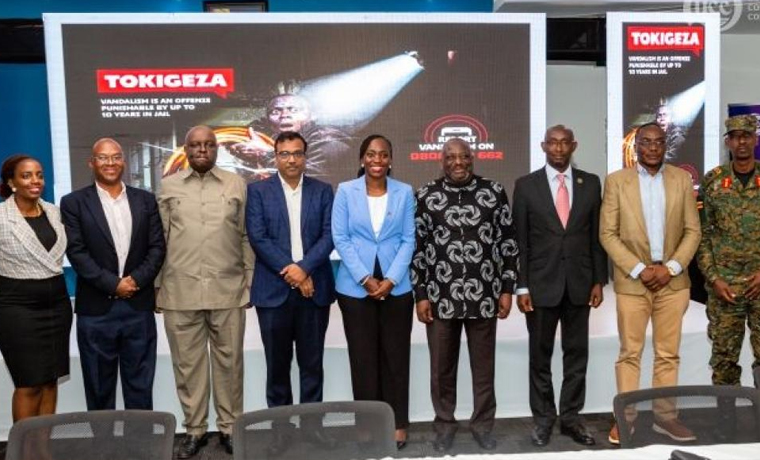
Speaking during the launch of the “Tokigeza” campaign, a national initiative aimed at curbing vandalism of telecom infrastructure, Thembo emphasised that such crimes jeopardise critical national services, including emergency response, healthcare, education, and banking. “These are not ordinary vandals. They are economic saboteurs and enemies of the people. When a network goes down, lives are at risk. Imagine a hospital operation disrupted because someone stole a fibre optic cable. That’s not theft, that’s attempted murder,” said Thembo.

The Tokigeza campaign, which translates loosely to “don’t dare” or “don’t touch”, is a coordinated response to the increasing cases of telecom infrastructure vandalism. The campaign involves awareness drives through radio, television, and digital platforms, community outreach through schools and local councils, and collaborations with Boda Boda riders and landlords. Citizens are also being encouraged to report incidents via a toll-free number, 0800288262.
Thembo revealed that the campaign is supported by the country’s major telecom operators, and infrastructure provider ATC Uganda, as well as the Uganda Police Force, the Uganda People’s Defence Forces (UPDF), the judiciary, and the Director of Public Prosecutions (DPP). “We already have a docket open in the courts, and we are working to ensure expedited prosecution. We are also in the process of amending the UCC Act to include harsher penalties for these crimes,” he said. “Under the amended Computer Misuse Act, penalties can go up to 750 million Shillings or life imprisonment in extreme cases.”
He highlighted that with consultations with the President, telecom towers may soon be declared “critical national infrastructure,” giving them extra legal protection and making vandalism punishable as economic sabotage. “There will be no bail. There will be severe penalties. We must send a strong message: if you touch telecom infrastructure, you’re not just stealing, you’re endangering lives,” he emphasised.
According to the UCC boss, telecom infrastructure is not just a private-sector investment but a pillar of national security and public welfare.
Dorothy Ssemanda, Chief Executive Officer of ATC Uganda, which owns and operates over 4,300 telecom towers across the country, said that they have recorded over 820 incidents of cable theft, more than 300 cases of fuel theft, and countless losses of batteries and other telecom equipment. “Every time a tower is vandalised, a whole community goes dark, no mobile money, no banking, no emergency calls.”
She cited Sheema District, where a telecom site at Kitagata was vandalised, affecting 13 surrounding towers. The entire region lost connectivity for nearly a week, and pregnant women who could not reach hospitals in time. “One woman had to give birth at home by candlelight because she couldn’t call for help,” said Ssemanda.
She noted that ATC Uganda, along with telecom operators, has invested heavily in security technology, including trackers for batteries and generators, and these measures have led to the arrest of several suspects.
Major General Moses Rwakitarate, the Coordinator of National Vital Assets and Strategic Installations, echoed the urgency of the campaign. “This is now a national security issue. As someone who once relied on satellite phones to check on family while deployed in conflict zones, I understand the value of connectivity. We are committed to working with telecom companies to secure these sites,” Rwakitarate said.
He added that the military’s widespread presence across Uganda gives it a unique advantage in responding quickly to threats against telecom infrastructure. “We’re everywhere. If an alarm goes off on a rural tower, we should be the next call after your monitoring centre. We know the terrain. We know the value of this infrastructure,” he stated.
The General also criticised the public’s indifference to vandalism. “People see someone lifting a generator in broad daylight and assume it’s normal. We must educate the masses so they understand that this theft affects their lives directly,” he said.
Nicolas Beijuka, speaking on behalf of MTN Uganda’s CEO, and Rajesh Agarwal, from Airtel Uganda, both joined forces with other Internet Service Providers and telecom sector stakeholders in expressing concern and support for the campaign.
“This isn’t about competition. We are here as one voice against a crime that affects all Ugandans. Whether it’s a missed bank transaction or a student unable to access online learning, the impact is widespread and devastating,” said Agarwal-URN. Give us feedback on this story through our email: kamwokyatimes@gmail.com