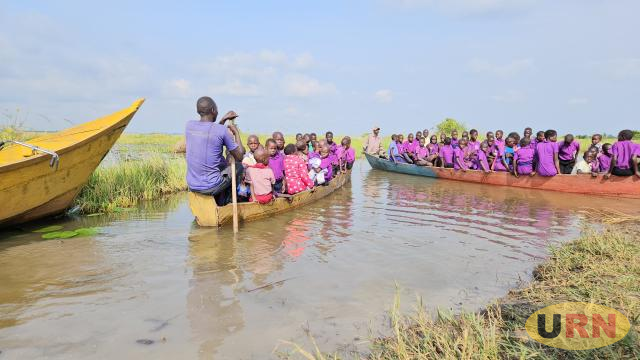
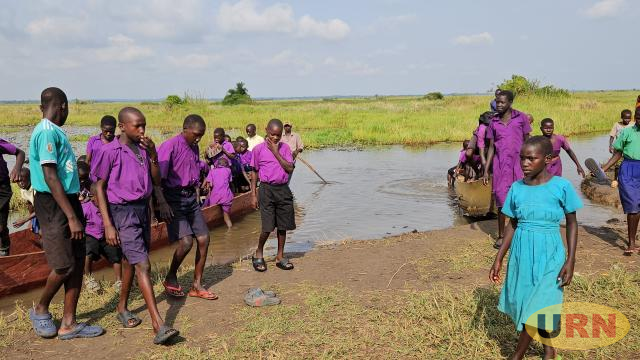
 Every school morning at Bata-Ibwol Island in Abalang Sub-county, Dokolo District, the school day begins not with the ringing of a bell but with a race to catch a canoe. By 9:00 a.m. on Thursday, nearly 100 learners had squeezed into small wooden canoes, clutching their school bags above their heads as they crossed floodwaters to reach Abalang Modern Primary School.
The pupils are among more than 500 learners enrolled at the school, the only primary school serving the island community located about three kilometers from their homes. The road linking Bata-Ibwol village to the school has remained submerged for years following persistent flooding, leaving canoes as the only reliable means of transport.
For many learners, missing the canoe means making a difficult decision: stay home and miss school or wade through waist-deep water to class. The daily ordeal has taken a toll on both attendance and academic performance. Peter Omara, the head teacher of Abalang Modern Primary School, says many learners report to school long after lessons have begun because of transport delays.

According to Omara, late arrival is only part of the problem. Children who attempt to walk through the flooded road often arrive with soaked books and uniforms, making it difficult to participate in class. He says prolonged exposure to these hardships has contributed to absenteeism and an increasing number of school dropouts.
The head teacher also appealed to parents to embrace the school feeding program, arguing that a meal at school would encourage learners to remain in class despite the difficult journey and the growing effects of climate change, including prolonged dry spells that continue to affect household food security. Among those battling the floods is 14-year-old Tobias Opio, a Primary Four pupil.
On Thursday morning, Tobias missed the community canoe after spending extra time helping his mother in the family garden. Left with no alternative, he and another pupil removed their shoes and waded through the floodwater, carefully balancing their books above the water to keep them dry.
By the time they reached school, their uniforms were drenched. Instead of joining their classmates in class, the two spent nearly an hour drying their clothes under the morning sun. Opio says this has been his daily reality for the past two years.
Despite the hardships, Tobias has not abandoned his dream. He hopes that one day the road will be rehabilitated, allowing children to attend school safely and consistently. He wants to become a teacher and help children from communities like his receive a better education.
Behind the daily school crossings is John Calvin Olum, a 42-year-old resident of Bata-Ibwol village whose commitment has become a lifeline for hundreds of children. Since the floods first cut off the community in 2019, Olum has voluntarily paddled schoolchildren across the water every weekday. Initially, three residents shared the responsibility, but the demanding work and lack of any financial support forced the others to quit, leaving Olum to shoulder the burden alone using only three functional wooden canoes.
Each morning, Olum ferries dozens of learners in multiple trips before classes begin. During peak hours, each canoe carries up to 70 children, often exceeding its safe capacity. He says thick water weeds, strong winds and heavy rains frequently make the crossings dangerous, but stopping is never an option because the children’s education depends on him.
Bata-Ibwol village is home to about 280 households with an estimated population of 730 people. Of these, at least 223 are school-going children. Harriet Hope Apio Ocen, the female councilor representing Abalang Sub-county in Dokolo District Council, says the flooded road has become one of the biggest barriers to education in the area.
According to her, girls are particularly affected, with many dropping out because parents fear for their safety during the daily crossings or because repeated absenteeism eventually pushes them out of school altogether. Apio says the district leadership is aware of the challenge and has initiated discussions aimed at rehabilitating the road to restore access to schools and health facilities.
For residents of Bata-Ibwol, however, promises alone will not keep children in school. They are calling on both the district and central government to priorities climate-resilient infrastructure, including raised roads, proper drainage and safe water transport, to protect education from the recurring floods.
For years, flooding has continued to disrupt education, healthcare and livelihoods across Dokolo District. Schools are periodically cut off, family incomes are destroyed as gardens remain submerged, and children are exposed to waterborne diseases while travelling to and from school.
Education stakeholders warn that unless long-term adaptation measures are implemented, communities like Bata-Ibwol will continue paying the price of climate change through lost learning opportunities and rising school dropout rates-URN. Give us feedback on this story through our email: kamwokyatimes@gmail.com