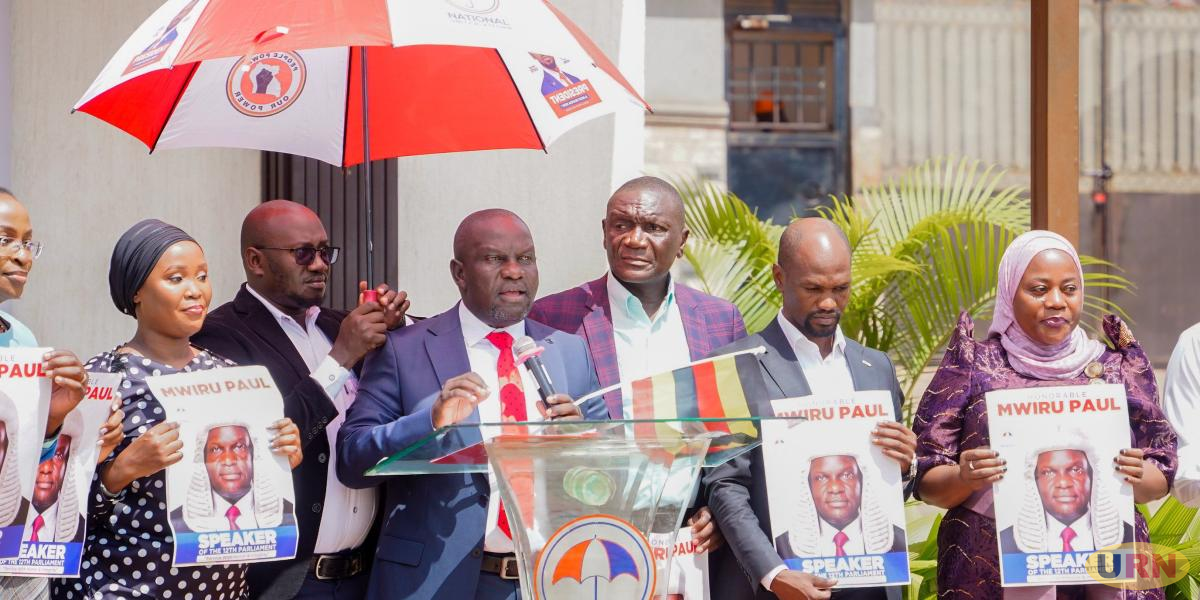
National Unity Platform’s Paul Mwiru says he is committed to restoring public confidence in Parliament if elected to lead the house as Speaker of Parliament. While launching his manifesto for the leadership of the legislative arm of government at NUP’s headquarters in Kavule- Kampala, Mwiru outlined a four-point agenda that he says will guide his leadership if elected Speaker.
“My candidature stands firmly on four pillars: restoration of the rule of law in Parliament, equity and inclusivity for all members and citizens, responsiveness to the aspirations of Ugandans, and competent, exemplary and accountable leadership,” Mwiru said. He pledged to uphold parliamentary integrity, protect democratic processes, and serve all Ugandans fairly. “I ask for your support and prayers as we work together to strengthen our Parliament and deepen democracy,” he added.
Mwiru joins a highly competitive contest that has become one of the most closely watched political battles following the conclusion of the 2026 general elections. The Speakership race was initially expected to revolve around outgoing Speaker Anita Annet Among and Deputy Speaker Thomas Tayebwa. However, the political landscape shifted dramatically after Among withdrew from the race amid mounting political pressure and growing controversy surrounding her leadership.

Her exit opened the field to several contenders, including Jacob Marksons Oboth-Oboth, who is backed by Patriotic League of Uganda (PLU), a pressure group linked to the ruling National Resistance Movement (NRM).The race has also attracted Democratic Party (DP) party President Norbert Mao and now Mwiru from the main opposition party, NUP. The contest has evolved into a broader debate on the future of Parliament, its independence from the Executive, and public trust in the institution.
Alice Alaso, the acting National Coordinator for Alliance for National Transformation (ANT) says that much as the opposition parties don’t have the numeral strength in parliament, Mwiru’s candidature serves as a statement of determination to rule of law and governance. The race has also been heavily influenced by the involvement of the Patriotic League of Uganda (PLU), whose leaders have recently emerged as influential power brokers in the formation of the next parliamentary leadership. PLU initially endorsed Among for Speaker and Tayebwa as Deputy. However, it withdrew the endorsement, triggering intense political speculation and signaling shifting alliances within the ruling National Resistance Movement (NRM) camp.
In recent days, PLU leaders associated with Chief of Defence Forces Muhoozi Kainerugaba have publicly backed Oboth-Oboth for Speaker while maintaining support for Tayebwa as Deputy Speaker. The endorsements have also elicited debate over the extent to which external political actors should influence the election of parliamentary leaders, with critics arguing that Parliament must remain an independent arm of government.
Mwiru’s entry into the race also comes amid growing pressure from women’s rights activists and female politicians who have warned against abandoning the tradition of gender balance in Parliament’s top leadership.
Following Among’s withdrawal, women’s movement leaders expressed concern that the emergence of male candidates for both Speaker and Deputy Speaker could reverse gains made in women’s political representation. Activists have argued that Uganda’s political leadership has historically benefited from balancing gender representation in key offices and have urged political parties and legislators to consider female candidates for one of the two top parliamentary positions.
The debate has added another layer to an already complex contest, forcing candidates to address issues of inclusivity and representation alongside governance and accountability. Mwiru’s emphasis on restoring the rule of law and parliamentary integrity reflects growing criticism directed at the 11th Parliament over the past five years.
The outgoing Parliament presided over major legislative decisions, including controversial budget approvals, constitutional amendments, and the enactment of the Anti-Homosexuality Act and Protection of Sovereignty Act, among others.
However, it was also frequently criticized by opposition politicians, civil society organizations, and governance experts who accused it of failing to provide adequate oversight of the Executive. Among’s tenure as Speaker was further overshadowed by corruption allegations and public concerns about accountability in Parliament, issues that opposition leaders repeatedly cited as evidence of declining public trust in the institution. Legislators are expected to elect the Speaker and Deputy Speaker on May 25 when the 12th Parliament convenes-URN. Give us feedback on this story through our email: kamwokyatimes@gmail.com