By KT Reporter
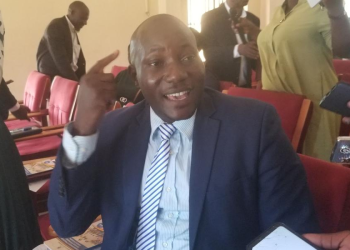
The newly appointed Director of Public Prosecutions (DPP), Lino Anguzu, has opened up about the shifting nature of crime, the pressures of prosecution, and his personal philosophy on justice.
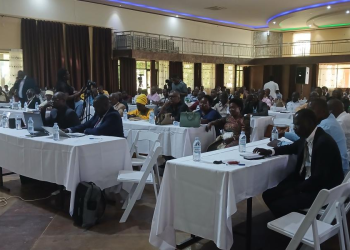
Anguzu, who has just replaced Justice Abodo as the Director of Public Prosecutions (DPP) of the Republic of Uganda on Wednesday, made his first online address at X space hosted by City Lawyer, Elison Karuhanga, under the theme “Inside the Mind of the DPP: the future of law and justice.”

Given the standoff between the Uganda Law Society and the former DPP, Jane Frances Abodo, and the current public perception about the office, Uganda Radio Network listened into the space in which the DPP spoke about wide-ranging issues in the prosecution and administration of Justice.
Who Is Lino Anguzu?
Asked to introduce himself, Anguzu described himself as a career prosecutor, born and raised in Arua, who has served in the Office of the DPP for more than 21 years. “I love my job. I love breaking barriers, solving puzzles, and paying attention to detail,” he said.
“What lies at the corner of all this is justice. Everyone deserves to be heard fairly.” Despite holding one of the most public positions in Uganda’s justice sector, he described himself as “a very private person” who prefers to blend in quietly.
” I like to keep everything simple. I hate braggados and bossing people around. I like to just blend in quietly without anyone or everyone knowing who I am or what I do. And so usually I just like to blend in quietly. And so I don’t like a lot of attention, public attention, and stuff like this. It’s not for me,” he said
His Approach to Justice
Anguzu said his philosophy is shaped by the belief that justice is an objective outcome, not a subjective feeling—an idea he learned from former Deputy Chief Justice Richard Buteera.
“In every criminal case, many people are looking for justice—the victim, the accused, the community, and the court,” he said.
“Sometimes when you lose a case, that actually is justice.”
He emphasized that prosecutors must imagine themselves in three positions: Thevictim — who suffers trauma and loss, the accused person — who might be innocent and faces loss of liberty, and the public — whose interest must be protected. “The responsibility placed on a prosecutor is heavy,” he said.
“You must be sure the decision you make is the right one, grounded in law and evidence.”
He insisted that weak cases should never be taken to court and that prosecutors must be bold enough to withdraw cases when evidence collapses.
The DPP as the First Judge
Anguzu explained that prosecutors act as “the first judges” of criminal cases. “A prosecutor makes the preliminary judgment: Does this person have a case to answer? Should this matter be tested before a court?” he said. “Few cases are black and white. Many fall in grey areas.” He observed that only evidence—not public emotion—should propel a case forward.
What a Modern Prosecutor Must Become.
Responding to a question about the evolution of prosecution, Anguzu said the modern prosecutor must undergo a complete mindset change. “You must stop looking at your role as simply obtaining convictions,” he said. “You are an officer of justice and a public servant,” he said.
He outlined qualities needed for the contemporary era, including the need for competence with a strong legal knowledge, proper drafting, and persuasive advocacy. He noted that Ugandans are increasingly aware of their rights, more cases are being litigated, and AI-driven crime presents new challenges.
The DPP on Integrity in the Justice System
Anguzu underscored the importance of collaboration across the justice chain. “If prosecutors, defense lawyers, and judicial officers all do their work with integrity, the product is justice,” he said.
He echoed a biblical proverb cited by the moderator:
“The first to speak seems right, until someone comes forward and cross-examines him.” (Proverbs 18:17 )
He said the country’s justice system can only function effectively if all criminal justice institutions understand their distinct roles and work in close coordination. Speaking during Judicial Service Conversations, Anguzu reflected on the structure of the justice chain and the necessity of collaboration.
Why Multiple Justice Institutions Exist?
As Anguzu settles in office, some have observed that there seems to be a clash of function between the DPP’s office and the Inspectorate of Government (IGG)
He partly agreed, saying each institution plays a unique but interconnected role in producing what society calls justice.
“If you have the courts, why do you need the Office of the DPP? If you have the DPP, why do you need the police? Why do you have the Prison Service, the Uganda Law Society, the Amnesty Commission?” he asked.
“Our forefathers must have determined that because of the nature of justice, it is important to have different institutions playing distinct roles, all contributing to the same outcome.”
He noted that some institutions have mandates that appear to conflict, citing the Amnesty Commission (which grants amnesty) and the DPP (which prosecutes crime).
“You must recognize these areas and meet at the leadership level to agree on how to harmonize operations,” he said.
He also referenced the overlapping mandates of the DPP and the Inspectorate of Government (IG). “You can enter memoranda of understanding: if a matter falls under your mandate, we cede; if it falls under ours, you cede.” He explained. Joint planning, budgeting, and even sharing transport or other resources, he said, can strengthen partnerships.
Public Trust and the DPP’s Image.
There are concerns that the public has “lost trust” in the Office of the DPP. Anguzu disagreed with the phrasing but acknowledged serious trust challenges. “I wouldn’t say the public has lost trust completely, but the trust is not as strong as it should be,” he said. He noted that many people still bring cases to the DPP, follow up files, and thank prosecutors for their work.
“So, it’s not true that trust is entirely lost,” he said. However, he admitted that unethical conduct among staff—lateness, absenteeism, mishandling of files, bribery, and failure to explain decisions—has affected public confidence. The secretive nature of criminal investigations, he added, also creates suspicion. “We must improve the quality and efficiency of everything we do,” he said. “We must be able to explain our decisions to victims, complainants, and accused persons.”
He revealed that DPP will engage more through barazas, community meetings, court open days, and platforms like Judicial Service Conversations.
“We want the public to know the DPP is not barricaded in an office.” He emphasized treating all clients—including accused persons—with respect. “Our primary clients are members of the public. How we speak to people and attend to them will determine whether they trust us.”
“My determination is to win back more public trust during my tenure,” he said.
Prison Congestion: A Priority Issue
When asked by a listener about Uganda’s severely overcrowded prisons—holding more than four times their capacity, with nearly half of inmates on remand—Anguzu said reducing congestion is “top, top, top on my agenda. The first thing I want to do is to close the inlet tap. And the message.”
He revealed that on the day of his swearing-in, he met the Attorney General, Deputy Chief Justice, and Principal Judge (and former DPP) to agree on coordinated efforts to address the crisis.
“We are already heavily overworked and critically understaffed,” he said. “I’m instructing prosecutors not to take poorly investigated or minor cases to court. Some matters like simple assault or petty theft can be resolved at the community level.” He added that all regional offices have been directed to review capital cases—especially those contributing to long remand periods—and forward them to his office for scrutiny.
He said cases lacking strong evidence or where circumstances have changed may be discontinued. Justice Anguzu also promised stronger internal discipline, saying prosecutors who repeatedly sanction cases without sufficient evidence will be summoned to explain their decisions. “If it is incompetence, we shall train and mentor. If it is unethical conduct, the Rewards and Sanctions Committee will take action,” he warned. Addressing concerns about the withdrawal of charges against former Minister Lugolobi, Justice Anguzu said he could not comment because the decision was made before he assumed office.
However, he emphasized that termination of cases goes through “three or four layers of review” and is never taken lightly. On access to justice for vulnerable groups, the DPP highlighted the growing burden of sexual and gender-based violence, which accounts for about 70% of criminal cases. He said the Office has created a dedicated department for SGBV and children’s cases, introduced special court sessions, and expanded its presence to 148 service points nationwide. The ODPP is also planning to introduce a toll-free line to improve accessibility. As the discussion drew to a close, Justice Anguzu reiterated his commitment to accountability and professionalism.
“The taps are going to be closed,” he said, referring to the inflow of weak cases. “We must focus on serious crimes—murder, defilement, cybercrime, financial fraud, corruption. That is how we regain the public’s trust.”
-URN. Give us feedback on this story through our email: kamwokyatimes@gmail.com