By KT Reporter
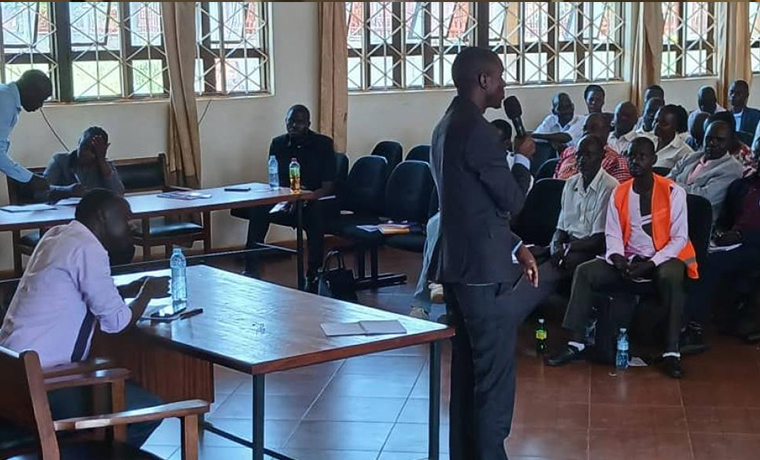
The Judicial Service Commission (JSC) has reaffirmed its commitment to promoting transparency and accountability in the judiciary following a high-level engagement with stakeholders in Pader District. The sensitization meeting, held on Tuesday, March 18, 2025, at the district headquarters’ council hall, aimed at addressing corruption in the courts and strengthening trust in the justice system.
Isaac Nduggwa, a legal officer with the JSC, noted that many people are dissatisfied with court processes due to a lack of legal awareness in the communities. He observed that most corruption in courts is often fueled by both court officials and the public, stating that some individuals attempt to influence rulings in their favor. He identified ignorance of legal procedures and poor record-keeping as key drivers of corruption, which in the end leads to poverty.

Richard Ojwini, the Pukor Sub-County Chairperson, called on the JSC to extend training and sensitization efforts to village chairpersons, arguing that they play a critical role in addressing corruption at the grassroots level. He suggested that empowering local leaders with legal knowledge would help communities understand judicial processes and reduce corruption.
Ballex Okello, the Paiula Sub-County Councilor V, raised concerns about inconsistencies in court rulings after appeals. He questioned why different levels of court often deliver varying judgments on the same case, which leads to confusion among litigants. In response, Chief Magistrate Martins Kirya explained that judicial errors can occur, which is why the appeal system exists.
He further clarified that a Grade One Court ruling can be overturned by the High Court, and subsequently, the Supreme Court can annul a High Court decision. He emphasized that these legal provisions are important in ensuring justice and accountability within the judicial system.
Meanwhile, Ray Charles Okwir, the Pader District Secretary for Works and Technical Services, who represented the district chairperson, criticized the police for making arrests without conducting thorough investigations. He further questioned why suspects are often detained beyond the legal 48-hour period as required by law before being presented in court.
Okwir urged law enforcement to always conduct proper investigations before forwarding cases to the Director of Public Prosecutions (DPP) to avoid unnecessary delays and wrongful detentions. He further called on the JSC to provide specialized training for police officers in criminal investigations to strengthen case preparation and investigation to prevent weak prosecutions.
Nduggwa urged the public to trust the judicial system rather than resorting to bribery or taking the law into their own hands, which undermines justice. As part of the fight against corruption, he proposed solutions such as increased community sensitization through media and public meetings, recruitment of more judicial officers, and the creation of more courts to improve access to justice.
His Worship Kirya welcomed the engagement meeting, stating that it is an opportunity to bridge the gap between the judiciary and the community. He admitted in his speech that many locals remain reluctant to approach court offices due to mistrust, despite efforts to promote an open-door policy.
Kirya pointed out that delays in court proceedings often stem from limited manpower in the judicial service and poor police investigations, urging law enforcement to present well-prepared cases to prevent unnecessary adjournments, among others.
Pader Resident District Commissioner (RDC) Amos Asimwe acknowledged that corruption in courts is a nationwide problem, and not just in Pader. He noted that many locals confuse corruption with procedural delays, which often lead to mistrust in the judiciary. Asimwe emphasized that ensuring justice requires collaboration among all key players, including the police, the Resident State Attorney, the courts, and the local community.
The RDC further urged stakeholders to work together in addressing the slow submission of case files, which has been a major concern among residents within the district. The JSC reaffirmed its commitment to ensuring transparency in the judicial process and urged residents to report any cases of misconduct within the judiciary using their available means, such as toll-free numbers and approaching their offices-URN. Give us feedback on this story through our email: kamwokyatimes@gmail.com