Retired Lt Gen Charles Otema Awany says he considers himself fortunate to have returned home alive after 47 years of military service through some of the most turbulent periods in Uganda’s history. Speaking to Uganda Radio Network after his retirement from the Uganda People’s Defence Forces, Otema said many of the officers and friends he joined the army with are no longer alive.
“I must say that I have been a lucky soul. God has protected me for all this long. If I look back, most of the people I joined the army with, and the friends I met in those early days, are no longer alive. But today, when I see myself back home, I feel very, very excited,” Otema said.
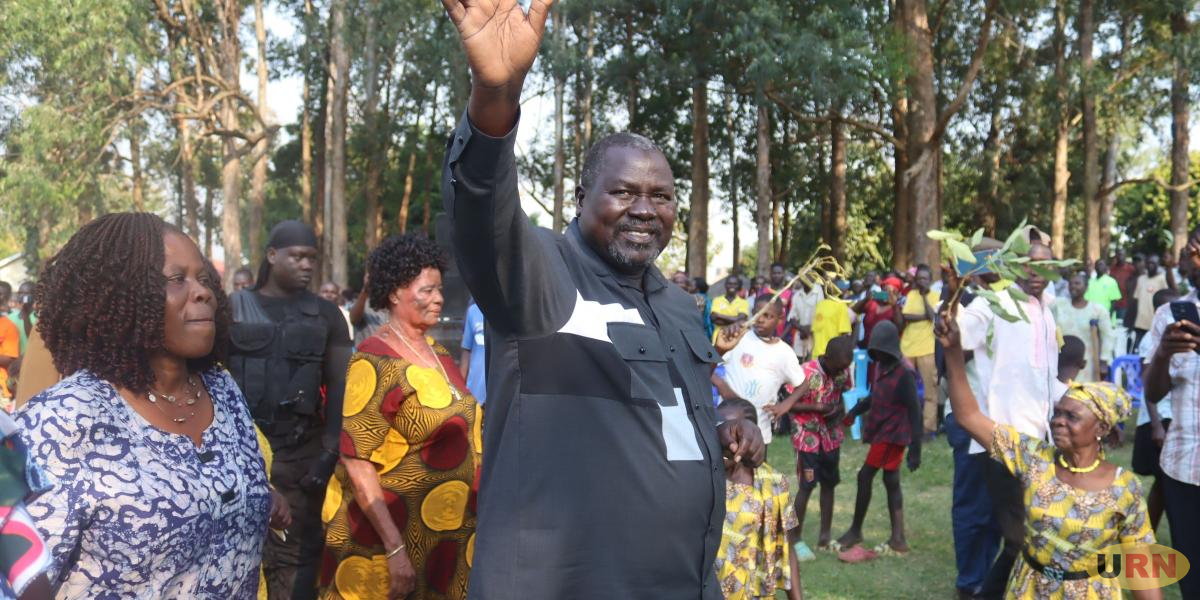
Otema was among 19 senior generals who retired from the UPDF last week, bringing to an end a military career that began in 1979. On Saturday, he returned to his ancestral home in Tangi Cell, Purongo Town Council in Nwoya District, where he was welcomed by clan elders and underwent traditional cleansing rites.

The ceremony included stepping on an egg and stepping over a Layibi tree log, practices traditionally associated with cleansing and welcoming home people who have spent long periods away. Otema described the ceremony as more than a cultural ritual, saying it represented an honour from the elders who sent him into the army decades ago.
“Being received by the elders and ancestors showed me that my tribe has a very rich traditional culture. Such honour is given only to those who have lived a complete life of good character,” he said. He also used his return home to caution young people against allowing military rank or possession of a firearm to separate them from their communities. “Some young people think that once you have a gun or become a military officer you are above everyone,” he said.
Otema joined the army on May 6, 1979, as a young man. He said his decision was influenced in part by the trauma he experienced after his father was harassed and arrested by a family whose sons had been involved in the military before and after the overthrow of former President Idi Amin.
“As a young man, the trauma I went through was something I could not tolerate,” he recalled. He later served in the Uganda National Liberation Army during the government of former President Gen Tito Okello Lutwa between 1980 and 1986.The government was overthrown in 1986 by the National Resistance Army, now the UPDF, led by President Yoweri Museveni. Otema said the government’s policy of integrating former UNLA soldiers into the new army gave him an opportunity to continue his military career. He attributed his longevity in the army to discipline, relationships with colleagues from different ethnic backgrounds and a commitment to protecting civilians affected by Uganda’s conflicts.
Otema was involved in Uganda’s military campaign against the Lord’s Resistance Army insurgency in northern Uganda. He recalled that the LRA was at one point estimated to have about 10,000 fighters when he was posted to the region as an intelligence officer. Between 2002 and 2006, he served as Special Director of Operations in the External Security Organisation during the height of the insurgency. But Otema said his experience of the conflict also convinced him of the need to pursue a negotiated settlement.
He subsequently became part of the government delegation that engaged LRA representatives in the Juba peace talks, which began formally in 2006.He described the transition from fighting the rebels to negotiating with them as difficult but necessary.
“It was difficult for me to move from the battlefield to sit face-to-face with people I had been fighting, but for the sake of our people I went and told them they were wasting time. They should come out of the bush so that the suffering of our people could end,” he said. Otema said his participation in the peace process was driven by the desire to end the suffering of civilians in northern Uganda.
Following his retirement, Otema says he intends to devote more time to agriculture and hospitality. He owns agricultural enterprises in Nwoya District and a hospitality business in Gulu City. His return has also been welcomed by traditional leaders in Acholi. Acholi Paramount Chief Rwot David Onen Acana II said Otema’s return home alive after decades in the military was an achievement worth celebrating.
Acana said many Acholi officers who served in the military died before returning home, while others completed their service without receiving similar public recognition. “There were others that people were hoping, whom they looked at as their pillars and leaders. An example is the late Gen Paul Lukech, who didn’t come back home alive. He died. Others, like Walter Ochora, served and finished, but he’s not there to do this,” Acana said.
He called on the Acholi community to celebrate Otema’s service and described him as a generous man who contributed to peace efforts in northern Uganda. A public celebration to mark Otema’s retirement is scheduled for Friday at Kaunda Parade Grounds in Gulu City, where thousands of people and several dignitaries are expected to attend.
Otema rose through the military ranks and held several senior positions during his career. He served as Commander of the UPDF Second Division from 2007 to 2008 and Commander of the Fourth Division from 2008 to 2012.He later served as Chief of Logistics and Engineering from 2012 to 2019.
He was also Commander of the UPDF Reserve Forces, a position he held before his retirement in 2026.After 47 years in uniform, Otema now returns to civilian life, saying he is grateful to have survived a military career that took him through several of Uganda’s wars and ultimately into efforts to negotiate an end to one of the country’s longest conflicts-URN. Give us feedback on this story through our email: kamwokyatimes@gmail.com