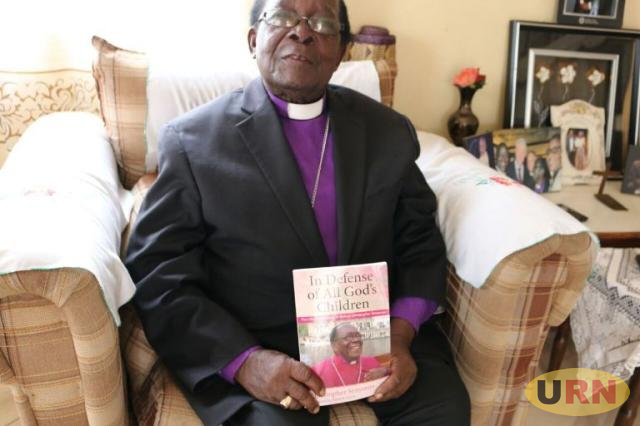
The Right Rev. Christopher Ssenyonjo, the former Bishop of West Buganda whose support for LGBTQ community led to his excommunication from the Church of Uganda and turned him into one of the country’s most controversial church leaders, has died at the age of 94.
His death was confirmed by Mengo Hospital, where he had been admitted for several weeks following a prolonged illness.
His death marks the end of a ministry that spanned more than six decades and left behind two sharply contrasting legacies. To supporters, he was a pastor who chose compassion over institutional acceptance.

Within the Church of Uganda, he departed from Anglican doctrine and discipline.
Few Ugandan clerics attracted as much international recognition or as much opposition.
Officials at the Church of Uganda’s Provincial Secretariat and clergy in West Buganda Diocese, where Ssenyonjo served for 24 years, were reluctant to comment publicly on his passing or his legacy during service, underscoring divisions that endured until his death.
“We cannot talk about him. He is in a different category,” one member of staff at the Provincial Secretariat told Uganda Radio Network.
Two priests in West Buganda Diocese also declined to discuss the former bishop.
Born on December 8, 1931, to Erika Kapere and Maria Nosianta Terugwa, Ssenyonjo’s childhood was shaped by tragedy. In his own memoir he shares that his father died from a cobra bite, and because the family never recovered the body for burial, the loss remained with him throughout his life. Years later, his first wife, Ruth Nakanwagi, died from a snake bite only 17 days after their wedding.
From different archive information, Friends said those painful experiences strengthened his Christian faith.
After leaving Makerere University, where he had enrolled to study medicine but failed to complete the course, he became a teacher before joining Buwalasi Theological College in 1961.
Ordained a deacon two years later, Ssenyonjo pursued further theological studies in the United States at Union Theological Seminary, where he served at the Episcopal Church of the Epiphany under the mentorship of Rev. Hugh McCandless.
He was ordained priest in 1964 by Bishop Horace Donegan.
Returning to Uganda in 1968, he lectured at Bishop Tucker Theological College in Mukono, teaching African Traditional Religion and helping train future clergy.
His contribution extended beyond the classroom. In 1973, he joined Roman Catholic, Anglican and Seventh-day Adventist scholars in translating the Bible into modern Luganda, one of the country’s most significant ecumenical projects that made the scriptures more accessible to millions of Luganda speakers.
In January 1974, he was consecrated the third Bishop of West Buganda Diocese. For the next 24 years, Ssenyonjo led the diocese through some of the most turbulent political periods, including the final years of Idi Amin’s rule and the country’s reconstruction after years of conflict.
He strengthened the Anglican Church in an area historically regarded as a Roman Catholic stronghold through parish expansion, pastoral outreach and clergy development.
He also witnessed one of the darkest moments in Uganda’s church history. In February 1977, Ssenyonjo was among the Anglican bishops who accompanied Archbishop Janani Luwum to the then International Conference Centre after they were summoned by Amin’s government. Luwum was later murdered.
When Ssenyonjo retired in 1998, few expected the most defining chapter of his life would begin afterward.
Around 2000, he started counseling young Ugandans who had been rejected by their families and churches because of their sexual orientation.
He insisted every person deserved dignity and pastoral care regardless of sexuality.
His decision soon placed him on a collision course with the Church of Uganda.In his memoir, In Defense of All God’s Children, Ssenyonjo wrote that his position was rooted in his understanding of Christ’s ministry.
“Moreover, Jesus’s call to his disciples was to preach the good news of salvation to all without discrimination. In the gospel Jesus reached out to everyone, including the prostitute. I therefore resolved that I could not abandon the LGBTQ community, in spite of the authorities’ disapproval,” he wrote.
He also lamented what he regarded as growing hostility within the church.
“However, it grieved me deeply when a number of my colleagues and friends furiously turned against me; though in my heart, I still loved them. I prayed that God grant them the magnanimity to listen to and empathize with LGBTQ persons,” he wrote.
The dispute escalated rapidly. In May 2001, the Namirembe Diocesan Council passed resolutions accusing him of promoting homosexuality. The same year, South African Archbishop Desmond Tutu wrote to encourage him, assuring him of his prayers and support for what he described as Ssenyonjo’s principled stand.
The following year, the House of Bishops summoned him over alleged departures from the 1998 Lambeth Conference resolutions on homosexuality. During the consecration of the Bishop of Mukono Diocese in July 2002, Ssenyonjo was permitted to join the procession but was barred from taking part in the laying on of hands.
Church leaders maintained throughout that disciplinary action against him resulted from violations of Anglican canon law, including his participation in episcopal activities involving churches outside communion with the Church of Uganda.
Ssenyonjo and his supporters argued that his ministry among LGBTQ people lay at the centre of the conflict. In 2006, under Archbishop Henry Luke Orombi, the Church of Uganda formally declared that he was no longer recognised as one of its bishops and withdrew the privileges attached to the office, including his pension.The decision effectively severed his relationship with the institution he had served for decades.
Ssenyonjo refused to abandon ministry. He continued wearing episcopal robes, insisting that his calling came from God rather than from church structures. In 2010, he founded St. Paul’s Reconciliation and Equality Centre in Kampala, offering counselling and spiritual support to LGBTQ people and other marginalized communities.
His advocacy attracted international recognition, including the Clinton Global Citizen Award, honorary degrees and invitations to speak around the world. It also brought threats, financial hardship and deep isolation from many former colleagues.
One of his final public appearances within the Anglican church came in March, 2025 during the enthronement of the seventh Bishop of West Buganda at St. Paul’s Cathedral, Kako. Observers noted that he received little of the recognition traditionally accorded to retired bishops, a reminder that the divisions surrounding his ministry had never disappeared.
“We were instructed to address him as ‘Mr. Ssenyonjo,’ rather than ‘Bishop’,” one of the event organizers recalled. Speaking with sympathy, he said it was painful to see a man who had shepherded West Buganda Diocese for 24 years no longer accorded the respect traditionally reserved for a retired bishop.
Ssenyonjo is survived by children, grandchildren and an extended family. His wife, Canon Mary Ssenyonjo, died in 2021-URN. Give us feedback on this story through our email: kamwokyatimes@gmail.com