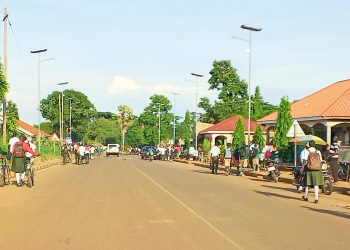



Parents at Arua Public Secondary School have rejected a directive to suspend school feeding and withdraw support for teachers paid through their contributions, choosing instead to keep paying extra fees to keep learning activities running.
The decision puts the parents at odds with the concerns raised during Local Government Minister Balaam Barugahara’s nationwide anti-corruption campaign, in which he directed government schools not to collect money from learners.
Parents resolved this during an extraordinary Parents-Teachers Association (PTA) meeting convened after the directive disrupted payments, with the school administration warning that the shortfall was affecting operations and learning activities.

According to school records, parents are expected to contribute Shs250,000 for breakfast and lunch, Shs40,000 for utilities and emergencies, and Shs20,000 for lunch during weekend lessons, bringing the total to Shs310,000. PTA chairperson Geria Patrick said the school feeding programme was introduced following a parents’ resolution several years ago to help learners concentrate during lessons, particularly in the afternoon, and reduce absenteeism.
Arua Public Secondary School, a mixed O- and A-level institution, was founded by the Asian community in 1966, taken over by the government in 1972, and brought fully under government control in 1976.
The school implements Universal Secondary Education (USE) at O-level and Universal Post-Ordinary Level Education and Training (UPLET) at A-level. It has an enrolment of 2,866 students but continues to face shortages of teaching and non-teaching staff.
The government provides the school with an estimated Shs450 million annually in capitation grants, disbursed in instalments of about Shs150 million each term. However, the amount falls well below the school’s estimated annual budget of Shs2 billion. School administrators say parents’ contributions help bridge the funding gap, including meeting costs for additional teachers and support staff whose services are considered necessary to maintain learning.
Head teacher Maxwell Dramadri said the government had provided only 59 teachers against a standard staffing requirement of 142, leaving a gap that the school partly fills through locally supported staff. Most of the additional teachers, he said, handle science subjects.
Maxwell added that contributions towards feeding, utilities and emergencies help meet expenses that cannot be covered by the capitation grant, which is subject to government spending guidelines.
Last month, school stakeholders held a meeting at executive level to discuss the funding dispute. They subsequently proposed suspending the feeding programme and withdrawing support for all 33 teachers paid through parents’ contributions, with the resolutions intended for presentation to the wider parent body.
However, parents rejected the proposals at the extraordinary meeting and resolved to continue contributing towards the programmes, arguing that feeding learners at school and sustaining teaching activities would support attendance and academic performance.
Parent Habib Abubakar said he supported the decision, arguing that the payments were intended to supplement government funding and improve the education provided to their children.
Another parent, Nasila Margaret, said the anti-corruption campaign was affecting school operations, adding that parents were willing to contribute towards activities they believed would improve learning and academic performance.
Senior Education Officer in charge of Arua Central Division, Godfrey Asiku, said voluntary contributions towards school activities were not prohibited, provided they were not made compulsory. Asiku explained that government capitation grants come with strict guidelines governing their use and cannot be diverted to activities outside the stipulated purposes.
The dispute highlights the funding pressures facing the school as it attempts to maintain feeding, staffing and other services amid calls for government institutions to stop collecting money from learners. Since its establishment, Arua Public Secondary School has expanded its infrastructure and enrolment and improved its academic performance. It has also secured a freehold land title.
The school management attributes part of this progress to additional financial support from parents, which it says supplements the government’s capitation grant-URN. Give us feedback on this story through our email: kamwokyatimes@gmail.com