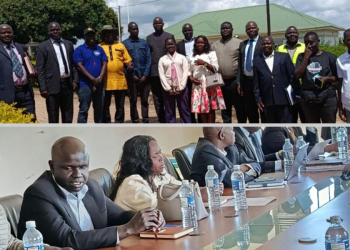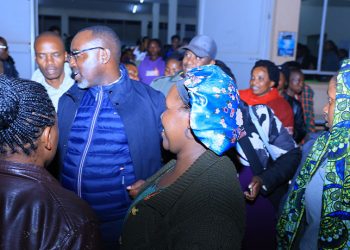
Fourteen families in Buliisa District whose land was compulsorily acquired for TotalEnergies’ Tilenga oil project had their compensation dispute heard by the Court of Appeal.
The judges are expected to consider whether to allow the families to appeal against an earlier ruling outside the prescribed time.

Some of the affected families have expressed hope that the judges may finally grant them the opportunity to resolve their disputes
The families filed the cases against the Government of Uganda, seeking to enforce their right to prompt, fair and adequate compensation under Article 26 of the 1995 Constitution.
The cases also raise questions about the protection of property owners’ rights when the government compulsorily acquires land for public or project-related purposes.
The matters before the court include an application for permission to file an appeal out of time, which was filed in June 2021, and the substantive appeal challenging the earlier court proceedings.
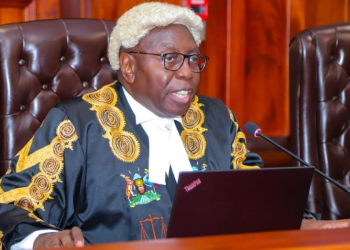
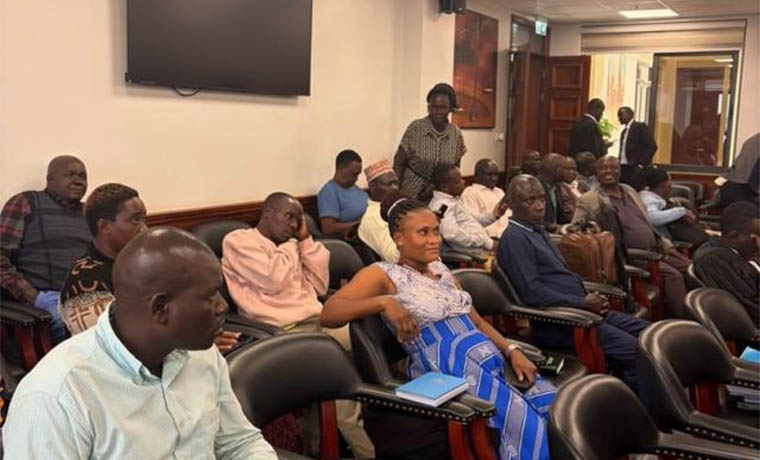
Justices Geoffrey Kiryabwire, Margaret Tibulya and Cornelia Sabiti Kakooza heard the two cases at the Court of Appeal in Kampala on Wednesday, October 21, 2026.During the hearing, attended by nearly all 14 families, the judges asked lawyers representing the Attorney General whether they objected to the court hearing the appeal despite it having been filed out of time.
The Attorney General’s office was represented by Franklin Uhwezira and Claire Kukunda, who did not expressly object to the judges’ question.
Margaret Talemwa, one of the lawyers representing the families, said the judges indicated that they would consider the application for an extension of time alongside the substantive appeal and deliver their decision on both matters on notice.
“This was an encouraging development as it effectively gave us an opportunity to present the substantive appeal for consideration,” Talemwa said.
She added that the judges would consider both the reasons the families had not appealed within the prescribed time and the issues raised in the appeal.
At the beginning in 2017, TotalEnergies compulsorily acquired land and other property from 622 asset holders for its Tilenga Industrial Area in Buliisa District.
The acquisition affected 786 acres of land, including property in which the 14 families had interests. TotalEnergies proposed compensation of 3.5 million shillings per acre.
The families rejected the offer, arguing that it was inadequate and unfair. Other families affected by the acquisition also rejected the proposed compensation.
In July 2020, the Government of Uganda sued 17 families, including the 14 now before the Court of Appeal, at the High Court in Masindi.
The government asked the court to compel the families to accept the compensation they had rejected and to allow the money to be deposited in court.
In April 2021, the court ruled in the government’s favour, granting it vacant possession of the families’ land.
According to the Africa Institute for Energy Governance (AFIEGO), the affected families faced difficulties accessing legal services, which prevented them from filing an appeal within the prescribed time.
AFIEGO later provided lawyers to support them in filing the two cases before the Court of Appeal.
Samuel Bigirwenkya, one of the litigants, said the families wanted an opportunity to explain their experiences to the judges and obtain adequate compensation.
“We wanted to speak in court. We wanted to share our testimonies so that the judges can really see how we are suffering because the government, through TotalEnergies, failed to compensate us adequately. What we hope for is justice and adequate compensation. We hope that court will ensure that we get both,” Bigirwenkya said.
Besides the cases involving the 14 Tilenga-affected families, the Court of Appeal heard three other cases involving people affected by the Tilenga oil project and the East African Crude Oil Pipeline (EACOP).
One was an appeal arising from a December 2023 case involving some of the 42 families sued by the government.
In proceedings before the High Court in Hoima, the government sought permission to deposit the families’ compensation in court and obtain vacant possession of their land.
The High Court granted the requests in December 2023. Talemwa said the Court of Appeal raised questions about resolving disputes involving project-affected people through approaches that address their practical concerns, rather than focusing exclusively on declarations of legal rights.“
“During the hearing of this case, the court observed that there is a need to move from purely rights-based approaches to interest-based resolution of such disputes, that is, solutions that address the project-affected persons’ actual problems rather than declarations of rights without practical results,” Talemwa said.
She clarified that the remarks were observations and questions from the bench, not decisions.
With the pleadings on record, Talemwa said, the judges asked the parties whether they would agree to have their conferencing notes adopted as written submissions.
The parties agreed, and the judges indicated that they would consider the record and deliver judgment on notice.
The court also heard an appeal filed in May 2025 by some of the 80 people affected by the EACOP project.
The appeal followed a government suit filed in August 2024 seeking permission to deposit the families’ compensation in court and obtain vacant possession of their land.
Talemwa said the Court of Appeal directed the lawyers representing the affected families to submit their evidence and serve it on the Attorney General by October 23, 2026.
The Attorney General is required to respond by October 30, while the families’ lawyers must file their response by November 4.
Another application, filed in February 2025 by some Tilenga-affected people seeking to stop their eviction, was withdrawn after it was overtaken by events.
The affected people’s property was demolished in March 2025 before the appeal could be heard. The Court of Appeal’s decisions in the pending cases will determine the next steps in the families’ legal challenges over the acquisition of their land and compensation-URN. Give us feedback on this story through our email: kamwokyatimes@gmail.com