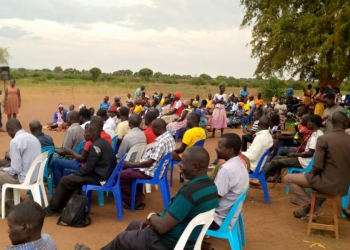
The Royal Chief of Okol Chiefdom in Mucwini and Madi Opei sub-counties, Jude Ogik, has called on employers, leaders, and communities to create healthy psychosocial working environments to improve productivity and workers’ well-being. Rwot Ogik made the remarks while delivering the keynote address during the belated Labour Day celebrations at Kitgum Public Playground in Kitgum municipality on Thursday.
Speaking under the theme “Ensuring a Healthy Psychosocial Working Environment,” Rwot Ogik said workers perform better when they feel respected, safe, valued, listened to, and supported at their workplaces.“You can give somebody food, salary, promotion, or a good position, but if you insult them, humiliate them, isolate them, or make them live in fear, they cannot perform well,” Rwot Ogik said.
He warned that toxic leadership, intimidation, overworking employees, and harsh working conditions create fear among workers and negatively affect productivity. According to Rwot Ogik, many workers silently struggle with stress, depression, family pressure, debt, domestic violence, alcohol abuse, unemployment, and toxic work environments.

He noted that some employees become fearful of their supervisors to the extent that they avoid reporting to work whenever their bosses are present.The cultural leader also criticized employers who mistreat domestic workers and children, recounting an incident he witnessed while living in Kampala, where a young girl employed as a housemaid was allegedly overworked, denied food, and prevented from attending school.
Ogik said he reported the matter to a child protection organization, which later rescued the girl and returned her to school.“You are your neighbour’s keeper. Some children are suffering as domestic employees instead of going to school, yet education is available,” he said.
Drawing from Acholi cultural practices, Ogik said traditional communal work promoted unity, storytelling, laughter, teamwork, and emotional support, unlike modern isolated work systems that increase stress and loneliness. “In our tradition, people worked together, ate together, rested together, and solved problems together. Work was not seen as punishment but as a communal activity,” he said.
Rwot Ogik further urged leaders to practice humanity in leadership by treating workers with dignity and understanding their personal struggles. “As leaders, we must lead with humanity. This person you supervise is somebody’s child, husband, wife, or parent,” he said.
He also challenged workers to uphold honesty, discipline, integrity, and teamwork, warning against absenteeism, negligence of duty, and abuse of office by employees who feel protected by connections to powerful individuals.The chief called on institutions to establish counselling spaces, encourage dialogue and prayer, allow workers adequate rest, and promote teamwork and compassion in workplaces.
James Okello, the District Community Development Officer, said workers should be respected, listened to, and supported without fear of humiliation, intimidation, or punishment.Employees should feel free to share ideas without fear or embarrassment. They are entitled to be listened to,” Okello said.
He noted that many workers silently suffer from stress, depression, family pressure, debts, and mental health challenges due to poor working conditions and economic hardships. “Some people are dying quietly without addressing their issues. We need psychosocially safe environments,” he added.
Okello said healthy working environments encourage innovation, teamwork, and productivity, adding that workers perform better when they are stress-free and given manageable workloads. He criticized unrealistic deadlines, excessive workloads, child labour, and workplace harassment, saying such practices negatively affect workers’ mental health and family life.
According to Okello, many workers in Kitgum face challenges, including poor salaries, limited promotion opportunities, inadequate working tools, nepotism, poor lighting conditions, and gender disparities in employment. “The structure is very stiff. Sometimes, for one to be promoted, you wait for your boss to retire or die,” Okello said.
Okello further appealed for the establishment of counselling and mental health support units at workplaces, as well as stronger conflict resolution mechanisms through dialogue, mediation, arbitration, and reconciliation.
Meanwhile, RDC Jimmy Segawa Ebil said the government has continued improving workplaces to ensure they are psychologically healthy and environmentally friendly. He cited the construction of breastfeeding and child-care spaces in Kitgum Main Market as part of the government’s efforts to support working mothers.
“We planned spaces where mothers can breastfeed and nurse their children while working in the market,” Ebil said. He added that the government is amending laws to require workplaces to provide breastfeeding and nursing spaces for mothers.
The RDC also blamed unemployment, poverty, and excessive borrowing for increasing stress among workers and families. To address these challenges, Ebil highlighted government wealth creation initiatives such as Emyooga and Parish Development Model (PDM), which he said are aimed at improving livelihoods and reducing financial pressure-URN. Give us feedback on this story through our email: kamwokyatimes@gmail.com