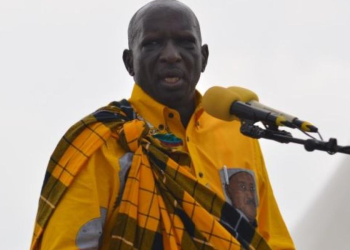
Advocate Samuel Muyizi Mulindwa has spent nearly two decades defending opposition politicians, activists, and ordinary Ugandans accused in politically sensitive cases. But long before he became one of the lawyers associated with some of the most controversial political trials, he testified that he was first a political prisoner himself. “I’ll add that I’m also a former political prisoner,”
Muyizi told a gathering organized under the Uganda Law Society’s Radical New Bar weekly briefing. “Yes, I’ve been a political prisoner, I think, more than four times since my days at Makerere University.”
Calmly speaking, Muyaizi traced his journey from student activism at Makerere University to courtrooms across Uganda. He has represented opposition activists from the Democratic Party (DP), the Forum for Democratic Change (FDC), and, most recently, the National Unity Platform (NUP).

Muyizi has, over the years, learned that the story of political prisoners in Uganda is not merely about criminal law or constitutional procedure. It is about power. “It has ceased being a matter of law, but a matter of politics,” he said. “We are talking at a time when we have a regime which is trying to protect their gains… as lawyers try to push back to fight for those who do not have the privilege.”
Muyizi, who practices with Alaka and Company Advocates, says his baptism into political litigation came in 2005 when he joined Elias Lukwago and Caleb Alaka defending former presidential candidate Dr. Kizza Besigye before the General Court Martial.
“That is the first case that launched me into having, really, all through the years, quite some experience in handling political cases. And it’s very significant. If you have to look at the jurisprudence of politically related matters, you will find that the years 2000, there was a bit of 1996 to 2001,” said Muyizi Mulindwa.
Since then, he says, the country’s election cycles have increasingly become synonymous with waves of arrests, remand, and politically charged prosecutions. “If you note, all the years that I’ve highlighted are election years, or on the eve of elections,” he said. “This is what clearly tells you that all these matters are political in nature.”
According to Muyizi, the pattern has repeated itself over the years, first involving DP activists during the Paul Kawanga Ssemogerere and John Ssebaana Kizito, later FDC supporters around Dr. Besigye’s campaigns, and now hundreds of NUP supporters following the rise of Robert Kyagulanyi, popularly known as Bobi Wine.
“Between 2021 and 2026, we have very big numbers, more than ever before, political prisoners of the NUP,” he said. Yet despite the sheer number of prosecutions, Muyizi says many of the cases never reach a logical conclusion in court.
“I will tell you that the practice for political prisoners has been mainly bail. I do not remember a case which was prosecuted by the state to its logical conclusion, at least not those that we’ve handled. And this is not to state that the case should be eager to prosecute and convict on the directions of the state.”
Muyizi is among the lawyers representing Dr Kiiza Besigye and Obeid Lutale, who have been denied bail despite fulfilling all the requirements. He has witnessed elements of interference during this trial. “There’s a statement that came from Entebbe, or Nakasero Entebbe, questioning the DPP and state attorneys why they have never convicted retired Colonel Dr. Kiiza Besigye. And since then, we’ve seen all the rules of procedure in the high court being overturned. We’ve seen the law not at work,” he narrated.
In such cases, Muyizi says some lawyers get frustrated. “We’ve seen a case where anyone who went to law school and LDC really not feel comfortable being defense counsel. That’s the ongoing case of retired Colonel Dr. Kiiza Besigye. It is a 2024 case where all rules, about extradition, rules of procedure, and criminal matters have all been flouted.”
He argues that pretrial detentions have become the norm, and a remand has become the punishment. “The time you spend on remand is the sentence that you serve,” he said. As an advocate, Muyizi is aware of the “subjudice” or the fact that the Kiiza Besigye, Obeid Lutale case is still before a judge or court. But he states that this trial and the related complications and delays have even overturned the previous good jurisprudence that lawyers, Sam Njuba, Wandera Ogalo, Kiyemba Mutale, Yusuf Nsibambi, Joyce Mubiru, and Ladislaus Rwakafuzi had secured out of the famous bail applications or bail decisions of Dr. Kiiza Besigye.
In November 2005, the then Principal Judge, Justice James Ogoola, granted an interim bail to Dr. Besigye to allow him to contest for the presidency. The judgment set a precedent that Muyizi and others now bemoan as Dr. Besigye and Obeid Lutale get denied bail. For Muyizi, one of the clearest signs that Uganda’s justice system is increasingly overwhelmed by politics is what he describes as the collapse of ordinary legal procedure in political cases.
“We’ve seen all the rules of procedure in the High Court being overturned. We’ve seen the law not at work.” At one point during his remarks, Muyizi described the strange reality of defending people who technically exist in prison but whose files cannot be traced in court.
“As we talk about political prisoners,” he said, “we have political prisoners who have files, and we have political prisoners who actually do not have files.” According to him, some detainees remain incarcerated despite the absence of remand warrants, court records, or transferred files after military cases were supposedly shifted to civilian courts.
“You go to the High Court,” he said, “the High Court will tell you we cannot proceed with this matter because there’s no file for us to proceed. Even if we are to give relief to your client, we have no file before us,” he said. He described situations where courts acknowledge that individuals are detained but still decline to intervene because official records are missing.
“What would you do as a private practitioner faced with a decision of the High Court that does not even want to listen?” he asked. “Even with the fact that the High Court is aware, it is an undisputed fact that there’s a person who is detained in prison unlawfully, a person who is detained without a trace or file, and the High Court chooses not to give audience.”
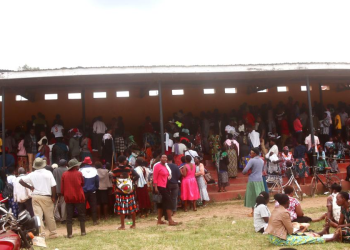
Muyizi said many of these detentions emerged from mass arrests during election periods, especially after the 2021 general elections. “We get a lot of such in the election years. I remember a situation where I went to Wakiso Court, and actually, the prison warders were in charge of all court premises because the cell was so full. The green belt had to be a prison,” he recalled.
According to him, legal teams representing opposition supporters frequently faced impossible caseloads. “You get hundreds from Masaka, hundreds from Jinja, hundreds in Wakiso, hundreds in Mbarara, all on your desk. And when you go to courts, it is not the law again… it’s not the procedure being applied, but the politics,” he said.
Muyizi said he has encountered judicial officers who, he says, privately admitted that some detainees would only be released after politically significant events such as elections or presidential swearing-in ceremonies. “You imagine a judicial officer telling you as counsel that, ‘You know, these people… don’t even waste your time. These will only be released after the election on the 15th. Then, after the 15th, ‘No, this cluster of people will be released after swearing-in.’”
He added: “You face a judicial officer who, after denying bail, you go behind in their offices, and you find them so emotional about the decision that they made. You find judicial officers no longer comfortable practicing or being judicial officers. So, we are all under state capture,” he said.
Muyizi also offered a rare glimpse into the pressures faced by lawyers who choose to represent political detainees. “Several practitioners have decided really to stop practicing in these areas,” he said.
He attributed this not only to frustration with the courts but also to intimidation and harassment directed at lawyers themselves. “Finding our offices broken into, finding spies always following us, finding our families being threatened, so is the practice of a private practitioner in such cases.” He referred to recent public threats against his senior colleague, Caleb Alaka, and questioned why military officials would publicly involve themselves in legal representation.
“Where does the CDF have business dealing with an investigation into a criminal matter?” he asked. Muyizi said political defense work has become so difficult that many advocates quietly withdraw after realizing legal arguments alone may not determine outcomes.
“If the law is not applied, if it is politics. Should we become politicians in courts of law?” he asked. He argues that the current practice in the court is partly why some lawyers have opted for confrontational activism around rule of law issues. “It would be very unreasonable for you to remain as reasonable as we are expected to be. “faced with such a challenge,” he said.
He stated that the criminal justice system increasingly appears to function through improvisation rather than evidence. “We have files of political prisoners where you only find statements of police, police, and police only on file. You find young people, 16, 18, on a capital charge without any background. I found myself in Mengo with a file with a person who is clearly insane,” he said.
At times, Muyizi said, the experience leaves lawyers questioning the very meaning of justice within the system. “If it were the law, probably I would have seen a case being prosecuted to its logical conclusion.” After nearly 20 years navigating Uganda’s political trials, Muyizi says the issue can no longer be left to lawyers alone.
“The judiciary… is one that calls for further action to try to radicalize the people. Because we cannot do this fight alone,” he said. For now, however, he and a small group of advocates continue appearing in courtrooms across the country, arguing bail applications, searching for missing files, defending detainees they say are trapped in a justice system increasingly shaped not by evidence or procedure, but by politics.
And for many of those detainees, Muyizi says, freedom often depends less on legal merit than on political timing. “The time you spend on remand is the sentence that you serve,” he stated-URN. Give us feedback on this story through our email: kamwokyatimes@gmail.com