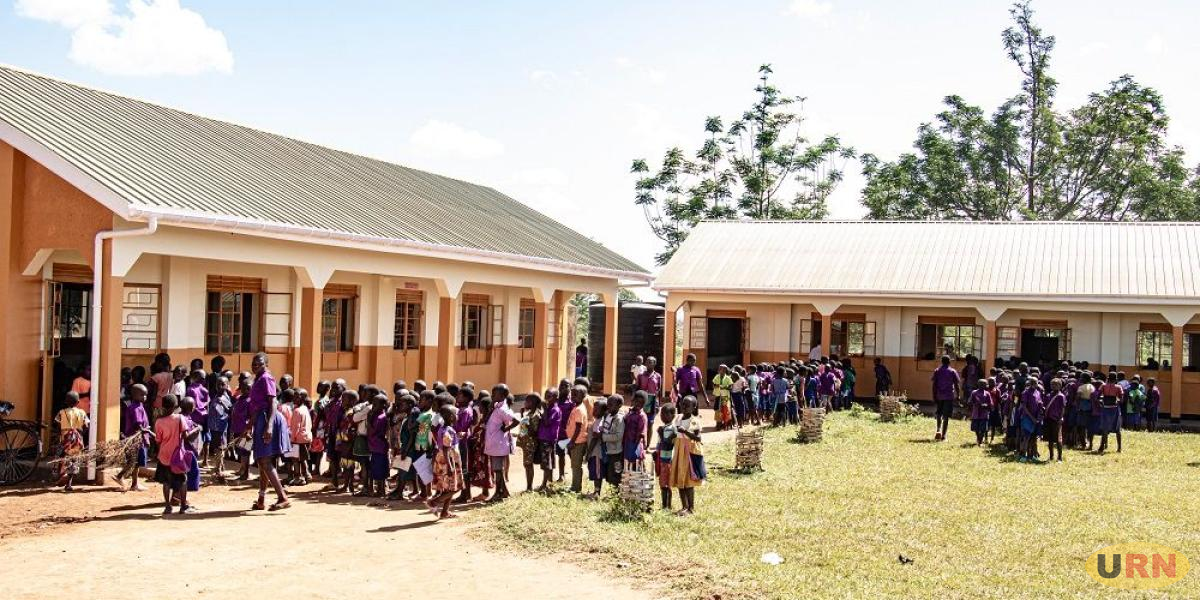
Several government-aided schools have received their third-term capitation grants nearly a month after reopening, easing weeks of financial strain caused by the delay.
The funds were credited to school accounts at the end of last week, according to several headteachers who spoke to Uganda Radio Network. The headteachers said the delay had left schools struggling to meet basic operational needs, particularly after the government banned Parent-Teacher Association (PTA) contributions.
At Buvuma College in Buvuma District, headteacher Robinah Nakakande said the school had been operating without funds since the beginning of the term. She said the school had been unable to raise money through PTA contributions and was therefore left without an alternative source of revenue to meet urgent needs, including those related to examinations.

Nakakande said the release of the funds had relieved the pressure on the school, particularly as national examinations approach. She warned that a further delay would have left the school in a difficult situation at a critical time of the academic year.
The delay also strained relationships between schools and their suppliers. A headteacher in Kampala, who requested anonymity, said suppliers had become increasingly reluctant to provide goods and services on credit because of uncertainty over when schools would receive their funds.
The headteacher said schools had previously relied on suppliers to provide goods and services at the beginning of each term, with payments made once government funds were released. However, the prolonged delays had made suppliers less willing to continue with the arrangement.
Another headteacher, who also requested anonymity, said schools were now being forced to plan more cautiously because suppliers increasingly demanded prompt payment instead of extending credit. The headteacher said schools had received no clear explanation for the delays, adding that any communication about the releases appeared to reach town clerks and other local government officials rather than the schools themselves.
As a result, headteachers were often left uncertain about when the money would arrive. The headteachers also indicated that the latest allocation was based on physical headcounts conducted at the end of last year rather than the most recent data in the Education Management Information System (EMIS).
EMIS is the Ministry of Education and Sports’ digital platform for tracking learners and educational institutions and has been promoted as a tool for improving the accuracy of resource allocation.
However, discrepancies between EMIS figures and actual enrolment, alongside ongoing verification exercises, have contributed to delays in some funding cycles. The latest delay is not the first time schools have struggled to access capitation funds on time.
In Yumbe District, headteachers recently reported shortages of chalk, pens, schemes-of-work books and other scholastic materials as they waited for the funds. Media reports quoted Kasule Ewago, headteacher of Koka Primary School, saying that the situation had become so difficult that he had resorted to borrowing chalk from a neighbouring school.
However, the situation has not been uniform across the country. In Masaka City, headteachers told URN that they had received their capitation funds as the third term began.
Responding to the concerns, Dr Denis Mugimba, the Ministry of Education and Sports spokesperson, said the ministry releases capitation funds at once and that delays experienced by some schools or districts could be attributed to other factors.
Mugimba explained that funds released in the second quarter are intended to support schools through the third term. He said the government’s funding schedule provides for capitation grants for the first term and part of the third term to be released in the first quarter, while the second-quarter release covers the remaining requirements for the second and third terms.
He said the challenges reported by some schools could therefore be isolated issues within particular local governments rather than a systemic problem. Mugimba explained that the July release and the October release together cover the capitation requirements for the second and third terms, while the second-quarter release does not include funding for the first term of the following academic year, apart from salaries.
Capitation grants remain the primary source of operational funding for government-aided schools under Universal Primary Education (UPE) and Universal Secondary Education (USE). Under the current funding formula, each government-aided school receives a fixed baseline allocation of Shs1.35 million.
Additional funding is allocated based on enrolment, with approximately 20,000 Shillings provided per primary learner annually, equivalent to about 6,667 Shillings per term; 58,000 Shillings per O-Level student; and about 90,000 Shillings per A-Level student. The grants are intended to finance instructional and teaching materials, co-curricular activities, school administration and management, utilities, minor maintenance and repairs, contingencies and examination-related expenses-URN. Give us feedback on this story through our email: kamwokyatimes@gmail.com