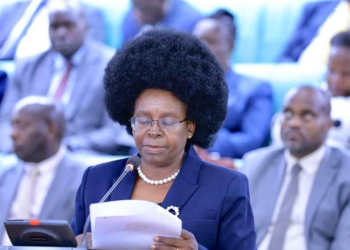
The High Court in Entebbe has brought to an end a 21-year dispute over a large piece of land involving Jovia Akandwanaho, the wife of General Salim Saleh, ruling that the kibanja interests claimed by the plaintiffs were legally invalid.
Lady Justice Flavia Nabakooza dismissed the suit with costs after finding that the plaintiffs had failed to prove that they were lawful or bona fide occupants of the disputed property.
The case, filed in 2005, involved the Registered Trustees of the Uganda Brothers of Christian Instruction, Namuli Galiwango Teopista, Chris Mubiru Galiwango, administrators of the estate of the late Charles Galiwango, and Fred Bugembe.

The plaintiffs claimed that they had bought kibanja interests on the land between 1976 and 1978 from a man identified as Petro Lukonge.
They told court that they had occupied and used the land for decades, growing crops and planting eucalyptus, fruit and medicinal trees, until Akandwanaho allegedly entered the property in 2004.
According to the plaintiffs, Akandwanaho cut down trees, destroyed crops, blocked access routes and began construction on the land without their consent.
They asked court to cancel her certificate of title, alleging that it had been fraudulently obtained and did not cover the land they occupied. Akandwanaho rejected the claims, maintaining that she was the lawful owner of the property.
She told court that she bought the land from Emmanuel and Harriet Mpiima, who had obtained a 49-year lease from the Uganda Land Commission in 1987. The property was subsequently transferred into Akandwanaho’s name on April 28, 1995.
In her judgment, Justice Nabakooza focused on how the plaintiffs acquired their alleged kibanja interests. The judge found that because the transactions took place after the Land Reform Decree of 1975 came into force, they were subject to the requirements of that law.
The decree placed land in Uganda under the Uganda Land Commission and required notice to the prescribed authority before customary interests could be transferred.
But the plaintiffs did not produce evidence showing that the Uganda Land Commission had been notified before they allegedly bought the kibanja interests from Lukonge.
Justice Nabakooza, relying on previous Supreme Court decisions, held that failure to comply with the mandatory requirement made the transactions null and void.
This meant that the alleged purchases from Lukonge could not give the plaintiffs a legally recognisable interest in the land. The court also rejected the plaintiffs’ claim that Akandwanaho had obtained her title through fraud.
The plaintiffs had pointed to differences in the location, block numbers and measurements appearing in various land documents.
They argued that the land initially applied for by the Mpiimas was located in Nambigirwa Swamp in Sisa-Musaale Sub-county, while the property claimed by Akandwanaho was described as being in Kisubi-Kawuku under Katabi-Sabadu Sub-county.
But the court found that the discrepancies were not enough to establish fraud. Evidence from a government surveyor and another court witness showed that the land existed on the ground and corresponded with the property described in Akandwanaho’s title. Justice Nabakooza also personally inspected the property and found that it was largely wetland, consistent with the description of Nambigirwa Swamp.
The judge further addressed a discrepancy in the size of the land. The plaintiffs had questioned why the certificate of title indicated 155.19 hectares while the deed plan referred to 155.19 acres. The court found this to be an error rather than evidence of fraud, noting that the deed plan reflected the actual acreage of the property.
Justice Nabakooza also noted that the plaintiffs had failed to produce documentary evidence from the Uganda Land Commission to substantiate their claims that the original allocation and subsequent transfer of the land were irregular.
The court therefore found that none of the allegations of fraud against Akandwanaho had been proved. Instead, the judge found Akandwanaho to be a bona fide purchaser for value without notice. She held that Akandwanaho had acquired the property for consideration when it was registered in the names of her predecessors in title and that she held a valid certificate of title.
The court consequently found that the plaintiffs had no subsisting legal interest in the disputed property and were not entitled to the remedies they had sought. The suit, which had remained before court since 2005, was dismissed with costs to Akandwanaho-URN. Give us feedback on this story through our email: kamwokyatimes@gmail.com