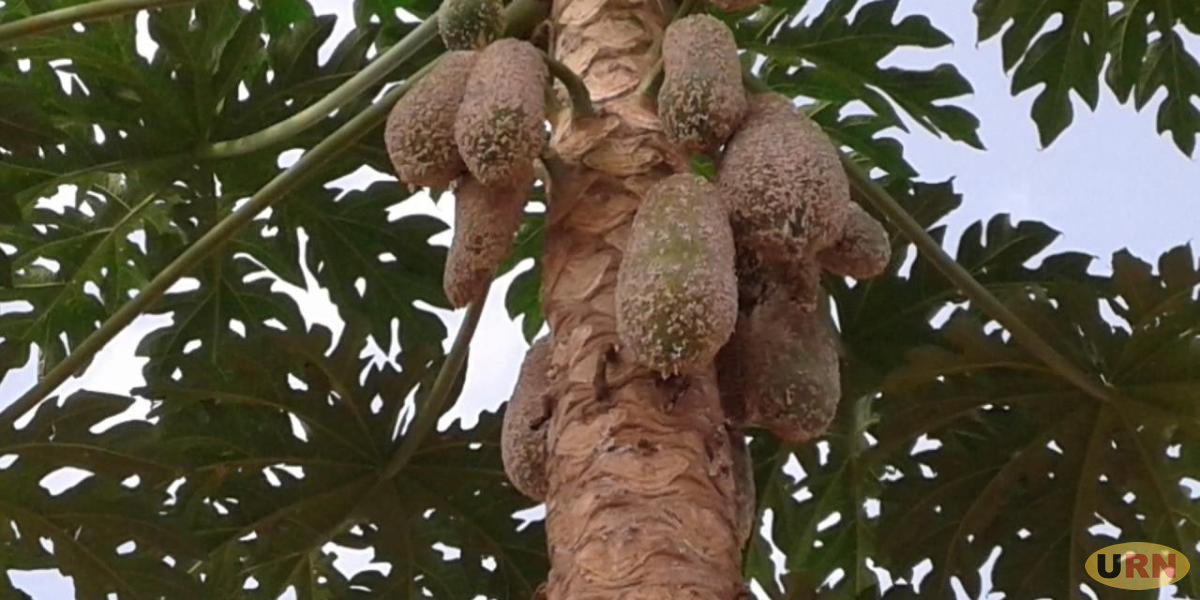
An invasive mealybug is severely affecting pawpaw production in Kitgum District, reducing farmers’ yields and incomes, according to a new study by Kitgum District Entomologist Barnabas Opiyo. The study found that farmers lose an average of 161 kilograms of pawpaw per acre to the pawpaw mealybug (Paracoccus marginatus), an invasive pest that has become widespread across Northern Uganda. The losses account for nearly 13 percent of the expected average yield of 1,267 kilograms per acre, translating into significant income losses for smallholder farmers who depend on pawpaw sales to support their households.
The pest attacks leaves, stems, and fruits, covering them with a white, cotton-like waxy substance that contaminates the fruit and lowers its market value. Opiyo’s research surveyed 381 farmers in high-risk sub-counties and found that awareness of the pest is nearly universal. About 99.4 percent of respondents could identify the mealybug, while 63 percent referred to it by its local name, “Kwidi Paipai.”
“The study demonstrates that farmers clearly recognize the pawpaw mealybug as a major constraint to pawpaw production and associate it with substantial yield losses,” Opiyo said. The research also found that 62.5 percent of farmers reported more severe infestations during the dry season, when rainfall is low. However, many respondents said the pest remains a problem throughout the year, a trend researchers attribute to climate variability.

“Farmers’ perceptions of increased pest severity during the dry season under changing climatic conditions point to the need for climate-sensitive pest management interventions,” Opiyo noted. Most farmers rely on traditional methods to control pests. The study identified wood ash as the most commonly used management practice, while the use of chemical pesticides remains limited because of high costs and inadequate technical knowledge.
“Farmers largely rely on indigenous and low-cost management strategies, especially the use of wood ash, while adoption of chemical control remains limited,” the study observed. The research further revealed that farmers’ ability to identify and manage pests varies by age, education level, and location, exposing gaps in agricultural extension services.
Opiyo recommended strengthening farmer training, translating extension materials into local languages, and scientifically validating indigenous pest-control practices. “Strengthening extension services through locally translated field guides, targeted farmer training, and scientific validation of effective indigenous practices will be critical for developing sustainable integrated pest management strategies,” he said.
Kitgum District Production Officer Denish Ocira explained that the insects’ cotton-like coating protects them from predators and reduces the effectiveness of some contact pesticides. He advised farmers to use systemic pesticides, which are absorbed into the plant’s tissues and sap. When the mealybugs feed on the treated plants, they ingest the chemical and die.
Farmers say the pest first appeared in Kitgum in 2020 and has continued to devastate their orchards. Patrick Okello, a pawpaw farmer from Labongo Amida Sub-county, said the infestation has drastically reduced his earnings.
“I have about 100 pawpaw trees. I used to earn at least Shs3 million every year from selling pawpaw, but now many fruits dry up before maturity. The insects cover the fruits and leaves, making them unattractive to buyers,” Okello said.
Juliet Adong, another farmer from the sub-county, said the pest has turned what was once a reliable source of household income into a risky venture. “Before these insects appeared, pawpaw helped me pay school fees and meet family needs. Now the fruits are fewer and smaller, and I sell them cheaply,” Adong said. Pawpaw is widely cultivated across Kitgum District for both household consumption and commercial sale.
Farmers warn that without effective interventions, the invasive mealybug will continue to reduce yields, depress incomes, and threaten livelihoods across the districts-URN. Give us feedback on this story through our email: kamwokyatimes@gmail.com