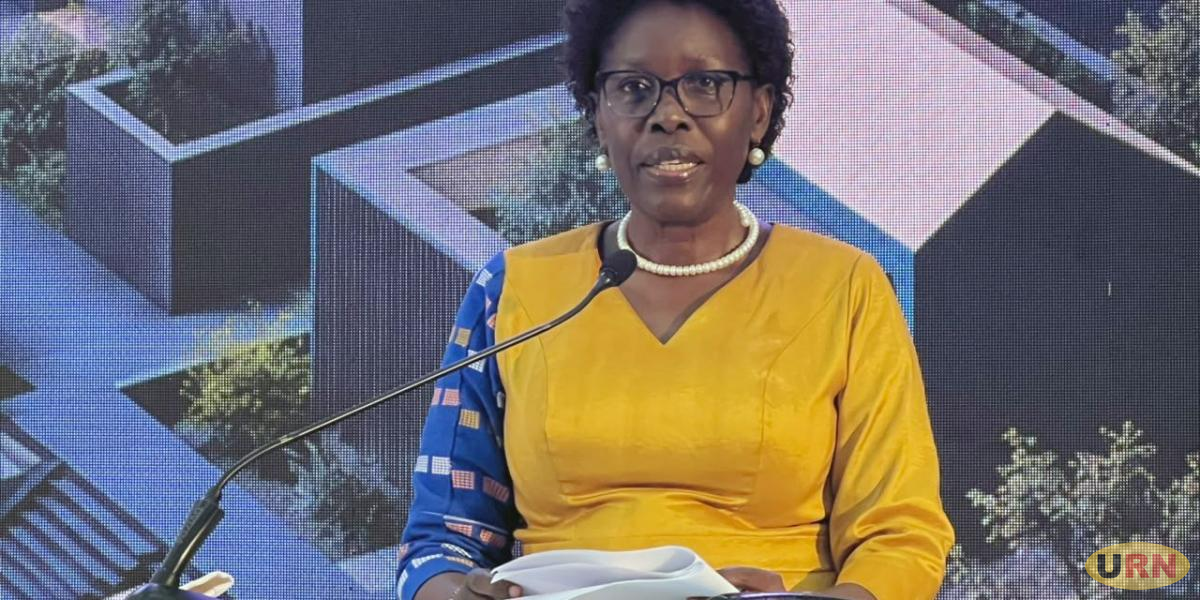
Uganda must ensure that new housing is climate-resilient, energy-efficient, durable and properly serviced as the country races to address a housing deficit of about 2.48 million units, Lands, Housing and Urban Development Minister Judith Nabakooba has said.
Nabakooba said the country cannot afford to respond to its housing crisis by simply putting up more houses without considering the increasing risks posed by floods, droughts and landslides. “Affordable housing must not mean poor quality housing,” Nabakooba said. “Affordable housing must be safe, durable, healthy, serviced, but also dignified.”
Her call came as Uganda marked World Habitat Day 2026 alongside World Architecture Day, with stakeholders warning that the country’s housing crisis requires a shift from documenting the problem to implementing practical solutions. About 60 percent of Ugandans are estimated to live in informal settlements or inadequate housing conditions, while the country produces only about 50,000 housing units annually—far below what is needed to close the deficit.

Nabakooba challenged government, private developers, financial institutions and development organisations to rethink not only how many houses Uganda builds, but what kind of houses it builds and where they are located. “If we go at the pace of 50,000 housing units, it may take ages for us to narrow the gap,” she said.The minister was speaking at Uganda’s National Housing Dialogue organised by Habitat for Humanity Uganda on Monday, October 5, where stakeholders examined ways of making housing more affordable and accessible to millions of Ugandans.
Nabakooba said climate change must now be considered in housing design and physical planning, particularly as poorly planned settlements become increasingly exposed to floods and landslides. She also linked the housing challenge to weaknesses in physical planning and land-use management, saying unplanned development is contributing to urban sprawl, informal settlements and rising costs of providing infrastructure.
For Nabakooba, addressing the housing deficit therefore requires more than increasing construction. “The question before us is therefore not simply how do we build more housing. It is, how do we build the right housing?” she asked. She said Uganda must embrace better planned and more compact urban development, including densification, to make efficient use of increasingly expensive land while reducing the cost of providing roads, water, sanitation and other services.
Uganda already has policies and plans intended to guide land use and physical development, including the National Land Policy and National Physical Development Plan, while work is ongoing on implementation of the National Land Use Plan. But Nabakooba acknowledged that policies will have little impact unless they translate into improvements in people’s lives.
“What we are saying is that government, we have done some laws and policies, but now we need to see them being felt on the ground,” she said. The housing crisis is particularly acute for low-income households, young people entering the workforce, women and people working in the informal economy.
High construction costs, expensive land, limited access to affordable housing finance and insecure land tenure are making it increasingly difficult for many Ugandans to move from renting or informal housing to home ownership. Nabakooba said rising land prices are no longer restricted to major urban centres, with rural communities also experiencing increases that are making it harder for ordinary Ugandans to acquire land for housing.
She said the government is engaging the Ministry of Finance and financial institutions on ways of developing low-cost, long-term housing finance. Conventional mortgages, she noted, are often inaccessible to young people because of high interest rates, short repayment periods and collateral requirements.“How do we make them more affordable for young people?” she asked. The call for practical solutions was echoed by Owek. Robert Waggwa Nsibirwa, Board Chairman of Habitat for Humanity Uganda, said the country already understands the scale of its housing problem.
“Today I want us to move to the how. Practical how,” he said. Nsibirwa cited the example of a young Ugandan who saves about Shs12 million to buy a 50-by-100-foot plot but is unable to raise the money required to build a house. He said the question should be how stakeholders can help such a person turn land ownership into home ownership.Nsibirwa also warned against turning the National Housing Dialogue into an annual event dominated by speeches without measurable action. He proposed quarterly, issue-based meetings focusing on specific challenges such as housing finance for young people aged 18 to 35 and affordable construction technologies.
He also called for an online platform where stakeholders could share housing policies, research, technologies, innovations and successful projects from Uganda and elsewhere. Habitat for Humanity Uganda National Director Paul Okiring said housing should not be treated solely as a social-sector concern because it is closely linked to the economy, health, education and climate resilience.
During the dialogue, Habitat displayed what Okiring described as “silent walls” to represent the conditions in which millions of Ugandans live. “These silent walls are speaking,” Okiring said. He pointed to settlements such as Kamokya and Katanga in Kampala, saying similar housing conditions exist in communities across the country.
Okiring said estimates presented at the dialogue suggest that as many as 96 percent of Ugandans cannot afford an average formally constructed house. He called for greater use of housing microfinance, housing cooperatives, savings groups and incremental housing loans that allow families to build gradually.Savings groups, he said, could potentially use pooled savings as collateral to access credit from financial institutions. Okiring also identified land tenure as a major obstacle to housing development.He called for faster land registration and titling, digitisation of land administration, stronger protection of women’s land rights and regularisation of tenure in informal settlements.He also proposed strategic land banks and greater investment in serviced land around rapidly growing urban centres. The argument is that Uganda cannot close its housing deficit without simultaneously addressing the cost of land, access to finance and the availability of infrastructure.
Habitat for Humanity Uganda Program Director Evelyn Frances Aguti said the people represented by the country’s housing statistics should not be forgotten in the policy debate. Habitat, which began operating in Uganda in 1982, works with vulnerable families on housing, water and sanitation, climate-smart agriculture, support for vulnerable children and land-tenure issues. “Once you are homeless, then you are powerless,” Aguti said.
The organisation says it has constructed more than 4,000 homes in Uganda, most of them in rural communities. Its model requires beneficiary families and communities to contribute labour and other forms of support, including providing land, participating in construction and helping monitor projects.
Habitat also uses technologies such as interlocking soil-stabilised blocks and locally available materials to reduce construction costs. Aguti said funding remains one of the organisation’s biggest challenges because of the high cost of housing construction.
Okiring said Habitat for Humanity Uganda’s 2026–2028 strategy is built around three pillars: building more and better homes, transforming housing systems to make finance more accessible, and mobilising communities and other stakeholders to take action. The organisation also plans to mobilise more resources locally to expand its work-URN. Give us feedback on this story through our email: kamwokyatimes@gmail.com