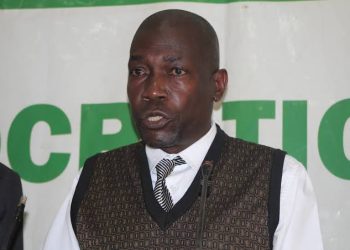


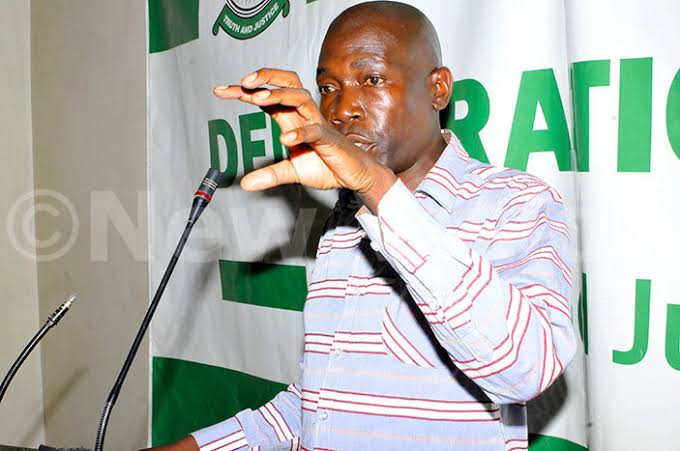
Uganda’s opposition leaders may be united in their demand for political change, but they are increasingly divided over what should happen next, with DP’s Fred Mwesigwa defending Gen Salim Saleh’s proposed post-Museveni political arrangement while challenging critics to offer workable alternatives to national dialogue.
Mwesigwa, the personal assistant to Justice and Constitutional Affairs Minister and DP President Norbert Mao, argued that Uganda cannot escape its longstanding political divisions through confrontation, insults or another round of electoral competition in which the winner takes everything.
His position contrasts sharply with that of the People’s Front for Freedom (PFF), whose leader Michael Lulume Bayiga dismissed the Saleh-Otunnu initiative at a press conference on Monday, November 9, questioning its intentions and warning fellow opposition politicians against being politically co-opted into a succession arrangement that could preserve the Museveni family control of the state.
PFF instead called for a genuine political transition anchored in constitutional reforms, independent institutions, truth and reconciliation, and credible elections.
But Mwesigwa has insisted that excluding President Museveni and the NRM from negotiations would make any attempt at national reconciliation meaningless.
“Let that old man leave power peacefully. And this is the only way. Let us discuss the document, where you see that it is wrong. Let us discuss, as Ugandans,” Mwesigwa said.
He argued that Museveni, having governed Uganda for more than forty years, should be allowed to retire peacefully and remain available as an elder and political adviser rather than leave office through a violent confrontation, the way his predecessors did.
“I think President Yoweri Kaguta Museveni should be the first person to hand over power to any Ugandan who has won an election, free and fair election,” he said.
Mwesigwa added that Museveni should remain around as an elder and political adviser because of his long experience in government.
The Consociational Democracy Agreement, authored by Saleh and and his personal secretary Prof Ogenga Otunnu, proposes a broad-based governance arrangement in which competing political, ethnic, religious and other organized interests participate in managing the country.
Its four major pillars include a grand coalition government bringing political parties into the executive, proportional representation, minority veto powers and segmental autonomy, under which different groups retain substantial powers to manage their own affairs.
Mwesigwa said these proposals would address the winner-takes-all political system, which he blamed for perpetuating exclusion and political tension.
“This is what we are fighting for. That when you share power, you remove that tension of the winner takes all,” he said, further adding that no political group should monopolize government simply because it has won an election.
He further defended Gen Saleh’s involvement, saying his military and political experience, as well as his continued engagement with communities across the country, gave him an understanding of Uganda’s historical grievances.
However, Mwesigwa maintained that the agreement should not be treated as a finished settlement or imposed on the people of Uganda simply because Gen Saleh and his friend Otunnu had written it.
He called for all political parties, religious institutions, cultural leaders, women, youth, academics, businesspeople, elders, retired judges and former militants to examine the document and contribute proposals.
“Let us involve all political actors. All elites, elders, religious leaders, cultural leaders, women and the youths,” he said.
Mwesigwa also proposed that different interest groups establish their own councils to discuss the country’s future before their recommendations are consolidated at a national conference.
He went further and called for the document to be translated into various languages so every Ugandan can understand its proposals instead of leaving the debate to only politicians and literates.
He said the process should eventually produce a consolidated document that would be submitted to Cabinet and Parliament for consideration.
Mwesigwa further urged Ugandans to revisit Supreme Court recommendations arising from previous presidential election petitions, particularly those concerning electoral reforms, political violence and the conduct of elections.
He argued that Uganda should not ignore recommendations already made by the country’s highest court while searching for solutions to its political problems.
The disagreement between Mwesigwa’s position and PFF’s demands exposes a fundamental divide over the character of Uganda’s next political chapter, whether it should be negotiated through an inclusive power-sharing arrangement involving Museveni’s leadership or begin with a more radical transition that dismantles the existing political structure.
While PFF fears that dialogue without enforceable guarantees could become another instrument of political co-option, Mwesigwa insists that no lasting settlement can be achieved by excluding the very actors who have controlled the state for decades.
He maintained that Ugandans should take responsibility for resolving their own political differences rather than waiting for foreign governments to negotiate the country’s future.
“Nobody is going to discuss Uganda. Somebody does not come from Europe, or America, or Kenya to discuss about Uganda issues. This is our internal things. We must discuss ourselves,” he said.
He urged journalists and political actors to promote the debate instead of dismissing the agreement without reading it, warning that another generation of Ugandans should not inherit the country’s unresolved political conflicts.