By KT Reporter
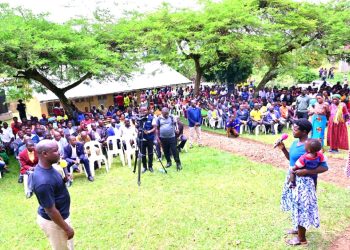
A severe shortage of court-accredited mediators has emerged as a key factor behind the mounting case backlog at Soroti High Court, leaders revealed during an open court session officiated by Dr. Flavian Zeija, the Chief Justice of Uganda. Mediators help disputing parties reach mutually acceptable solutions before matters escalate to a full trial. However, the limited number of trained mediators has slowed this process, leaving cases pending for years. Some matters at the court date as far back as 2000 through to 2023.
Paul Sande Emolot, the Emorimor Papa Iteso, urged the Judiciary to fast-track long-pending cases and expand court services across Teso. “I want to congratulate you for having managed to establish Magistrate’s Courts in some districts in Teso, including Soroti as a High Court. However, I urge you to decentralize the judicial courts in every district of Teso to help reduce the time taken in the legal process and alleviate the backlog,” he said.

Emolot called for the establishment of functional Grade One Magistrates’ Courts in Kapelebyong and Butebo districts and urged the Judiciary to operationalise the Pallisa High Court to serve Pallisa, Butebo, Kibuku, and Budaka districts. “By operationalizing these courts, our people in the region will be able to access judicial services more conveniently and affordably,” he added.
William Alloch Akol, a Teso elder, stressed the need to appoint neutral, trained mediators to handle disputes before they escalate to court, especially land cases. “I pray that the judiciary appoints neutral mediators who are experienced and can engage with key witnesses in the community to help reduce the backlog,” he said.He also urged collaboration with clan leaders, arguing that many disputes—particularly land cases—are already addressed at the community level. Florence Tino, a widow from Kachumbala Sub-county in Bukedea District, expressed frustration over her son’s case. He was arrested in 2024 on alleged defilement charges.
“Since my son was arrested and detained at Bukedea police, he was transferred directly to Soroti government prisons. I have not been allowed to speak to him or even see him,” she lamented. She added that she frequently travels to Soroti but is told there is no file and that her son is never produced in court.“Every time I come to court, I am told that there is no file, and he is never produced anywhere. Please help us sort out these matters that are taking shape in this court, where the poor are mishandled while those with money manage to buy their way out,” she pleaded.
Eddie Nagulu from the Uganda Law Society raised concerns about access to justice. “There’s no way we can talk about access to justice when only a small fraction of the population benefits,” he said, noting that many citizens have lost confidence in the courts. He urged the Judiciary to safeguard citizens’ rights and make bail a mandatory right.
Soroti High Court Resident Judge Doniface Wamala acknowledged the heavy workload. “Because of the significant number of cases we have, we begin with the earliest in the system. We are prepared to listen,” he said. As of February 2026, the High Court has 1,256 cases, with 437 classified as backlog. There are 527 inmates on remand for capital offences, while 786 are convicts and 690 are remanded prisoners, the majority facing serious charges.
Only three Chief Magistrates’ Courts—Soroti, Katakwi, and Kaberamaido—are operational in the region. Katakwi handles 567 cases, 83 of which are backlog, while Kaberamaido has 109 cases with no backlog. Wamala said the High Court completed 71 cases through plea bargaining and 25 through mediation in 2025, but noted low uptake due to limited mediators, resistance from some legal practitioners, preference for cultural settlements, and inadequate funding.
“If mediation is enhanced, the case backlog could soon become a matter of the past for the Soroti High Court,” he explained. Chief Justice Flavian Zeija attributed prison congestion and prolonged remand periods to inadequate funding. “If this is resolved, we can handle all these cases effectively,” he said, adding that Parliament must address the funding gap.He further revealed that the Judiciary is engaging cultural leaders and strengthening mediation training to speed up case disposal. The discussions underscored the urgent need for expanded court infrastructure, increased funding, and stronger alternative dispute resolution mechanisms to restore public confidence in the justice system in Teso.
-URN. Give us feedback on this story through our email: kamwokyatimes@gmail.com