The Health Ministry has ordered the Pharmaceutical Society of Uganda (PSU) to stop issuing Annual Practising Licences to pharmacists after the Attorney General’s Chambers ruled that the power to license pharmacists belongs to the Pharmacy Board and its Registrar. The Ministry issued the directive on September 18, 2026, following a legal opinion by Solicitor General Pius Perly Biribonwoha that found the Society has no statutory mandate to issue the licences.
The dispute arose after the PSU announced that its Annual Membership Certificate had been converted into an Annual Practising Licence for members who had fully paid their membership subscriptions. The development prompted the Ministry of Health to seek a legal interpretation of the Pharmacy and Drugs Act, Cap. 309, particularly on whether the authority to issue annual practising licences lies with the Pharmacy Board or the Pharmaceutical Society.

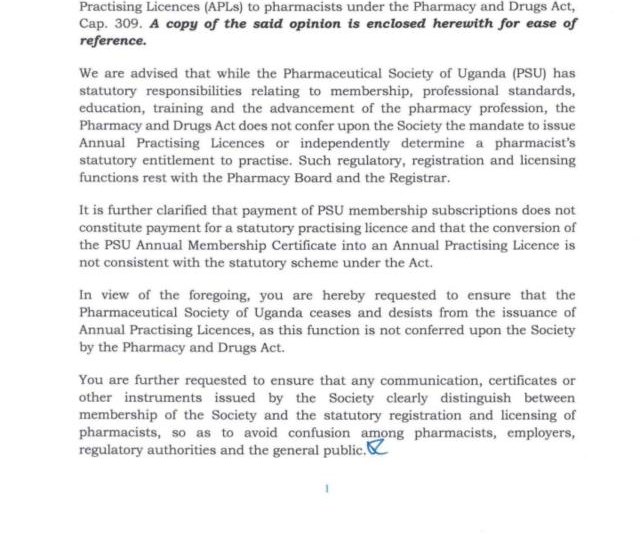
In his September 11 opinion, Biribonwoha said the Act gives the PSU significant responsibilities in relation to membership, professional standards, education, training and the advancement of the pharmacy profession, but does not give it the power to issue annual practising licences. Instead, the opinion states that the statutory functions of regulating, registering and licensing pharmacists rest with the Pharmacy Board and the Registrar.
Section 13 of the Act establishes the registration framework for pharmacists and requires the Registrar to maintain the register and, upon the direction of the Pharmacy Board and payment of the prescribed fee, register qualified pharmacists and issue certificates of registration. The Solicitor General said membership of the PSU and statutory registration as a pharmacist are distinct, although related, matters. While membership of the Society is relevant to registration under the Act, Biribonwoha said it does not give the Society the authority to determine whether a pharmacist is legally entitled to practise.
He further ruled that payment of a PSU membership subscription cannot be treated as payment for a statutory practising licence. The legal opinion therefore concluded that the Society’s conversion of its Annual Membership Certificate into an Annual Practising Licence, where the licence is issued solely based on membership subscription, is not consistent with the statutory framework governing pharmacy practice. Following the opinion, Director General Health Services Prof Charles Olaro wrote to the Secretary of the PSU, Dr Lutoti Stephen, directing the Society to cease and desist from issuing the licences.
Olaro also directed the Society to ensure that its communications, certificates and other documents clearly distinguish between membership of the Society and the statutory registration and licensing of pharmacists. The Ministry said the distinction is necessary to prevent confusion among pharmacists, employers, regulatory authorities and the public. The Society has also been asked to work with the Pharmacy Board and the Registrar to ensure a smooth transition and communicate the changes to affected pharmacists and other stakeholders.
The Solicitor General further clarified that although cessation of membership has consequences within the statutory registration framework, the PSU does not independently have the power to suspend, cancel or otherwise determine a pharmacist’s statutory right to practise. The Ministry copied the directive to the Minister of Health, the Minister of State for Health (Primary Health Care), the Minister of State for Health (General Duties) and the Permanent Secretary-URN. Give us feedback on this story through our email: kamwokyatimes@gmail.com