By KT Reporter
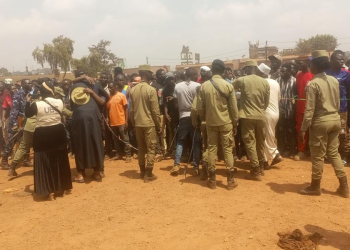
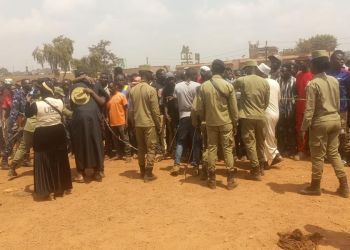
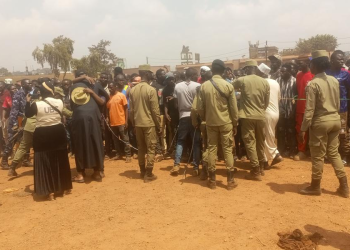
On a sunny Friday afternoon, I joined a small group of residents of The-Okot village, Got Apwoyo, Sub-county in Nwoya District on a short walk towards the boundary of Murchison Falls National Park. The Path lined with shrubs and grasses led us to a row of beehives suspended on wires hooked to low-hanging tree branches.
The air was calm, but with over a dozen individuals on this short trip, noise was inevitable, something that attracted a polite caution from our armed guide from the Uganda Wildlife Authority (UWA), saying we should maintain silence since bees don’t like noise. Te-Okot lies near the boundary of the Murchison Falls National Park, one of Uganda’s largest and most biodiverse conservation areas.

But for years, that proximity came with a price to locals as elephants from the Park frequently strayed into the community, destroying crops and forcing many to abandon agriculture. Christopher Oyirwoth, a resident of Te-Okot village, had been growing crops in the area but turned to charcoal burning about six years ago owing to the incursion of the elephants on the farmland.
Oyirwoth told Uganda Radio Network in an interview that in 2018, a mass destruction of their farmlands by marauding elephants forced them to summon Uganda Wildlife Authority (UWA) for an engagement. The 31-year-old farmer, who also doubles as the secretary of the wildlife scout in the community, claimed several herds of elephants invaded the village and destroyed every food crop on their path, forcing many to ask for compensation and intervention from UWA.
“In 2018, we complained to UWA about elephants destroying our crops. They asked us what kind of projects we wanted. Some said motorbikes, others goats or pigs. But a few of us said we wanted beehives,” he recounts. At that time, he said the community already had 12 locally made hives crafted from Borassus palm logs installed by a group of 27 local wildlife scouts trained by UWA.
Beehive Fence Solution
In November 2024, with support from TotalEnergies E&P Uganda through the Community Integrated Development Initiative (CIDI), the community launched a beehive fence project, one of the creative approaches to deter elephants using bees. The initiative began with 150 modern beehives installed along a one-kilometer stretch of the park’s most vulnerable boundary, a hotspot for elephant incursions into community land.
According to Oyirwoth, ever since the installation of the beehive fences, the elephants have stopped invading their area, saying that they only cross from the park a kilometer away from their community. “Sometimes in a year, we see elephants once and in a far distance when they are passing from up that side,” said Oyirwoth as he pointed to a far distance side of the park boundary.
Oyirwoth noted that with expectations that they will make a good harvest of honey this December, he plans to quit charcoal production, which is no longer lucrative due to the ongoing ban on commercial charcoal production. President Museveni issued Executive Order No. 2 in May this year, banning charcoal production in Northern Uganda to protect the natural tree covers that are under threat from charcoal production and illegal logging.
Like Oyirwoth, Nyeko Karim, another farmer and charcoal producer in Te-Okot village, received seven modern beehives from TotalEnergies E&P Uganda as part of an effort to boost his livelihood. Nyeko, who is a member of the Can Tek Group of over 20 group members, however, noted that after receiving the beehives, he too decided to team up with the local wildlife scouts to install the beehives along the Park boundary.
He said that while they haven’t yet benefited from the honey harvest, which they anticipate will come out by next month, the influx of elephants in the community has greatly decreased. “We used to fear elephants a lot, but ever since these beehive feces were installed, the elephants ceased passing from here; they cross from a different side, but these small animals still cross,” he said.
With the beehives project currently helping to deter elephants, Nyeko said several locals have resumed small-scale farming, unlike in the past when many abandoned it for fear of making losses. Nyeko, however, said once they harvest the honey and make good sales out of it, the group intends to expand the initiative by adding more beehives to neighboring areas where the elephants still cross into community land.
“If we harvest and make a lot of money, even if UWA doesn’t support us with beehives, we intend to buy on our own more beehives and install them along the porous areas in case UWA is still interested in signing a Memorandum of Understanding with us,” he told URN. To mitigate fire incidents on the beehives, the community has set up Tuesdays and Fridays every week for compulsory bush clearing around the one-kilometer stretch of the beehive fences.
Why Beehives
Wilson Kagoro, the conservation education officer at Murchison Falls, noted that the initiative is part of a broader strategy to promote coexistence between wildlife and people bordering the conservation area. He said elephants are known to fear bees, and even the sound of buzzing can keep them away from a particular area.
“Elephants, huge as they are, have very sensitive ears. So, when the bees are coming, they look for those sensitive parts of the elephant, and those are the ears. They sting them in the ears, and I can assure you, elephants go running for their life,” said Kagoro.
Kagoro said the arrangement benefits both conservation and livelihoods since the honey that the community will be able to get money for. According to the park management has already signed similar agreements with communities in hot spot areas in the districts of Oyam, Masindi, Kiryandongo, and Buliisa, where there have been cases of elephants straying into community land.
The areas include four agreements signed in Kiryandongo, three in Masindi around Nyakarongo in Kiruli Sub-county, Kichumbanyobo in Labongo Sub-county in Masindi district, and Ngwedo in Buliisa district.
Electric Fencing
Besides the Beehives project, UWA embarked on the phased installation of electric fences in key hotspot areas in Nwoya District and other areas bordering the Murchison Falls. Kagoro revealed that 91 kilometers of electric Fence have been installed in Nwoya District, Oyam and Buliisa districts, with an additional 31 which are work in progress in the same districts. In Nwoya district, particularly, UWA intends to cover the areas of Koch Lii, Anaka, and parts of Purongo Sub-counties and extend from Latoro Sub-county to Pajengo and Kololo.
In total, UWA is targeting the phased installation of electric fences spanning 133 km in the four hotspot districts. According to Kagoro, besides fencing and beehive initiatives, UWA is also promoting trench digging, sky shooting, and the cultivation of unpalatable crops such as sunflower, simsim, soybeans, and coffee, all crops that elephants and other wildlife tend to avoid.
Compensation
Despite these efforts, farmers and local leaders in Nwoya and neighboring districts have long complained about delays in compensation for wildlife-related losses. Kagoro, however, acknowledged these concerns but explained that the process is ongoing. He noted that at least 92 people have been compensated in the last three years, but more than 300 are still pending approval by the authority to handle.
While campaigning in Anaka Town Council late last month, President Yoweri Museveni, the National Resistance Movement presidential candidate, pledged to instruct the Prime Minister to follow up on the compensation of victims of wildlife. He also recommended the completion of electric fences around hot spot areas of the national park to curb the straying of wild animals.
The President was responding to Richard Todwong, the NRM party Secretary General, who appealed for his intervention regarding the delayed compensation of victims of wildlife incursions in the district and a permanent solution to the influx of animals from the national park. Designated as a national park in 1952, Murchison Falls National Park is one of the oldest conservation areas covering an estimated 3,893 square kilometers across the districts of Nwoya, Buliisa, Masindi, Oyam, and Kiryandongo.
-URN. Give us feedback on this story through our email: kamwokyatimes@gmail.com