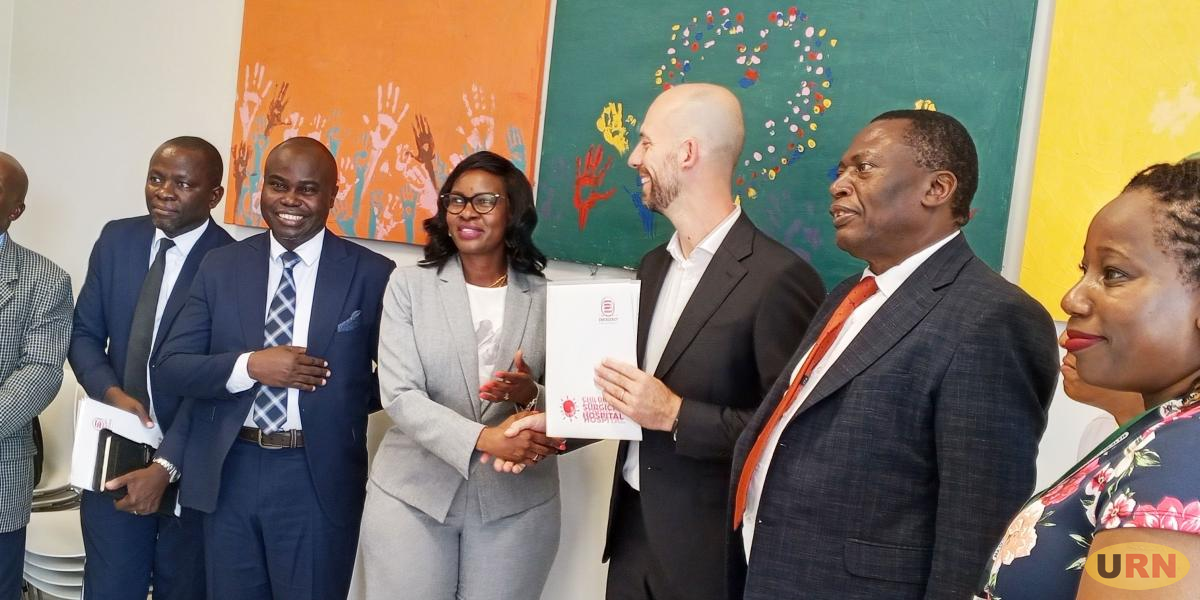
The government’s efforts to tackle a growing shortage of specialised child healthcare workers received a major boost on Wednesday after Mbarara University of Science and Technology – MUST signed a partnership agreement with the Children’s Surgical Hospital Entebbe.
The Memorandum of Understanding (MoU) backed by the Ministry of Health, is aimed at strengthening paediatric surgical treatment, clinical training, and specialist workforce development.
The MoU was signed at the Children’s Surgical Hospital in Entebbe following a high-level meeting involving Director General of Health Services Charles Olaro, MUST Vice Chancellor Pauline Byakika-Kibwika, and Giacomo Menaldo, Country Director of EMERGENCY’s Children’s Surgical Hospital.

The agreement comes amid Uganda’s limited paediatric surgical capacity where children constitute the majority of the population and where access to specialised surgical care remains critically inadequate.
According to Giacomo Menaldo, Country Director of Children’s Surgical Hospital, Uganda currently requires at least 220 paediatric surgeons to meet international standards, yet the country remains far below that threshold.
The shortage has left thousands of children with untreated congenital abnormalities, gastrointestinal disorders, urological conditions, cleft lip deformities, and other life-threatening surgical complications.
“The need is enormous,” Menaldo told URN after the signing ceremony. “Uganda is the second-youngest country in the world, and there is still a significant need to develop the health workforce required to care for all these children.”
The partnership is expected to provide medical students, residents, nurses, anaesthesia trainees, and biomedical engineering students from MUST with hands-on clinical exposure at one of East Africa’s most specialised paediatric surgical centres.
Dr. Charles Olaro pointed out that the agreement reflects a growing shift toward integrating academic training with practical hospital-based experience to address Uganda’s widening human resource gap in healthcare.
“This memorandum is fundamentally about developing the health workforce,” Olaro said. “When these competencies are brought together, we shall create a strong and formal structure for training health workers across multiple disciplines.”
The agreement aligns with Uganda’s National Health Policy III and the Human Resources for Health Strategic Plan, both of which prioritise specialist training, health workforce expansion, and partnerships between academic institutions and healthcare facilities.
It also supports broader commitments under the Sustainable Development Goals (SDGs), particularly SDG 3 on ensuring healthy lives and promoting well-being for all ages. According to Ministry of Health data and World Health Organization benchmarks, the country still struggles with low doctor-to-patient and specialist-to-population ratios, especially in surgical disciplines.
The challenge is even more acute in paediatric surgery, where specialised infrastructure, intensive care support, and highly trained personnel are required. Established in 2021 by Italian humanitarian organisation EMERGENCY ONG ETS, the Children’s Surgical Hospital in Entebbe has rapidly emerged as a national referral centre for complex elective paediatric surgery.
The facility was specifically designed to provide free surgical care to children aged between 30 days and 18 years. More than 5,200 children have been treated since the hospital opened, with approximately 6,500 surgeries performed across its three operating theatres.
In 2025 alone, the hospital handled nearly 1,300 patients, although officials noted that the number reflected an increase in the complexity of surgical cases rather than a decline in demand.
“More complex surgeries require longer operating times and longer hospital stays,” Menaldo explained. “That is part of our mandate with the Ministry of Health, to treat cases that cannot be managed elsewhere.” The hospital’s establishment significantly expanded Uganda’s paediatric surgical capacity by tripling the number of paediatric surgery beds in the country.
The 100,000-square-foot facility contains 72 beds, including intensive care and sub-intensive care units, outpatient clinics, a diagnostic centre, laboratory services, blood bank, pharmacy, and free accommodation for families travelling long distances for treatment.
“Our organisation believes healthcare is a human right,” Menaldo said, noting that both treatment and training at the facility are offered free of charge.
MUST Vice Chancellor Prof. Pauline Byakika-Kibwika described the collaboration as an important bridge between classroom instruction and real clinical experience. “As a university, we have a large student population and many departments, which means our training needs are enormous,” she said.
She noted that the university was particularly interested in exposing students to the hospital’s highly standardised infection prevention and control protocols, which she described as exemplary.
The collaboration is also expected to include staff exchange programmes and training opportunities for multiple disciplines beyond surgery and paediatrics, including anaesthesia and biomedical engineering. According to the Uganda Bureau of Statistics, more than half of Uganda’s population is below the age of 18, placing immense pressure on maternal and child healthcare systems.
At the time the hospital opened in 2021, Uganda’s under-five mortality rate stood at 43 deaths per 1,000 live births, figures partly associated with delayed access to specialised care, including surgery for congenital and treatable conditions.
The new partnership is therefore expected not only to improve clinical training, but also to strengthen Uganda’s long-term capacity to manage complex childhood illnesses domestically rather than relying heavily on overseas referrals or periodic medical camps. Discussions are already underway to expand similar partnerships to Makerere University as well as universities in Mbale and Gulu to decentralise specialised training opportunities across the country-URN. Give us feedback on this story through our email: kamwokyatimes@gmail.com