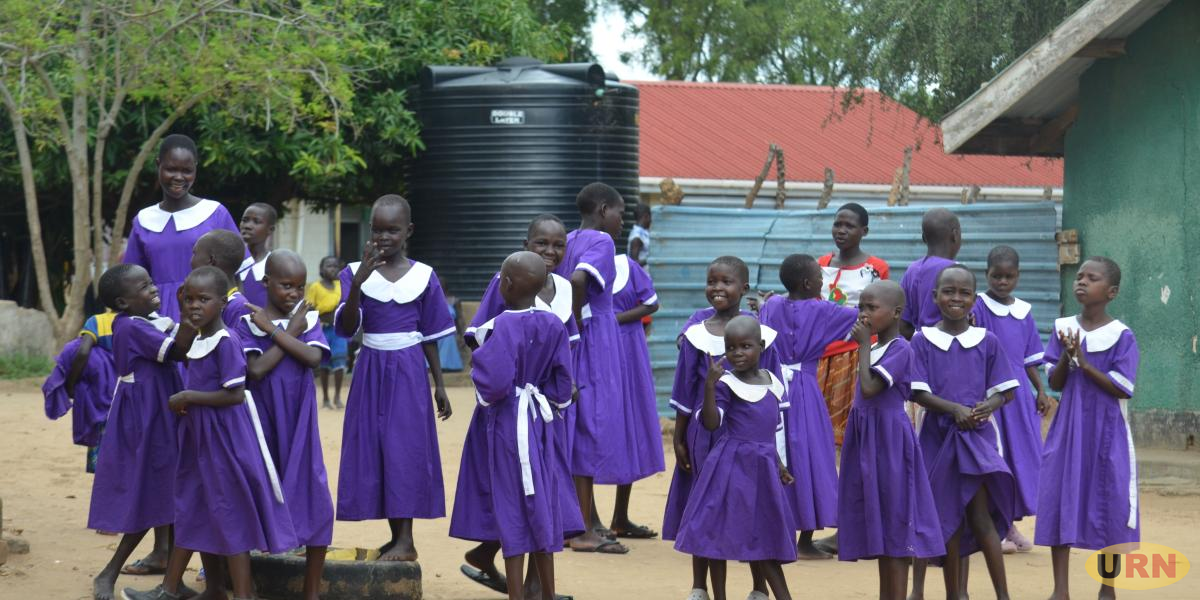
Schools in Moroto District remain half empty as the second term enters its third week. Headteachers blame hunger, child labour, and domestic work for the poor turnout. A spot check on Friday by the URN in primary and secondary schools on the outskirts of Moroto town found few learners had reported back.
The head teachers said that they were hopeful that enrolment will rise by the third or fourth week. They said that pupils are only released from their families after completing household duties such as weeding gardens, grazing cattle, and doing casual labour to help families find food.
In some community primary schools, partners like Welthungerhilfe have delivered books, pens, and mathematical sets to be given to learners for free to remove parents’ excuses about a lack of money for scholastic materials.

John Amodoi, the Deputy Headteacher of Nachele Community Primary School said they have so far enrolled 172 pupils in primary and 216 in ECD out of a total expected enrollment of 680.
Amodoi explained that older pupils are still engaged in domestic work, while younger ECD children were sent to school early to access food provided there. “Almost all the children from ECD have reported back because they have nothing to do at home,” he said.
He said the school expects enrolment to increase in the third or fourth week. For now, teachers are combining classes such as P4, P5, and P6 to raise the number that can be taught. “As of Monday, we received only one pupil per class in the upper classes, but the number is gradually increasing,” Amodoi said.
Robert Arou Okiror, head teacher of Loletekia Community Primary School, shared a similar experience. Last term, he registered 701 pupils, but only 178 have reported so far.
Okiror said the gap remains large and questioned why parents keep children at home when it is not yet harvesting time. He suspects boys have returned to kraals to look after cattle while girls are doing casual labour to sustain families.
“Usually, parents detain children at home to scare birds when crops are ready for harvest, but for now they are still weeding,” he said. Okiror added that Welthungerhilfe has provided scholastic materials to be given to learners once they report. “There is no reason for parents to keep their children at home because there is food and scholastic materials,” he said.
The situation is no different in secondary schools, where students were seen reporting one at a time. The teaching staff has also not fully reported.
James Kodet, deputy headteacher of Nadunget Seed Secondary School, said they have seen low turnout in S1 to S6 over the last two weeks.
Kodet said statistics show only 16 out of 30 teaching staff and four out of eight non-teaching staff have turned up, while only 200 students out of an average attendance of 370 have reported.
He attributed the poor turnout to household challenges. “June is always the peak of hunger and economic hardship, hindering parents from generating income to send their children to school,” Kodet said.
Kodet noted that since the World Food Programme withdrew school meal support, students are required to pay UGX 72,000 per term for food on top of school fees. “This might be a challenge as many students are struggling to raise that money,” he said.
Daniel Lokiru, an opinion leader in Moroto District, said education in Karamoja needs “a rough hand” to implement.
“Many times, measures and solutions by both government and partners have been tried to ensure children go to school, but all in vain,” Lokiru said.
He called for strong bylaws that are forcefully implemented, not just written on paper.
“I have learnt that everything in Karamoja requires force. People have been begging for a long time to take children to school, but they don’t want to listen; even leaders have been rendered powerless,” Lokiru said.
He urged that village leadership be empowered to arrest parents keeping children at home.
Local leaders in Karamoja have been advocating for free and compulsory boarding education for all children, arguing that school fees bar children from vulnerable families from accessing education.
Some community schools fully supported by partners provide scholastic materials and food, yet still struggle to attract learners.
In 2021, Save the Children introduced the Strengthening Education Systems, Bridging Learning Loss project, a 3-year Basic Education Project to boost learning in selected sub-counties in Moroto.
The primary beneficiaries included teenage mothers, learners who had dropped out for over a year, and children in child-headed households. The project provided scholastic materials, school feeding, and paid UGX 50,000 to each learner for upkeep. However, many beneficiaries, especially teenage mothers, reported to school to get the money and later dropped out.
Other partners, like the World Food Programme, have continued supporting primary schools with school feeding programs to keep learners in school. But it was observed that only lower classes record increased enrolment. Numbers drop-in upper classes as girls are withdrawn for marriage, while boys take care of animals-URN. Give us feedback on this story through our email: kamwokyatimes@gmail.com