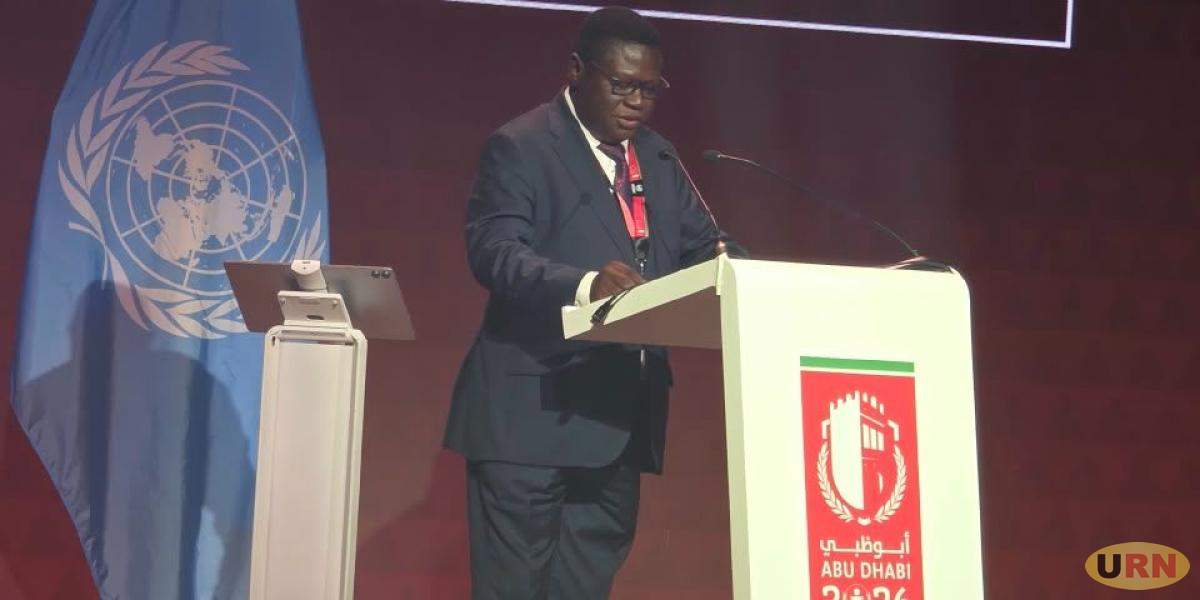
Criminal networks are increasingly exploiting national borders and advances in technology to expand activities such as terrorism, trafficking in persons, cybercrime and money laundering, prompting calls for stronger international cooperation to combat the growing threat. Uganda’s Minister of Justice and Constitutional Affairs, Norbert Mao, says no country can effectively tackle emerging and cross-border criminal threats on its own.
Mao made the call while addressing the 15th United Nations Congress on Crime Prevention and Criminal Justice, which is being held in Abu Dhabi, United Arab Emirates, from September 26 to October 1, 2026. Mao, who is leading Uganda’s delegation to the Congress, welcomed the Abu Dhabi Declaration and the Congress theme of accelerating crime prevention, criminal justice and the rule of law in the digital age.
According to a statement from the Governance and Security Programme Secretariat at the Ministry of Justice and Constitutional Affairs, Mao said Uganda supports positions advanced by the Africa Group and the Group of 77 and China, and considers effective crime prevention and criminal justice critical to sustainable development and the protection of human dignity.

He said Uganda attaches particular importance to extradition, mutual legal assistance and information sharing among countries, arguing that stronger cooperation is needed to prevent national borders from becoming safe havens for criminals involved in transnational activities. Mao also welcomed technical assistance and capacity-building support from international partners, while stressing that such interventions should be aligned with Uganda’s national priorities.
Uganda ratified the United Nations protocols against trafficking in persons and the smuggling of migrants in 2024. In October 2025, the country was also among the states that signed the new United Nations Convention against Cybercrime in Hanoi, according to the ministry. Mao said Uganda is developing a National Strategy Against Transnational Organised Crime, which will identify major criminal markets and the groups operating within them.
The strategy, he said, will also examine the root causes and conditions that enable organised crime, while incorporating gender and human rights considerations. Mao argued that criminal justice responses should not focus exclusively on punishment, saying efforts to make communities safer must also address the social and economic conditions that leave people vulnerable to crime.
He called for gender considerations to be integrated into crime prevention programmes and urged stronger action against impunity for gender-based violence. Mao also highlighted what he described as improvements in Uganda’s criminal justice system, saying the country has recorded a decline in crime rates for three consecutive years through a whole-of-government approach coordinated under the Governance and Security Programme.
He further said the Office of the Director of Public Prosecutions has achieved a 75 percent conviction rate. Mao attributed these developments to reforms across Uganda’s justice and security institutions, including digitised case management in the Judiciary, the Uganda Police Force’s Sub-County Policing Model, Prosecution-Guided Investigations Guidelines, measures by the Financial Intelligence Authority to protect the financial system, and rehabilitation programmes implemented by the Uganda Prisons Service.
On the growing role of technology in criminal justice, Mao said governments must embrace digital tools while ensuring that technology does not create new avenues for crime or undermine fundamental rights. “We must harness technology responsibly, without allowing it to become a new avenue for criminality or a threat to fundamental rights,” Mao said.
He called for criminal justice systems that are innovative, inclusive and evidence-based, while remaining anchored in the rule of law. The Director of Public Prosecutions has previously identified the diversity and complexity of transnational crimes as a major challenge, noting that such crimes often operate across multiple jurisdictions and increasingly make use of technology, making detection and enforcement more difficult.
The office has also pointed to challenges in identifying, investigating and prosecuting offences such as trafficking in persons, where investigative and prosecutorial approaches are still developing. Uganda is using the UN Congress to showcase reforms in its criminal justice system. The Ugandan delegation includes Principal Judge Lady Justice Jane Frances Abodo, Director of Public Prosecutions Lino Anguzu, and Rachael Odoi, Senior Technical Advisor at the Justice, Law and Order Sector.
Throughout the Congress, Uganda is hosting an exhibition titled “Showcasing Uganda’s Criminal Justice Reform Journey through the JLOS Chain-Link Model,” featuring demonstrations of digital justice platforms, documentary materials and a compendium of justice-sector reforms. Uganda is also scheduled to host a side event on Monday, September 28, from 11:30 a.m. to 12:30 p.m. Gulf Standard Time, under the theme “Criminal Justice and Crime Prevention Reforms in Uganda: Delivering Results Through Government and Civil Society Partnerships.”
The event is being co-organised with the Legal Aid Service Providers Network and Uganda Youth Development Link, with support from the Embassy of the Netherlands and the United Nations Office on Drugs and Crime. The 15th UN Crime Congress brings together governments and other stakeholders to discuss crime prevention, criminal justice and the rule of law amid evolving security and technological challenges-URN. Give us feedback on this story through our email: kamwokyatimes@gmail.com