Karamoja communities have called for urgent and practical private-sector interventions to address the worsening effects of climate change, which they attribute partly to extensive environmental destruction in the sub-region.The call was made on Wednesday during a multi-stakeholder dialogue organised by the Advocates Coalition for Development and Environment (ACODE), in partnership with the Africa Centre for Energy and Mineral Policy (ACEMP) and Karamoja Herders of the Horn (KHH).
The dialogue focused on stimulating private-sector investment in climate action to build a more resilient Karamoja. Community members at the forum particularly challenged mining companies to take greater responsibility for protecting and restoring the environment, accusing some of them of causing extensive environmental damage without doing enough to rehabilitate affected areas.
They said mining activities were contributing to drought, air pollution and environmental degradation, and called for practical measures to address the impact on surrounding communities. Jackson Angella, an elder from Rupa Sub-county in Moroto District, said the region had experienced prolonged drought for decades, with the situation becoming increasingly severe.

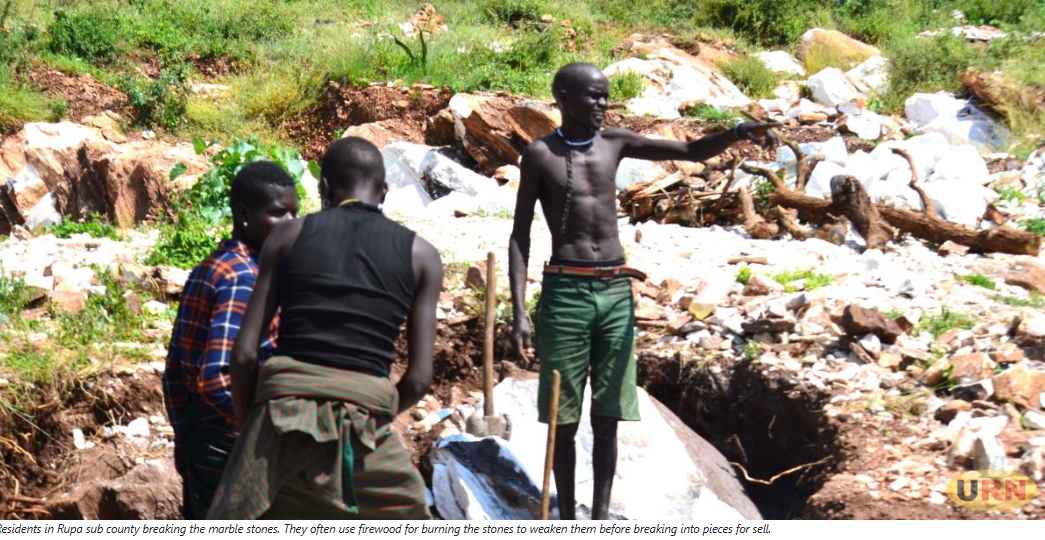
“The mining sector is very destructive to the environment, and they have done nothing to save the situation. The companies pretend to plant trees where mining takes place, but they keep destroying them,” Angella said. He said the environmental destruction had affected much of Moroto District, particularly areas where marble stone mining is taking place.
While acknowledging that communities also contribute to environmental degradation, Angella said mining companies should provide machinery to break stones instead of forcing communities to cut down trees for firewood used to burn and weaken the stones. “There is massive air pollution in areas where companies operate. Communities are suffering from dust from quarrying sites, and nothing is done to prevent it,” he said.
Angella also urged the government and development partners to provide alternative sources of livelihood for charcoal burners instead of simply stopping them from the trade. Christine Nakiru, a resident of Kotido District, said surrounding communities were bearing the consequences of mining activities.
“The mining companies carry out their activities and do not care about the wellbeing of surrounding communities and their environment,” Nakiru said. She said air pollution from mining activities was exposing communities to respiratory health risks, while many commitments contained in Memoranda of Understanding between districts and mining companies were not being implemented.
Nakiru called for affordable alternatives to firewood and charcoal, noting that electricity and gas remained too expensive for many households. She recommended the promotion of energy-saving stoves and investment in wind energy for cooking. She also raised concern over climate financing in Karamoja, saying that although significant resources had been invested in climate-related interventions, some development partners lacked clear exit strategies, leaving farmers vulnerable when projects ended.
Charles Topoth, a resident of Moroto, challenged mining companies to review their environmental and social impact assessments as well as the technologies they use to minimise environmental damage. Mark Abuku, Chairperson of the Karamoja Regional Development Initiative, said efforts to partner with mining companies on environmental restoration had not yielded a response.
“We are promoting environmental restoration using cashew nut trees. We have so far planted over 17,000 trees and have more than 40,000 seedlings in nursery beds,” Abuku said. He said cashew trees were drought-resistant and could also provide an income source for communities.
Responding to the concerns, Obed Kansiime, a representative of Sunbelt Mining Company, acknowledged that mining companies were among the contributors to environmental destruction but said communities also degrade the environment, sometimes unknowingly. He said mining companies were regulated by the National Environment Management Authority (NEMA) and were adopting technologies aimed at reducing environmental damage.
Kansiime also said some trees planted under agreements between mining companies and districts were destroyed by animals or bush fires. “Environmental protection should be a shared responsibility, not a one-man struggle,” Kansiime said. Faith Nagudi from Pearl Bank said the bank had a portfolio of approximately Shs1 trillion, with 30 percent targeted at agriculture, including support for climate-smart agriculture in Karamoja.
She said the bank also provides green financing for solar irrigation, renewable energy and waste management. Michael Lokiru from the Food and Agriculture Organization (FAO) said the organisation uses in-kind grants to support individual farmers and groups to improve food security while reducing pressure on the environment.
David Nangiro from ACEMP said the organisation was implementing a project focused on environmental protection and conservation through community sensitisation. He said charcoal burners had also been organised into groups to help them access alternative income-generating activities. Moroto Resident District Commissioner Benon Kwikiriza challenged the private sector, particularly mining companies, to ensure that their activities do not leave Karamoja environmentally degraded.
He identified water scarcity as one of the biggest obstacles to environmental restoration in the region. Moroto District LC5 Chairperson Anjelo Pulkol said climate change had severely affected the region through food insecurity and water scarcity, calling for joint efforts to increase access to water for production. Emmanuel Tebanyang, Executive Director of Karamoja Herders of the Horn, said communities were experiencing increasingly severe effects of climate change. “The effects are progressing, and the community will have to live with it because they have nowhere to run. We must adapt,” Tebanyang said. He called for increased capacity building to help communities adapt to climate change and strengthen mitigation efforts-URN. Give us feedback on this story through our email: kamwokyatimes@gmail.com