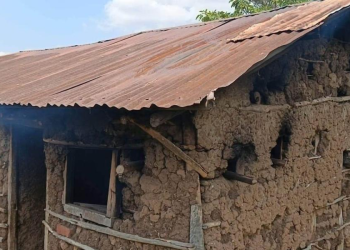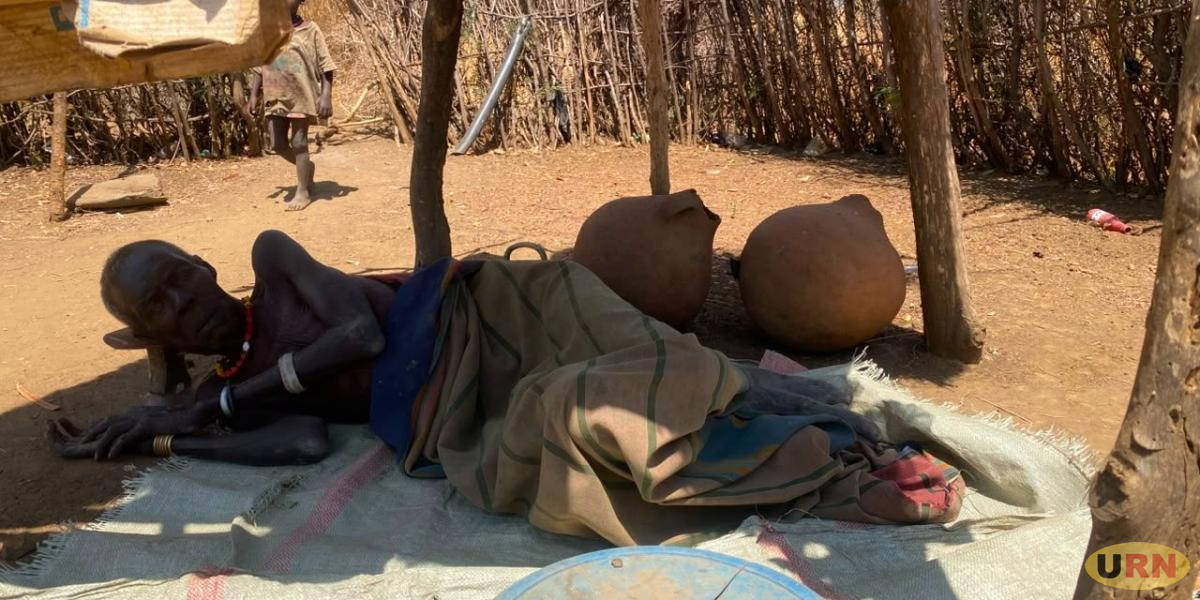
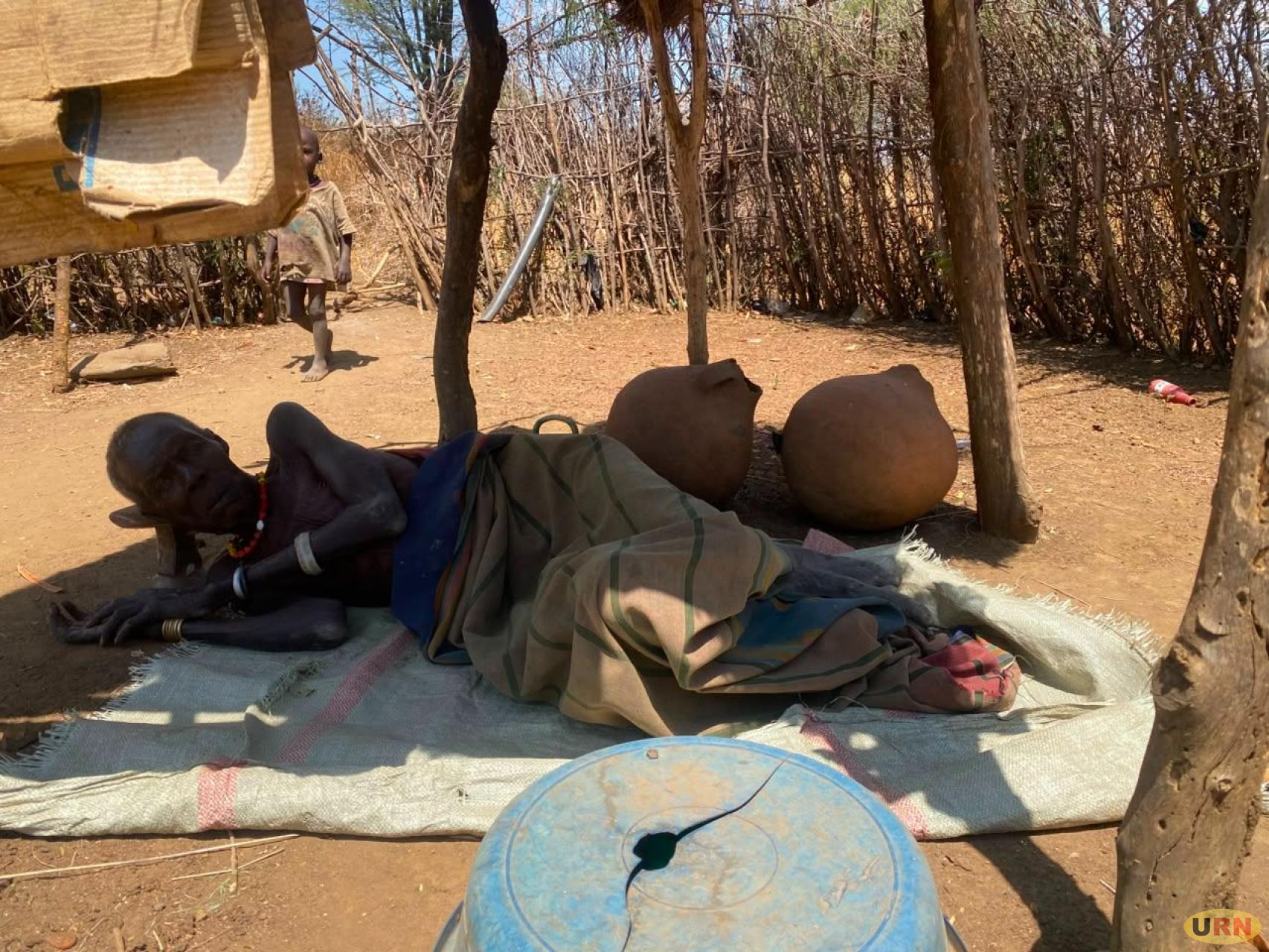
Elderly persons and people with disabilities in Moroto District have been left locked in houses for entire days as family members move out to look for survival elsewhere amid a biting hunger crisis. The exodus follows failed crops this season.
With no food at home, families are now abandoning their homes to work as casual laborers at mining and quarry sites, while others go to the streets of Moroto town to beg for food. A spot check by a URN reporter in villages in Rupa and Lotisan sub-counties found elderly people locked inside houses without care.
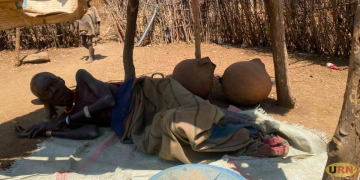
In Kalukalet Village, Rupa Sub-county, Peter Keem, 70, was found lying down, very weak and with no food to eat. Keem said he lives with a 16-year-old granddaughter after losing his wife last year. The girl often leaves him alone and goes to quarry sites to look for casual labor so she can buy food.

“In the event the girl doesn’t get any money, we have to sleep hungry because there is nowhere else to get food,” Keem said. “We usually survive on porridge that we eat at 7:00pm to enable us sleep at night.”
The situation is similar for Sagal Lokur, 80, a resident of the same area. Sagal lives with his wife, who is also vulnerable and cannot support herself. He said all their children were sent to quarry sites to look for money to buy food.
“The children earn between shs2, 000 and shs4, 000 a day. When they get that money, we prefer buying _malwa_ residues so that the whole family eats,” Sagal said. He added that food is very expensive, so they buy malwa , residues at shs500 per water jug and mix it with sugar before eating.
In Kidepo Village, Lotisan Sub-county, Anna Mary Ngorok, an elderly blind woman, was left alone while all her children went to town to work as maids. “The children spend the entire day in town and come back in the evening with very little or nothing at all for us to eat,” Ngorok said.
“Life is very difficult. If this continues for another two weeks, I might die of starvation.” She said her children are sometimes harassed on the streets, but she encourages them to stay because “it is the only way we can survive, or else we will all die.”
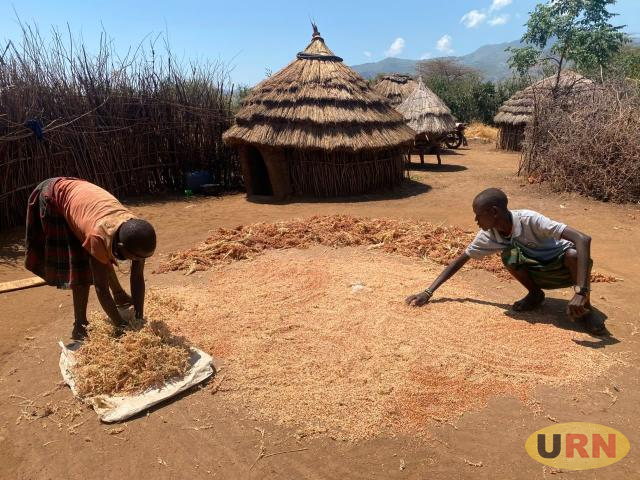
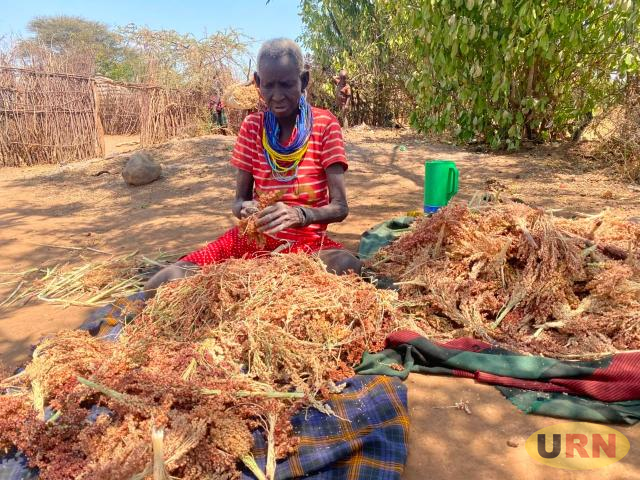
URN also found families harvesting premature sorghum that had dried in the gardens after the scorching sun. Others have turned to wild trees for survival.
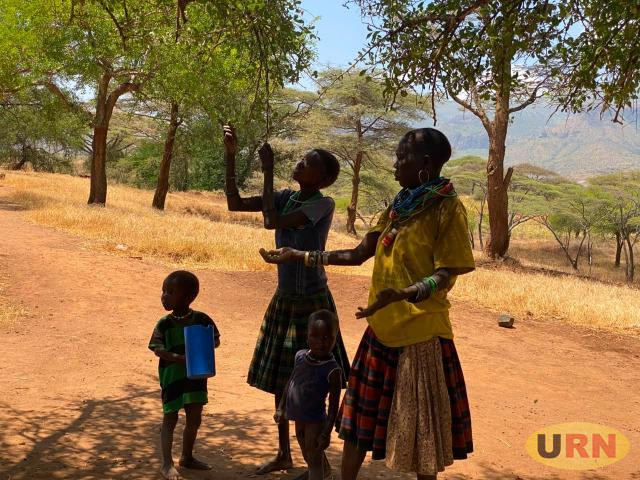
Esther Akol of Kwamong Village was found on a tree collecting leaves. “We now eat the leaves of this tree to survive,” Akol said. “We boil and pound them in a mortar to make them soft, and then eat with _ugali_. Our burden is now buying maize flour. Those who cannot afford it eat the leaves alone.” Paul Mickey Aliyan of Kalukolet Village said elders suffer the most because they cannot walk to look for food.
“Elders used to get milk from cows during hard times, but since all the cows were raided, we have nothing left,” Aliyan said. “Although we are supposed to look after the elderly, we are also vulnerable and have nothing to offer.”
Roseline Napeyok, who left home for quarry work, said breaking stones is their only hope. “I leave home early with my children to collect and break stones. We sell a full wheelbarrow at shs4,000,” she said. “But getting customers is not easy. Sometimes we go for a week without selling. The family has to starve until we get a buyer.”
Napeyok appealed to the government to rescue them, warning that people risk losing their lives if the quarry business does not improve.
Samuel Lopirin of Natopojo Village, Rupa Sub-county, said most gardens were abandoned at the weeding stage after the sun destroyed crops. “The current seeds, especially for sorghum, are no longer reliable. Most are hybrids that cannot be shared,” Lopirin said. He called for a return to traditional drought-resistant seeds, saying, “we cannot continue relying on food aid. Government should find sustainable alternatives.”
Simon Peter Otim, Lotisan Sub-county Chief, said the dry spell has worsened the crisis. “Whatever farmers planted was destroyed after rains disappeared for the last three months,” Otim said. He warned the situation could get worse because people have exhausted all livelihood means, and even if rains return, farmers may not have seeds to plant.
Otim said the government plans to distribute food aid but is also advising communities to use borehole water to grow green vegetables. “Such initiatives would help to partially address the crisis instead of waiting for government support that is not sustainable,” he said. He urged partners to set up water sources in every village and warned against charcoal burning as a coping mechanism.
According to the Integrated Food Security Phase Classification, approximately 473,000 people in Karamoja are facing high levels of acute food insecurity – IPC Phase 3 (Crisis) or above – during April to July 2026. Around 41,000 people are in IPC Phase 4 (Emergency), while 432,000, or 29% of the analyzed population, are in IPC Phase 3 (Crisis). All nine districts in the region are classified in Crisis.
Kaabong, Karenga, Kotido, Moroto and Nabilatuk are the worst hit, each with 5% of their population in Emergency due to prolonged dry spells and crop pests. Kaabong and Kotido have the highest proportions, with 45% of people in Phase 3 or above.
The government has so far released shs45 billion to address the hunger crisis. The food aid was flagged off on Wednesday and is expected to be delivered to Karamoja on Friday before distribution begins-URN. Give us feedback on this story through our email: kamwokyatimes@gmail.com