For a landlocked country, Uganda once had a railway that did not end at the shoreline. At Port Bell and Jinja, railway tracks ran to the water. From there, railway wagons could be rolled onto ferries and carried across Lake Victoria to Mwanza in Tanzania and Kisumu in Kenya, where cargo rejoined the railway systems leading to Dar es Salaam and Mombasa. The lake was, in effect, part of Uganda’s railway.
But the railway’s marine history is now a story of ships sunk, vessels grounded, infrastructure left idle, and public assets whose trail becomes increasingly difficult to follow. How did Uganda Railways Corporation go from operating a Lake Victoria railway-ferry system moving hundreds of thousands of tonnes of cargo a year to having a marine fleet repeatedly grounded?
MV Kabalega is permanently sitting on the lake floor after it sank on May 8, 2005. It may never be retrieved or recovered. The wreck continued appearing in Uganda Railways Corporation’s books as a multi-billion-shilling asset.A Treasury Memorandum indicated that as at June 30, 2021, URC’s non-current assets included Shs5.76 billion attributed to MV Kabalega.

The audit said the value could not be established because the ferry had been underwater and unretrieved. URC subsequently reduced the recorded value of the submerged vessels to 1,000 shillings in 2021/22, while awaiting offers to retrieve them. The story becomes broader when the records are examined beyond the three major wagon ferries that existed on Lake Victoria.
World Bank records show that Uganda Railways also had other marine assets, including a dry dock, a service launch, a small passenger ferry and a motorised lighter. In 1989, the World Bank said the “two motor vessels” were used for passenger and cargo services to offshore islands near Jinja. Those vessels have disappeared from the available URC asset trail.
The Jinja Pier, where Uganda’s marine system was based, is still there, as is the railway line connecting to it. Uganda Railways Corporation still lists Jinja Pier among its marine facilities. This investigation follows the waterborne transport component of Uganda’s railway story, from the post-1977 decision to build a new ferry system, through the years when it carried hundreds of thousands of tonnes of cargo, to the 2005 disaster and the unresolved fate of the assets that survived it.
It is a separate trail from the rolling-stock investigation published by Uganda Radio Network. In that earlier investigation, “The Missing URC Ledger: Billions Invested, Assets Unaccounted For,” URN examined the fragmented records of locomotives, wagons, coaches and other railway equipment acquired over decades.
The investigation also identified Lake Victoria ferries and marine equipment as part of the wider public investment whose history needed to be followed. The importance of Lake Victoria to Uganda’s railway became particularly clear after the breakup of the East African Railways and Harbours Corporation.
A 1979 Commonwealth Team report on the rehabilitation of Uganda’s economy records that the country had previously used the lake as part of its route to the ocean. “Until the breakup of EARC in 1975, Uganda did make some use of the alternative ocean outlet by ferry from Jinja to Mwanza, and then over Tanzania rail to Dar-es-Salaam,” the report says.
The report then records a decision by the Idi Amin administration in 1978 to increase its rail-wagon ferry capacity on Lake Victoria.“ A Belgian firm has been contracted to provide floating dry dock facilities at Port Bell, which will be used to assemble four wagon ferries each with a one-way load capacity of about 800 net tons of cargo,” the report says.
The same reconstruction records put the value of the Lake Victoria ferry contract at 393 million shillings at the time, of which 219 million shillings had been paid, and 174 million shillings remained outstanding. URC, which was operating under decree, was not merely buying boats. It was rebuilding a transport corridor.
The dry dock at Port Bell would allow the vessels to be assembled and maintained. The railway would bring cargo to the lake, and the ferries would carry it across the water. Railway networks on the other side would take it towards the ports. A World Bank transport study describes the original regional vision as the creation of a “seamless rail link around the lake”
Lake Victoria was not supposed to interrupt the railway. It was supposed to connect it. By the early 1980s, Uganda had three major wagon ferries operating on Lake Victoria. A World Bank assessment identifies them as MV Kaawa, MV Kabalega and MV Pamba.
“Three new ferries, each of 22 bogie wagon capacity, were acquired within the last few years for the Lake Victoria services,” the World Bank reported. A separate World Bank environmental assessment identifies the three vessels as MV Kaawa, built in 1983, MV Kabalega, built in 1984, and MV Pamba, built in 1985.
The same World Bank assessment lists a dry dock, a service launch, a small passenger ferry and a motorised lighter among the other URC-owned marine assets. There were also passenger services for island transport on Lake Victoria operating from the pier at Jinja.
The World Bank records give a glimpse into that lesser-known operation. The bank wrote: “Two motor vessels, recently refurbished, are used for passenger and cargo services to the offshore islands, near Jinja.
”In 1989, Uganda Railways was therefore not only transporting international freight between Port Bell, Mwanza and Kisumu. It was also operating vessels serving communities on the islands around Jinja. But the records examined so far do not identify the two vessels by name or provide a later disposal, retirement, or transfer record.
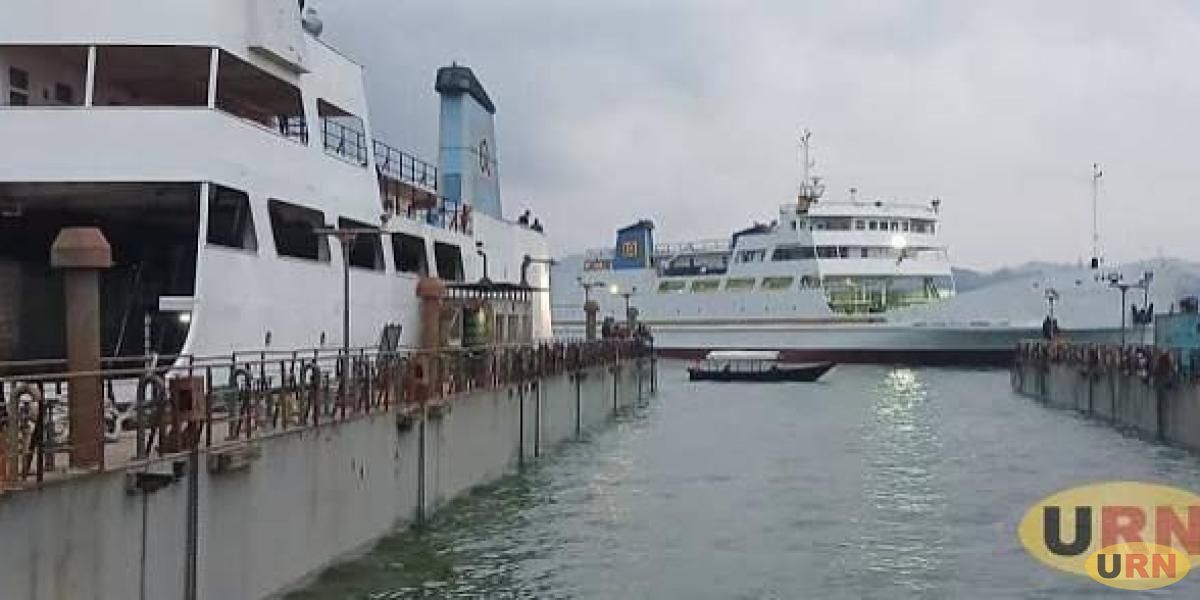
The physical setting for this forgotten part of the story is still visible at Jinja Pier. A later transport assessment describes the pier as a rail-wagon terminal built in the 1960s and connected to the railway station by a metre-gauge line. It had a berth and a rail linkspan for loading and unloading wagon ferries.
Daily Monitor, reporting from the pier in 2017, described its historical role more broadly. The newspaper reported that the pier was intended to support freight and passenger services between Uganda, Kenya and Tanzania and that vessels carried merchandise to Kisumu and Mwanza. By the time of that report, however, the pier had become largely quiet. The newspaper described an overgrown facility with old and rusted equipment.
URC still lists Jinja Pier as part of its marine network. Its current description says URC provides marine services at both Port Bell and Jinja Pier and that the piers are used by vessels transporting roll-on, roll-off cargo. URC also lists the Jinja-Jinja Pier railway section as part of its network.
Documentary evidence shows that the old marine system carried substantial volumes of cargo. A World Bank appraisal records the capacity of each Ugandan wagon ferry at 22 wagons per trip, or about 600 tonnes of payload.
The annual capacity was estimated at about 300,000 tonnes each way. Then the bank assessed how the system was actually performing.“URC moved 120,000 MT of exports and 164,000 MT of imports over the ferries in 1987, in a rather efficient operation of this new service,” it recorded.
That was nearly 284,000 tonnes of imports and exports in a single year. The system continued to operate at scale into the 2000s. A World Bank assessment recorded 350,000 tonnes of net goods transported in 2003. By 2004, Uganda Railways Corporation’s Marine Department planned to transport 365,386 tonnes.
The ferries operated daily, with about 25 crew and support staff on each vessel. The marine operation therefore employed people, moved cargo and connected Uganda to regional markets. MV Kabalega collided with MV Kaawa on Lake Victoria on May 8, 2005, and sank.
The accident effectively removed two of Uganda’s three wagon ferries from normal service. Kaawa was grounded after the collision, while Kabalega went to the bottom of the lake. Pamba was subsequently taken out of service. A World Bank retrospective described the accident in striking terms, calling it the “sinking of nearly the whole of Uganda’s entire commercial shipping.”
The institution’s account says Kabalega remained at the bottom of the lake, while Kaawa was eventually refurbished and returned to service after an investment of about US$3.8 million under the East Africa Trade and Transport Facilitation project.
The inquiry identified inadequately trained bridge crews, failure to implement recommendations from earlier accident reports, inadequate communication equipment and the absence of a search-and-rescue unit capable of responding effectively to a sinking ferry.
The Committee interviewed Samuel Kyabukulu, first officer of MV Kaawa, and Stephen Kaliisa, the third officer who had been on watch. Kaliisa admitted that he had never undergone professional marine training despite being appointed.
The then Minister of Works, Housing and Communications/Works and Transport, John Nasasira, visited Port Bell immediately after the sinking.
He was accompanied by then URC Managing Director Daudi Murungi and the late Paul Etiang, who was URC Board Chairman at the time. “We are not going to allow these ones to venture without insurance,” Nasasira said, referring to the surviving MV Pamba and MV Kaawa, which the government had stopped operating until their insurance was renewed.
The Parliamentary Committee on Works and Transport began examining the accident on May 23, 2005. The committee’s report also found that Kabalega’s insurance had expired in December 2004 and had not been renewed. Nasasira appointed a Commission of Inquiry headed by then Supreme Court Judge Bert Katureebe, before he was appointed Chief Justice.
The Katureebe Commission attributed the accident to human error as the immediate cause, which it linked to gross negligence, unprofessionalism and inadequate training. It also identified the unseaworthiness of the vessels as an intermediate cause because of inadequate repairs and maintenance.
Institutional and managerial neglect involving URC and, to some extent, the parent ministry was identified as a long-term cause. By 2006, Uganda’s wagon-ferry operations had been conceded to Rift Valley Railways. A World Bank lake-transport assessment later recorded that utilisation of the rail-wagon ferries declined substantially as the railway infrastructure and rolling stock deteriorated.
A World Bank transport study found that, apart from Tanzania’s MV Umoja, the other four wagon ferries on Lake Victoria were non-operational following the Kabalega sinking. The result, it said, was a “generally dilapidated rail and lake transport network.”Uganda’s marine infrastructure then entered a long period of uncertainty.
In 2008, URN reported that MV Pamba and MV Kaawa had been grounded at Port Bell for two years because of the absence of insurance and standard classification certificates. The sunken Kabalega had been located on the lake floor but remained unsalvaged.
The government considered recovering Kabalega, but the plan was eventually abandoned.A South African salvage company offered to retrieve the wreck for US$4.5 million. The government later abandoned the project after assessing the cost against the price of replacing the vessel.
Kabalega remained in Uganda Railways Corporation’s financial records.The Treasury Memorandum on the Auditor General’s report for the financial year ended June 2021 found that URC’s non-current assets included 5.760 billion shillings attributed to MV Kabalega. The same records contained another submerged vessel, MV Barbus, valued at 252 million shillings.MV Barbus, also owned by Uganda Railways Corporation, had also submerged.
Records show that the ship had a capacity of 150 passengers and carried 30 tonnes of cargo. Together, the two submerged vessels accounted for 6.012 billion shillings in URC’s reported non-current assets.
The Treasury’s concern was that the vessels had been underwater for years and had not been retrieved. Because they were underwater, they could not simply be disposed of, and auditors said it could not be determined whether they still retained the values recorded in URC’s books.
URC’s explanation was that the values were based on an independent valuation carried out between 2017 and 2018 and that the vessels were considered to retain value because they were made of steel. But the audit recommended that the submerged vessels be removed from the statement of financial position unless they were retrieved or professionally revalued.
URC reduced the recorded value of the submerged assets to a token 1,000 shillings in its asset register during the 2021/22 financial year. That leaves an important accountability question. As for MV Barbus, the Treasury records establish its presence as another submerged URC marine asset.
But the available records do not, by themselves, explain when or where it sank, what service it performed, the circumstances of its loss, whether an insurance claim was made, or why it remained on URC’s books for so long.
The sinking of Kabalega left Uganda with two major wagon ferries. Kaawa survived but required extensive rehabilitation. The World Bank later documented Kaawa’s rehabilitation.“MV Kaawa, the rescuer, was commissioned in 2012 after extensive refurbishing costing $3.8 million,” the bank reported.
The ship eventually spent about 16 years out of service before being rehabilitated and relaunched in 2022. It returned with capacity for more than 800 tonnes of cargo and up to 22 railway wagons. In 2025, URN reported that the vessel had spent almost a year undergoing repairs before being prepared for deployment.
URN also reported in 2018 that Kaawa and Pamba had previously each been making about 11 trips a month, carrying approximately 880 tonnes, before being grounded. The deterioration of the ships was reflected on the shore. Jinja Pier, once an important link between the Ugandan railway and the lake, entered a long period of decline.
A 2018 World Bank Lake transport due-diligence report described the Jinja port as having sufficient land and existing infrastructure but needing upgrading, navigation aids, dredging and protection against sedimentation.
The assessment noted that the port area was quiet and business was low. The Ugandan government has subsequently invested in the rehabilitation of the Jinja Pier railway line and yard. URC says the Jinja Pier line is part of a wider rehabilitation programme. The Corporation’s current marine information still lists Jinja Pier alongside Port Bell as a marine facility.
The physical infrastructure therefore survives. But the question is whether Uganda has recovered the transport system that was built around it. The collapse of the URC Lake Victoria “highway” is visible in the statistics. Port Bell cargo traffic was about 477,000 tonnes in 2001, slightly increased to about 478,000 tonnes in 2002, and then fell to about 402,000 tonnes in 2003 and 431,000 tonnes in 2004.
By 2005, the figure had dropped to about 105,000 tonnes, and in 2006 it fell to about 8,000 tonnes. The wider transport records describe the post-accident railway and lake system as increasingly unreliable.
A World Bank study said that the loss of four of the five regional wagon ferries, combined with deterioration of the Central Corridor railway, resulted in a “generally dilapidated rail and lake transport network.”
The 2006 concession of Uganda’s railway operations to Rift Valley Railways changed the institutional management of the system. The marine operation was part of that wider railway environment, but the marine system did not recover immediately. The documentary record instead shows a long period of reduced ferry utilisation, grounded vessels and renewed government and donor intervention.
These were not private assets. They were public railway assets. The records examined for this investigation allow much of Uganda’s major marine investment to be traced. The Commonwealth records show the decision to expand the Lake Victoria wagon-ferry system after 1977 and the investment in a floating dry dock at Port Bell.
The World Bank records identify the major wagon ferries and their capacity. They document cargo volumes, record the existence of other marine assets, and describe the 2005 disaster and the subsequent rehabilitation of Kaawa. Treasury records show that Kabalega and another submerged vessel, Barbus, continued to appear in URC’s accounts.
But several questions remain. What happened to the two motor vessels used for passenger and cargo services to offshore islands near Jinja in 1989? What happened to URC’s small passenger ferry? What happened to the motorised lighter? What is the present status of the Port Bell dry dock? What marine assets were formally transferred under the RVR concession? Which were returned? What was their condition?
The records should therefore be capable of showing the life of each asset. Uganda’s geographical problem has not changed. The country is still landlocked, and Lake Victoria still connects Uganda to Kenya and Tanzania. Mwanza and Kisumu remain important regional ports.
The Corporation’s current network description says Uganda’s railway system connects Kampala with Kisumu through Jinja Pier and with Dar es Salaam through Port Bell and Lake Victoria. The infrastructure therefore still carries the memory of a system that once worked at considerable scale.
The question is whether the government can make the system work again without repeating the institutional failures that allowed public assets to deteriorate, disappear from service, or remain underwater while still appearing in government accounts-URN. Give us feedback on this story through our email: kamwokyatimes@gmail.com