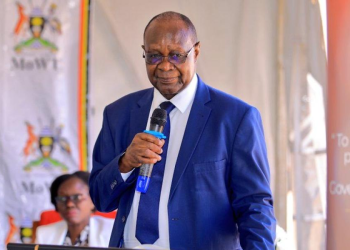
By KT Reporter
Janat Kataha Museveni, the Minister of Education and Sports, has announced that the ministry is making efforts to finalise the Technical and Vocational Education and Training (TVET) Qualifications Framework.
This initiative, she said, is aimed at supporting the ongoing reforms transforming the sector and ensuring smooth career progression for students.

“I recognise the urgent need to expedite the establishment of the TVET Qualifications Framework to facilitate seamless career progression pathways,” the speech partly read. “With the TVET Council and supporting legal structures already in place, the framework will soon be operational.”
The minister made these remarks during the release of the November/December 2024 technical and business assessment results at the National Skills Development Centre in Kyambogo. Her speech was read by John Chrysostom Muyingo.
Dr Kedrace Turyagyenda, Permanent Secretary at the ministry, also noted the critical role of the framework as a key document defining the competencies expected at each qualification level. It also bridges TVET qualifications with academic credentials, allowing for easier transitions between vocational and formal education pathways.
She added that the ministry aims to develop and implement the framework within a six-month to one-year transition period to fully benefit from the sweeping reforms in the sector.
The TVET Qualifications Framework (TVQF) has been pending for several years, with initial promises made before the reforms introduced following the 2019 TVET Policy. Alongside the TVQF, the ministry is also working on a broader National Qualifications Framework to guide the entire education sector.
At the event, Associate Professor Dorothy Okello, the Chairperson of the new Uganda Vocational and Technical Assessment Board, highlighted that the reforms offer a structured pathway to recognise both formal and informal skills. She added that this will allow individuals to obtain relevant qualifications and progress through the skill ladder.
“This means that the skills citizens acquire, whether formally or informally, will be acknowledged and valued in the job market. Many skilled workers, such as carpenters, plumbers, and builders, have lacked proper recognition of their expertise. The TVET system will help integrate them into the national skills register and provide a basis for prior learning assessments that bridge them to formal education,” she said.
Associate Professor Okello added that implementing the TVET Qualifications Framework will create a transparent and comprehensive structure for skills levels, making qualifications easier to understand and navigate.
In the same development, Minister Museveni also emphasised other key areas being addressed in the TVET reforms, including training of trainers, reviewing and developing curricula, and improving training facilities across all TVET programs. She called on all stakeholders to collaborate closely to realise the desired changes.
Meanwhile, the Uganda Vocational and Technical Assessment Board (UVTAB), formerly UBTEB, registered a total of 31,890 students for the December examinations, 12,111 females and 19,779 males. Of these, 503 (2%) registered for diploma courses while 31,387 registered for certificate programs spanning technical, vocational, business, humanities, and physical and biological sciences.
A turnout of 29,378 candidates (92%) participated in the exams. UVTAB Executive Secretary Onesmus Owesigye reported improved performance, with 91% (26,680) of candidates attaining full competence in their fields.
Owesigye also noted that no malpractice cases were recorded during the examinations. He added that the board intends to maintain strict measures against malpractice, particularly emphasising hands-on assessments to reduce cheating incidents, especially in lower qualification levels.
-URN. Give us feedback on this story through our email: kamwokyatimes@gmail.com