By KT Reporter
Uganda’s former President Idi Amin ruled with decree for eight years, his reign was characterized by terror, arbitrary arrests, and killings as many fled to exile away from the dirty deeds of his henchmen. As his reign haunts survivors, Paula Ataro, 80, reflects on her struggles for survival from Uganda to Kigwa after she fled the country from persecution.
Ataro is a surviving wife of Uganda’s de facto President, Lieutenant General Bazilo Olara Okello, who remained a key figure in the military and political power struggles of the country. On Sunday midmorning, April 11, 1971, Oboe’s regime fell to Amin. Bazilo left the capital to Sudan via his ancestral home in Madi-Opei, near the present-day Uganda-South Sudan border from Lamwo.

Bazilo abandoned his family behind as he set up a military camp at the eastern equatorial state ‘Owiny-Ki-Bul,’ a Luo word meaning ‘hear the sound of a drum,’ from where he summoned soldiers to fight Amin. Amin’s notorious State Research Bureau pursued him. “I didn’t know the whereabouts of my husband, but they came and found me home, arrested, and battered,” Ataro recalls in an interview.
Hosted for a few days to disclose the whereabouts of her husband, Ataro was aided to escape and sneaked to Gulu, where she survived on selling local brew and lived a low-profile life to evade surveillance. Within months, her presence in Gulu was no longer secret. “They started looking for me again. I got smuggled to Tanzania where my husband had regrouped his followers,” Ataro revealed.
Bazilo and his men were expelled from Sudan in 1972 when Khartoum’s government signed a peace agreement with Anyanya, the guerrilla fighters from Sudan. He moved through equatorial to Khartoum and boarded a rail to Port Sudan before connecting to Port Alexandria via cargo ship to Tanzania at Tanga in August 1972 and joined other fighting groups.
“Many of his soldiers died along the way before reaching Tanzania, some killed by malaria, others died from snake bites. They never had drugs and had no medics. Those who fell sick died,” Ataro stated. While in Tanzania, Bazilo embarked on military training, joining others who had assembled at Musoma, preparing to fight back and liberate Uganda from Amin’s dictatorial regime.
But poorly trained and ill-equipped, their attempt to capture Mbarara Town and Entebbe turned brutal as Amin’s soldiers responded and reportedly killed over 800 of them. Bazilo survived, backed off to Tanzania, and reconnected with Milton Obote, Tito Okello Lutwa, David Ojok Oyite, and President Museveni, who had established their base at Dar-es-Salaam.
The Tanzanian government then revived their hopes, giving them new land in Tabora to set up a refugee settlement, with Bazilo being a camp commandant. Ataro, however, recalls that, while in the settlement, to survive, they started farming, producing mainly Irish potatoes and tobacco, while men turned to charcoal burning.
“Women started getting food and some money from what we produce and sell. Men would burn charcoal in the morning and train in the evening. Life became good.” Ataro wistfully looks back. But the second attempt to overthrow Amin was successful. Bazilo’s 300 men boarded a boat to Entebbe, but their boat capsized in Victoria waters.
Until now, their accounts remained scanty, but Ataro revealed that only two Ugandans survived with four other Tanzanians, leaving about 90 of their wives and 81 children stranded in the training camp. “Those who died weren’t soldiers; they were refugees who had just arrived. They told my husband that the group was going for training but ended up in Lake Victoria dead,” she further explained.
When the boat capsized, an alternative plan to reach Kampala was quickly drawn up. Tito entered from Masaka, and Bazilo, from the Mutukula border, captured Masaka and proceeded to Kampala. President Museveni’s group reportedly attacked from Mbarara, which marked the overthrow of Amin’s regime, who later fled to Saudi Arabia, from where he lived and died.
“I still see the faces of the men who sank, and there isn’t any accountability or explanation as to how they died. Their bodies still sit in the belly of the water,” Bazilo’s elderly son, Samuel Olara, recalls.
After the overthrow of Amin, Bazilo was decorated with Lt. Col and appointed a commander of the fifth battalion and deployed in Makindye. Olara, however, noted that his father was overburdened by widows, orphans, and relatives of the missing soldiers who kept frequenting their home, seeking explanations.
“When my father asked Obote to respond to concerns, he (Obote) wanted to kill him but transferred him to Gulu instead,” Olara explained. Olara noted that Obote started plotting against his soldiers, adding that his father already knew of his fate and was on the red list as top army officers started disappearing and dying.
Bazilo, however, remained frustrated and exploited July 27, 1985, with a coup overthrowing Obote again from power before handing over the presidency to Gen. Tito Okello two days later. Bazilo was promoted to the rank of Brigadier General to Lt. General, appointed Chief of Defense Force, where he commanded the army until Museveni toppled their government on January 26, 1986.
He fled to Sudan, where he lived and died at Omdurman hospital in June 1990 from diabetes. His remains were later brought back home and accorded a state burial as a de facto president. For a second time, his wife Ataro became a refugee in the equatorial province, living with the Acholi community at Pajok, a present-day territory in South Sudan. She returned to Gulu and embarked on her struggles, selling on the streets and brewing local waragi to raise her children at the peak of the insurgency of the Lord’s Resistance Army in the north. Today, at her advanced age, Ataro commended Museveni for allowing the body of her husband to be reburied in his homeland and remained thankful for his dedication to serving the country.
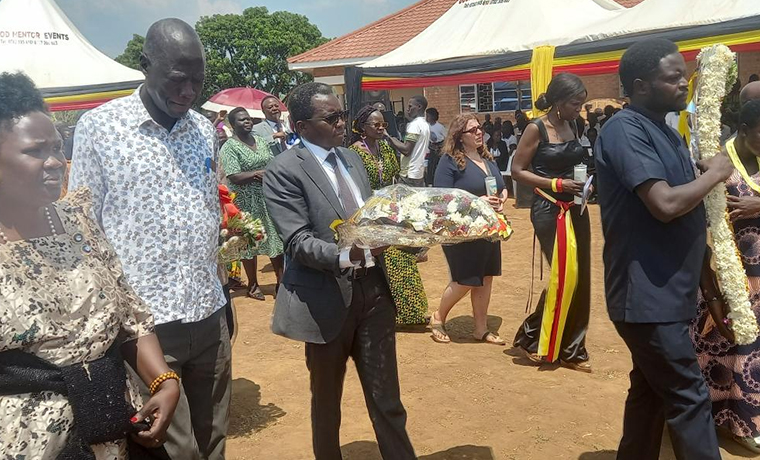
“He was a caring man who never cared for his families and put his life into defending the lives of many Ugandans. He is a happy man when he sees Uganda peaceful now,” Ataro remarked. Recently, while commemorating his life, Museveni, in his letter, acknowledged Bazilo as a man who devoted his life to serving his country with honesty and integrity.
He also acknowledged his significant contributions in developing Kigwa, a refugee camp in Tanzania, which later rose to a powerful urban center when Ugandans returned home. “With over 1,000 of his soldiers, most of them Acholi people, he started growing tobacco, which transformed Kigwa into a powerful center,” Museveni stated.
He, however, asked Ugandans to put aside their political differences, reconcile, and focus on wealth creation for sustained economic growth in the country. Meanwhile, the State Minister for Northern Uganda, Dr. Kenneth Omona, noted that, for ages, Uganda’s problems have only been two: the army and the politicians, which affected the country.
He argued that for Uganda to progress both politically and economically, peace and security must be guaranteed, and citizens must be involved in production, value chains, and marketing. “When I look at northern Uganda, I must thank God that he has allowed President Museveni to guide this country. Let’s protect this peace,” Dr. Omona stated-URN. Give us feedback on this story through our email: kamwokyatimes@gmail.com