By KT Reporter
With just 14 days to Uganda’s high-stakes general elections scheduled for January 15, 2026, the Electoral Commission (EC) has issued an urgent public warning over a rogue website falsely presenting itself as a voter assistance platform, cautioning that it could mislead voters and expose their personal data in an already tense political climate.
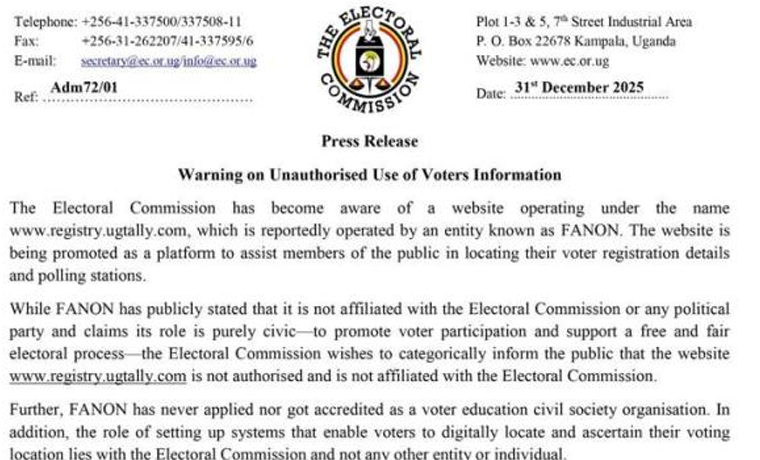
EC Chairperson Justice Simon Byabakama Mugenyi in a press statement dated December 31, 2025, disowned www.registry.ugally.com a website operated by an entity identifying itself as FANON, which has been widely promoted online as a tool to help voters locate their registration details and polling stations.

“The Electoral Commission would like to inform the general public that this website is not affiliated to the EC or to any political party,” the commission said, urging voters to avoid using it due to the risk of inaccurate information, voter confusion, and possible misuse of personal data.
Justice Byabakama warned that the operation of such platforms could amount to criminal conduct under Uganda’s electoral laws.
“Any unauthorized access, hosting, use, or distribution of voter registration data constitutes an offence punishable under the law,” Byabakama said.
He emphasized that under Articles 60 and 61 of the 1995 Constitution, as well as provisions of the Electoral Commission Act and the Data Protection and Privacy Act, 2019, the EC has the exclusive legal mandate to compile, maintain, update, and safeguard the National Voters Register, a responsibility central to the conduct of free and fair elections.
The warning comes amid heightened political tension ahead of the 2026 elections, in which President Yoweri Museveni, in power since 1986, is expected to seek another term against key challengers, including Robert Kyagulanyi, popularly known as Bobi Wine, leader of the opposition National Unity Platform (NUP).
Campaign activities officially began in August 2025, with presidential nominations concluded in September. However, the pre-election period has been marked by persistent allegations of voter register manipulation, intimidation of opposition actors, and excessive use of state security forces.
Kyagulanyi and other opposition figures have repeatedly accused the EC of bias and of facilitating electoral malpractice, claims the commission has consistently denied, insisting it remains impartial and committed to credible elections.
FANON, which has been described in online forums as a Gen Z-led civic tech initiative, has promoted itself as a non-partisan voter education platform offering multilingual voter locator software. The group claims its tools are designed to boost participation by helping voters access information such as voter numbers, demographics, and polling locations.
However, the EC said FANON lacks the legal authority to operate such a system.
“FANON has never applied for nor obtained accreditation as a voter education civil society organisation,” the commission stated, warning that unregulated digital access to voter data could facilitate misinformation, fraud, or abuse of personal information.
The EC further disclosed that it has engaged the Uganda Communications Commission (UCC) for guidance on how to address the website, signalling possible regulatory or enforcement action.
The controversy adds to a growing list of red flags flagged by election observers and civil society groups, who have warned of increasing militarisation and shrinking civic space ahead of the polls. Security agencies have in recent months cautioned opposition leaders against what they term “incendiary rhetoric,” while religious leaders have urged restraint by state actors.
Bishop James Bukomeko of Mityana Diocese has publicly called on government agencies to avoid abusing their authority during the electoral period, warning that repression risks undermining public trust in the democratic process.
Uganda’s elections have previously attracted international scrutiny, particularly the 2021 polls, which were marred by violence, arrests of opposition supporters, and a nationwide internet shutdown. Against this backdrop, election data integrity and digital security have become especially sensitive issues.
The EC advised voters to verify their registration details exclusively through its official platforms, including www.ec.or.ug/register, stressing that the warning was issued in the public interest.
“This notice is intended to protect citizens and prevent confusion, misuse of personal data, or other potential harm,” Byabakama said.
As Uganda approaches a pivotal electoral moment, with civil society organisations, faith leaders, and international partners emphasising civic education, peaceful participation, and the protection of vulnerable groups, the FANON dispute highlights the fragile balance between technological innovation and electoral integrity in a democracy under strain.
Voters have been urged to rely only on official, legally sanctioned channels to safeguard both their rights and the credibility of the 2026 elections.
-URN. Give us feedback on this story through our email: kamwokyatimes@gmail.com