By KT Reporter
The Entebbe Declaration coming after a weeklong Civil Society Forum condemns the continued growing unfairness of international treaties and bilateral trade and Investment agreements. The Forum happening at Entebbe, Uganda attracted civil society organisations, trade rights experts, and negotiators from more than 20 countries in Africa and Europe, under the theme “Aligning Investment Policy Frameworks to Climate and Sustainable Development Goals”.
The Entebbe Declaration, with the main objective of “Reclaiming Investment Frameworks for People and the Planet”, demands “transformative frameworks” of international investment agreements (IIAs) and policies. “These frameworks must advance human rights, gender, climate and environmental justice, sustainable economic and industrial development —not perpetuate systems of exploitation and inequality rooted in unbalanced economic models and profit maximization,” they say.

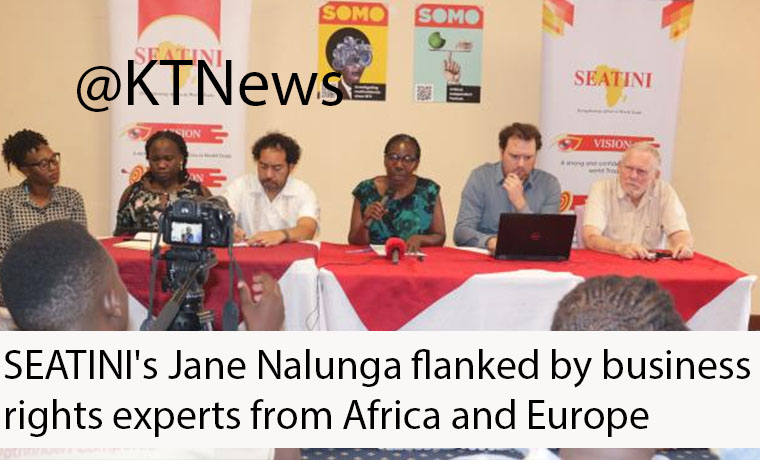
The forum was organised by SEATINI Uganda, Dutch Dutch-based NGO Both ENDS, a business sports NGO SOMO, Africa; and TNI (the Transnational Institute) based in the Netherlands were joined by a how of other Human Rights in Business NGOs.
The negotiators say that while Investments and in particular foreign Investments are vital for the development of host economies, the existing treaties, agreements, and frameworks play a negative role and are no longer in touch with today’s needs.
“However, the current system of IIAs is rooted in outdated economic paradigms that fail to serve the needs of people and the planet. These agreements disproportionately prioritize the profits of multinational corporations (MNCs) at the expense of Economic, Social, Cultural, and Environmental Rights,” they say, adding, “As a result, they have entrenched countries in a cycle of extra-activism, environmental degradation, and economic dependency undermining efforts to achieve sustainable and equitable development.”
Civil society demands international investment frameworks that are aligned with economic justice, social and environmental sustainability, and the needs of communities worldwide. They want a Framework for Sustainable Investment so that investment must not come at the cost of the environment, human dignity, or the rights of host communities.
Thus all future investment frameworks must integrate mandatory commitments to climate and environmental justice, ensure human and labor rights compliance in line with ILO conventions, gender justice, community-led decision-making, local value addition, and a just energy transition.
The Declaration also calls for the dismantling of Investor-State Dispute Settlement (ISDS) mechanisms which they call a flawed and a source of the injustice entrenched in current international investment agreements (IIAs).
They say the multinationals are given too much power including powers to sue states over public interest regulations. The experts also call for an end to “Exploitative Practices” in African and other Global South Economies to prevent resource exploitation that does not benefit the host countries.
According to them, the IMF, World Bank, the World Trade Organisation, and others have just watched as the resource hemorrhage continues, with little or no jobs, skills transfers and value addition realised.
The Declaration also calls for the involvement of the civil society and affected communities when developing these frameworks, to ensure transparency. Their commitment includes support to African and other developing countries to terminate harmful treaties and negotiate fairer agreements, as well as mobilising cross-border efforts.
In their Call to Action is the immediate moratorium on signing new international investment agreements and a demand for comprehensive audit to assess the impacts of existing harmful agreements. “We urge policymakers, governments, and international institutions to adopt a transformative agenda for investment governance – one that prioritises justice, sustainability, environmental protection, and the inherent dignity of all people.”
Showing how costly investment disputes are to African countries, Olivia Costa, Executive Director at Tanzania Trade and Investment Coalition said that Tanzania has more than 10 cases and is likely to pay heavily. She urged countries to stop signing such Investment agreements.
Fernando Hernandez Espino, from Both ENDS, said one of the elements that are keeping growth elusive in Africa are the international investment agreements which he says give multinationals super rights. Citing how Africa has been made to beg for climate funds, he said the world trade order is too skewed and that his organisation is ready to engage the media and the rest of the civil society in Europe to bring the plight of the African and other poor countries to light.
Esther Kisembo, Programme Coordinator, ActionAid accused the government of ignoring the right of the people to be involved in processing investors and instead, the state deals directly with the investors.
On her part, Jane Nalunga, the Executive Director of SEATINI Uganda, also blamed some Ministers for taking whatever they are offered without scrutiny, giving the example of oil companies that avoid some taxes because the agreements already protect them. She, however, says international agreements can be done away with, but should be transparent and balanced.
This was in response to concerns that this kind of declaration, if implemented might lead to retaliatory actions by the West and hurt Africa further. However, the experts said while there is a need to be firm and have a single voice, governments must be cautious when signing agreements to avoid exposing themselves to the negative effects.
Rob Davies, a South African-based economist and former finance minister of the country says all agreements should clearly state what a host country needs. He adds that unfortunately, the World Trade Organisation and the rest of the global trade regulatory mechanism is non-functional.
Last year, Kenya officially terminated its bilateral investment treaty (BIT) with the Netherlands, a move Both ENDS described as a significant win for economic justice and environmental protection, and “a reflection of a growing global trend of rethinking outdated treaties that often prioritize corporate interests over public welfare”.
Kenya joined South Africa, Tanzania, and Burkina Faso as the latest African country to terminate its BIT with the Netherlands. Bart-Jaap Verbeek, senior researcher at enterprise support NGO, SOMO, said Kenya and the other African countries should be a motivation for others to terminate all unfair BITs with different countries.
“Kenya’s decision to terminate its BIT with the Netherlands is a crucial step toward breaking free from outdated investment treaties that prioritize corporate profits over public goods. This move sets a powerful example for other countries seeking to reclaim their sovereignty and prioritize sustainable development,” Verbeek said. He called it time for nations worldwide to follow Kenya’s lead and put people, not profit, at the center of investment policies-URN. Give us feedback on this story through our email: kamwokyatimes@gmail.com