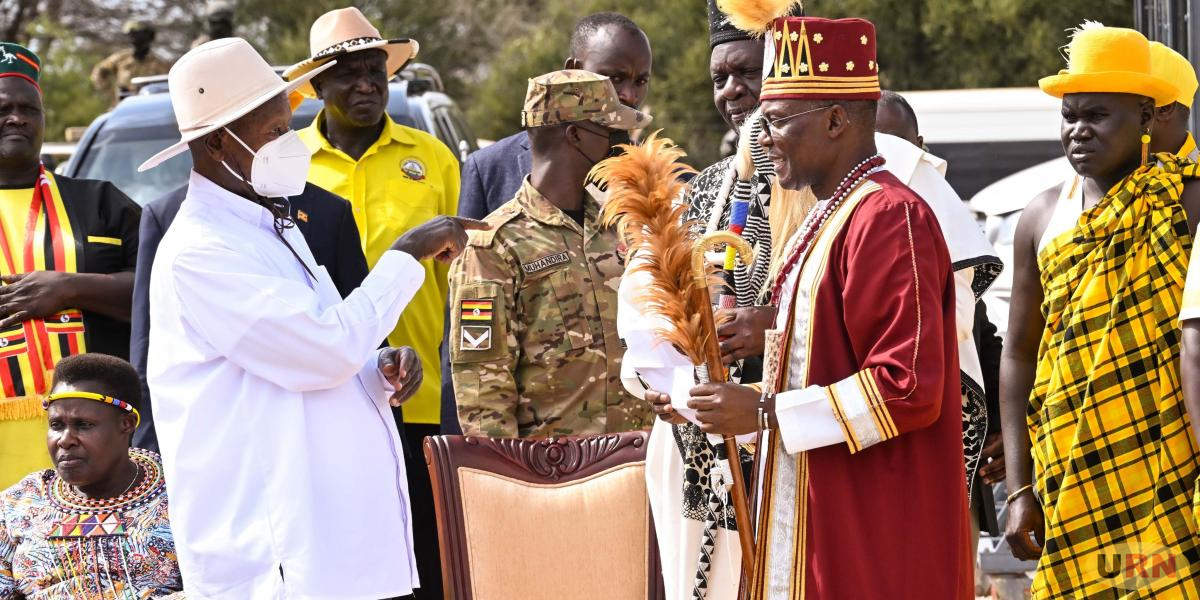
President Yoweri Kaguta Museveni has called for an audit of cultural practices in Karamoja, saying some traditions have contributed to the region’s persistent poverty and should be phased out. Museveni said some cultural practices remain incompatible with development and need to be reviewed to determine which ones should be preserved and which should be abandoned.
He was speaking on Wednesday during the official opening of the 11th Karamoja Cultural Festival at Naitakwae Grounds in Moroto District. The festival, which runs from September 6 to 12 under the theme, “Unity in Culture, Strength in Peace, Prosperity through Tourism and Natural Resources,” has attracted Ateker communities from Karamoja, Teso and Lango, as well as neighbouring Kenya, South Sudan and Ethiopia.
Museveni said culture remains important to society but warned against preserving practices that undermine economic development. He singled out nomadism, arguing that the traditional system of cattle rearing has kept Karamoja in extreme poverty for decades. According to Museveni, the way cattle are currently managed in the region is also stressful for the animals and affects the productivity of products such as milk.“There should be a serious audit on culture to know which one is good and promotes development and abandon those that are harmful,” Museveni said.

The President, however, praised what he described as the restrictiveness of some Karamojong cultural practices, saying they had helped protect the community against diseases such as HIV/AIDS. He noted that despite the prevalence of polygamous marriages in Karamoja, the region has historically recorded a lower HIV/AIDS prevalence rate than many other parts of the country.
Museveni also challenged religious leaders to work with traditional leaders to identify and eliminate cultural practices that are harmful to communities.
The Minister for Karamoja Affairs, John Baptist Lokii, said the government is working to rewrite the region’s history through peacebuilding and economic transformation. Lokii said Karamoja has for years been associated with insecurity, cattle theft and other negative practices that have hindered development.
He said more than 40,000 guns have so far been recovered from warriors as part of the government’s disarmament efforts, while former warriors have undergone mindset-change programmes. “This has helped to economically transform them. They have now agreed to drop cattle theft and instead focus on economic transformation,” Lokii said.
Lokii said communities have also opened up land for agriculture as they seek to increase food production, but unpredictable weather patterns continue to frustrate their efforts. He urged local leaders to promote the President’s four-acre model as one of the interventions for helping households move out of poverty.
NRM Secretary General Richard Todwong said culture can play an important role in transforming and empowering communities if it is linked to economic development. Todwong urged the people of Karamoja to embrace lasting peace and focus on tackling poverty at the household level.
He said the cultural festival provides an opportunity for communities to appreciate their diversity while using their cultural heritage to create wealth. Todwong challenged the Karimojong to move beyond celebrating their culture and turn it into an economic asset.
Karamoja has for decades faced high levels of poverty, driven by recurrent droughts and crop failure, food insecurity, and insecurity linked to cattle theft. Data from the Uganda Bureau of Statistics shows that the region’s monetary poverty rate stands at 74.2 percent, more than four times the national average.
The region is also currently facing food insecurity after prolonged dry conditions destroyed crops in gardens. The cultural festival has therefore provided a platform for government officials and community leaders to call for a shift from practices that constrain development towards using Karamoja’s culture, peace and natural resources to create wealth and improve livelihoods-URN. Give us feedback on this story through our email: kamwokyatimes@gmail.com