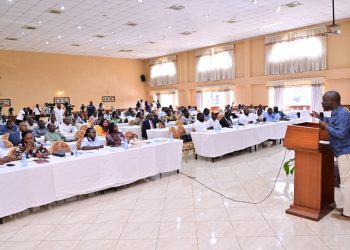
Members of Parliament have questioned the Ministry of Gender, Labour and Social Development over its low rate of resolving complaints involving Ugandans working abroad, raising concerns about the safety and viability of the country’s labour externalisation programme.
The MPs, sitting on the Committee on Central Public Accounts Committee (PAC) chaired by Patrick Oshabe Nsamba, raised the concerns while scrutinising the ministry’s performance with a team led by Permanent Secretary Aggrey David Kibenge.
The committee cited an Auditor General’s report showing that only 17 percent of 1,012 complaints received by the ministry had been resolved, with MPs particularly concerned about cases involving trafficking, deaths, repatriation, and refunds.

The MPs questioned why only one case had been resolved out of 101 reported trafficking cases. For run aways, no case was resolved out of the 290 reported and out of four illegal recruitment cases, none was resolved, among others.
Wakiso Woman MP, Betty Ethel Naluyima demanded manded an explanation for what she described as the ministry’s poor response to complaints involving migrant workers.
The committee also pointed to figures in the ministry’s submissions showing that out of 133 Ugandans who sought refunds of money paid to recruitment agencies, only 32 cases had been resolved. Similarly, only 36 out of about 204 requests for repatriation had been resolved, while 24 out of 46 reported cases involving deaths had been handled.
The MPs said the figures raise questions about whether the Ministry of Gender is adequately coordinating a programme that has become an important avenue for young Ugandans seeking employment abroad.
The MPs also questioned the effectiveness of the bank guarantees required from recruitment agencies and what happens when the guarantees expire before workers’ complaints are resolved.
Kibenge explained that licensed recruitment agencies are required to provide a bank guarantee of 100 million Shillings before they are granted a licence. The guarantee, he said, can be liquidated where a recruitment company is found culpable and fails to meet its obligations to a migrant worker.
He said the ministry monitors the guarantees and will not renew a company’s licence if its guarantee has expired and has not been renewed.
Kibenge said labour externalisation was introduced as a government response to the growing number of Ugandans travelling abroad for employment, with the aim of regulating recruitment and protecting migrant workers.
He said companies are required to recruit workers against verified job orders, sign agreements with workers and work with licensed employers and Ugandan missions in destination countries.
Workers are also supposed to undergo 14 days of pre-departure training and orientation to prepare them for the culture, technology and working environment in destination countries.
However, the Permanent Secretary acknowledged that some agencies continue to operate without licences, creating additional risks for Ugandans seeking jobs abroad. The committee was told that Uganda currently has about 257 licensed labour recruitment companies.
Assistant Commissioner for Employment Services Milton Turyasiima told MPs that the programme generates about four billion Shillings in non-tax revenue annually, although the money is paid into the Consolidated Fund rather than directly to the Ministry of Gender.
The ministry, he said, received about two billion Shillings to coordinate and manage labour externalisation during the financial year under review, but no additional release was made during the year-end review.
Kibenge attributed part of the ministry’s difficulties in following up complaints to inadequate funding, saying the ministry had not received some of the money it expected from the Ministry of Finance despite the labour externalisation programme generating revenue for government.
The MPs, however, questioned whether lack of funding should explain the low level of response to complaints involving Ugandans abroad.
The committee also raised concerns over unlicensed recruitment agencies and how job seekers can distinguish legitimate companies from fraudsters.
The MPs noted that the ministry had previously reported unlicensed agencies and questioned how young Ugandans, particularly those desperate for employment, can establish whether recruitment companies advertising jobs abroad are authorised.
They also demanded an explanation over reports that hundreds of companies had been deregistered, arguing that the continued emergence of unlicensed operators exposes Ugandans to trafficking, exploitation and financial loss.
The committee further questioned the coordination between the Ministry of Gender and the Ministry of Foreign Affairs, particularly in countries where large numbers of Ugandan migrant workers are employed.
MPs said Ugandan embassies in destination countries should have dedicated labour officers to respond to distressed migrant workers and coordinate complaints, just as other government agencies deploy specialised officials abroad.
They cited Saudi Arabia, one of the biggest destinations for Ugandan migrant workers, where MPs said the embassy has previously complained about inadequate resources to support distressed Ugandans.
The lawmakers said the absence of dedicated labour officers at some missions makes it difficult for the government to respond quickly to workers facing abuse, disputes with employers, deaths or other emergencies.
MPs also questioned the circumstances that cause migrant workers to abandon their employers despite signing two-year employment contracts.
Kibenge explained that some workers become “runaways” after being persuaded by friends or relatives to leave their contracted employers for what they believe are better opportunities elsewhere.
He said such cases can complicate efforts to hold recruitment companies responsible because the worker may have violated the terms of the employment agreement.
However, MPs insisted that the ministry should establish why workers abandon their employers in the first place, arguing that such cases could be indicators of poor working conditions, exploitation or discrepancies between the jobs advertised in Uganda and the conditions workers encounter abroad.
The committee also raised concern about allegations that migrant workers may have their personal documents taken from them by employers after arriving in destination countries.
MPs said such practices could expose Ugandans to exploitation and restrict their freedom of movement, urging the ministry to clarify the safeguards contained in labour agreements.
The lawmakers further demanded information on the number of bilateral labour agreements Uganda has signed with destination countries and the specific role played by the Ministry of Foreign Affairs in protecting migrant workers.
They argued that labour externalisation was once presented as a major government response to unemployment and could generate significant foreign exchange earnings if properly managed.
The committee said the government must therefore demonstrate its continued commitment to the programme by investing in monitoring, complaint resolution, labour officers abroad and stronger enforcement against unlicensed recruitment agencies.
The MPs said the Ministry of Gender cannot promote labour externalisation as an employment strategy while failing to provide adequate protection and timely responses to Ugandans who encounter problems after being recruited to work abroad.
The committee is expected to seek further accountability from the ministry on the complaints that remain unresolved, the revenue generated by labour externalisation, funding released to manage the programme, the status of bilateral labour agreements and measures being taken to protect Ugandan migrant workers-URN. Give us feedback on this story through our email: kamwokyatimes@gmail.com