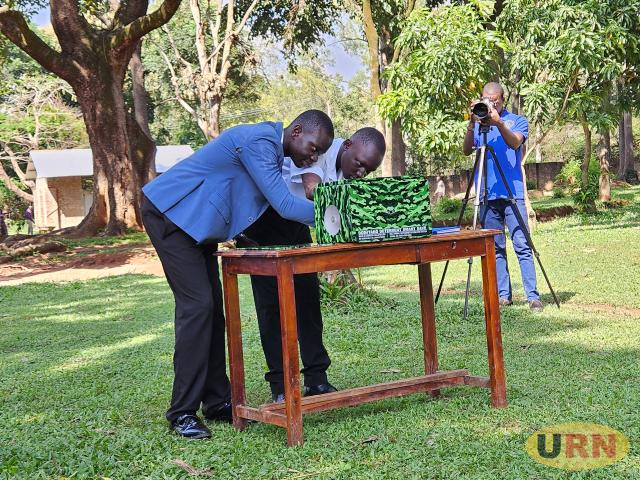
Students of Comboni College in Lira City have developed a prototype device designed to detect and deter wild animals before they reach farms and settlements, an innovation they hope could strengthen Uganda’s efforts to reduce persistent human-wildlife conflict around protected areas.
The innovation, dubbed Smart Park Deterrence, is among the projects competing in the 2026 Stanbic National Schools Championship, a nationwide innovation and entrepreneurship programme for secondary school students.
The learners say they were inspired by the increasing number of incidents in which elephants, buffaloes and other wild animals stray from protected areas into nearby communities, destroying crops, threatening livelihoods and, in some cases, being killed by residents in retaliation. “Our research showed that human-wildlife conflict is becoming a serious challenge,” said Cesar Okwir, one of the student innovators. “We wanted to develop a solution that protects both the communities and the animals.”

According to the students, the prototype uses motion sensors to detect animals approaching farms or settlements. Once activated, it emits loud alarm sounds and other deterrent noises intended to frighten the animals back toward protected areas.
At the same time, it sends alerts to wildlife rangers, indicating where the animals have crossed into community land, enabling a faster response. The students believe the technology could help reduce crop destruction while promoting peaceful coexistence between communities and wildlife.
Human-wildlife conflict remains one of Uganda’s most persistent conservation challenges, particularly in districts bordering Murchison Falls, Queen Elizabeth, Kidepo Valley, Kibale and Bwindi national parks, where expanding settlements increasingly overlap with wildlife habitats. Communities frequently report elephants raiding gardens, buffaloes destroying crops, hippos damaging farmland and predators such as lions and leopards attacking livestock.
In response, the Uganda Wildlife Authority (UWA) has over the years introduced a range of interventions, including electric fences, elephant trenches, beehive fences, buffer zones, community wildlife scouts (village vigilantes) and rapid response teams that drive animals back into protected areas.
Residents also rely on traditional deterrents such as beating drums, banging metallic objects, lighting fires and blowing whistles to scare animals away.
While these measures have reduced conflict in some areas, they have not eliminated the problem. Electric fences require substantial investment and maintenance, trenches are costly to maintain, while manual response teams often arrive after crops have already been destroyed.
The Comboni College students say their prototype is intended to complement, not replace, existing interventions by providing early detection and real-time alerts, allowing both communities and wildlife authorities to respond before damage occurs.
Beyond the innovation itself, the students say the programme has equipped them with practical entrepreneurial skills. Student Timothy Ereng Omani said participating in the competition has strengthened his understanding of business development and innovation.
His colleague, Cesar Okwir, said the programme has changed his perspective on innovation, showing him that ideas can be transformed into businesses that solve community problems while creating employment. The team hopes to refine the prototype, complete product registration and eventually begin commercial production if they secure financial support.
Comboni College patron Boniface Ajoli said the school’s innovation philosophy is to identify real community problems before designing practical solutions. He noted that the school won the 2023 Stanbic National Schools Championship after developing a solar concentrator capable of cooking food using sunlight, providing an alternative to charcoal and firewood at a time when Uganda was strengthening efforts to curb deforestation through restrictions on commercial charcoal production.
In 2025, the school also designed a fuel-free electric generator, inspired by rising fuel prices and unreliable electricity supply affecting businesses and households. Ajoli said the latest wildlife deterrent emerged after research conducted earlier this year highlighted increasing cases of wild animals leaving protected areas and destroying crops.
He appealed to government and development partners to increase funding for young innovators, saying many promising ideas fail to progress because schools cannot afford specialized components, testing and product development.
The Stanbic National Schools Championship, launched more than a decade ago, has evolved from a debate competition into a national innovation and entrepreneurship programme that equips learners with business, leadership, financial literacy and problem-solving skills.
Stanbic Bank Uganda’s Manager for Corporate Social Investment, Diana Ondoga, said the programme targets learners aged 13 to 18, encouraging them to become job creators rather than job seekers. She said participation has grown significantly over the years. Selected schools participate in a five-day boot camp covering entrepreneurship, innovation, leadership, financial literacy and mental health.
Each qualifying school also receives 500,000 shillings in seed funding to further develop its innovation before the final judging. Winning schools receive prizes that support both innovation and learning. After winning the championship in 2023, Comboni College received a solar power system worth about 20 million shillings, which now powers the school’s computer laboratory and library during electricity outages.
Ondoga said previous winners have also invested their prizes in water systems, school infrastructure and university scholarship opportunities through programme partners. She added that schools from the Lango sub-region have consistently excelled in the competition. Besides Comboni College’s 2023 victory, Mentor Secondary School has won previous editions, while the College of Technical and Vocational Education (COTVE) has performed strongly in other categories.
According to Ondoga, schools in Lira and the wider Lango region continue to account for a significant share of annual entries. She encouraged more schools to participate, saying the programme’s greatest impact lies in equipping young people with practical skills to solve real-world problems.
As Uganda continues searching for sustainable ways to reduce conflict between people and wildlife, technologies that improve early warning and rapid response are increasingly attracting attention. While the Comboni College prototype is still at the development stage, the students hope it can eventually complement existing conservation efforts and contribute to safer coexistence between farming communities and wildlife-URN. Give us feedback on this story through our email: kamwokyatimes@gmail.com