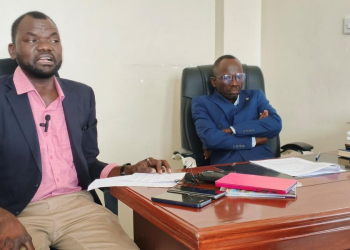
Dr. Kizza Besigye and Hajji Obeid Lutale on Wednesday suffered yet another setback in their bid to terminate treason proceedings against them. That followed the second ruling by the High Court Criminal Division Judge Emmanuel Baguma, which dismissed an application they had filed seeking to be freed because their constitutional rights had been violated.
Besigye and Lutale had asked the court to nullify the treason charges, arguing that their constitutional right to a fair trial had been irreparably violated. The ruling by Justice Emmanuel Baguma clears the way for the treason trial against Besigye, Lutale and UPDF Captain Denis Oola to begin on July 13, 2026.
In a ruling delivered electronically on Wednesday through the Electronic Court Case Management Information System (ECCMIS), Justice Baguma dismissed Criminal Miscellaneous Application No. 227 of 2026, describing it as incompetent and an abuse of court process intended to delay the hearing of the main criminal case.

They also sought orders for their unconditional release and requested that the government facilitate their treatment and rehabilitation at the African Centre for the Treatment and Rehabilitation of Torture Victims (ACTV), or another suitable medical facility.
In affidavits filed in support of the application, the two accused alleged that they were unlawfully abducted from Nairobi, Kenya, by Ugandan security operatives and forcibly returned to Uganda without following the required legal procedures.
They further claimed that they were detained incommunicado at Makindye Military Barracks, denied access to lawyers and medical personnel, held beyond the constitutional 48-hour limit before being presented to court, and detained in a military facility that is not gazetted for civilian detainees.
Besigye also accused the Chief of Defence Forces, General Muhoozi Kainerugaba, who was listed as the first respondent of making public statements threatening to have him hanged and portraying him as a criminal before trial, actions they argued undermined his constitutional right to a fair hearing. The respondents, General Muhoozi Kainerugaba, Colonel Peter Ahimbisibwe, Lieutenant Colonel Ephraim Byaruhanga and the Attorney General, denied all the allegations.
In affidavits filed through the Attorney General’s Chambers, the respondents maintained that Ugandan security agencies neither abducted nor arrested Besigye and Lutale in Nairobi. Through State Attorney Johnson Natuhwera, the government also denied that the named UPDF officers participated in any operation leading to the applicants’ arrest. The state further argued that Besigye and Lutale were informed of the reasons for their arrest, had access to legal representation and medical care, and that the treason charges were based on evidence and the law.
Baguma agreed with the respondents, holding that the applicants had failed to produce credible evidence proving the alleged violations of their constitutional rights. He found that the affidavit evidence presented amounted to speculation and conjecture rather than proof. “The affidavit evidence adduced by the applicants lacks credibility. The evidence was too shallow to persuade this court about the alleged violation of the applicants’ human rights and freedoms,” Justice Baguma ruled.
The judge noted that Besigye and Lutale had not complained about the alleged rights violations during earlier stages of the criminal proceedings, including their first appearance before the Nakawa Chief Magistrate’s Court in February 2025, committal proceedings in May 2025, plea-taking before the High Court in September 2025, or in several earlier applications they had filed.
Justice Baguma questioned why the allegations were only raised after the court directed the prosecution on June 11, 2026, to begin presenting its witnesses. “In my view, the applicants’ decision to file this application at this stage of the trial is an afterthought intended to delay the trial. This court will not condone such delays,” he said.
The judge observed that both the defence and prosecution had contributed to delays in the case, noting that the defence had filed numerous preliminary objections while the prosecution had delayed full disclosure of its evidence.
Justice Baguma also relied on the Constitutional Court’s June 2026 decision in Faruku Muhammad and Others v Attorney General and Others, which struck down provisions of the Human Rights (Enforcement) Act that had allowed criminal proceedings to be terminated solely on the basis of alleged human rights violations. He said the Constitutional Court had clarified that persons alleging violations of their rights have alternative legal remedies, including constitutional petitions, habeas corpus applications, judicial review and other public law remedies, rather than seeking to terminate criminal proceedings altogether.
The judge emphasized that criminal proceedings involve not only the constitutional rights of accused persons but also the interests of victims and the wider public, requiring courts to balance individual rights with the public interest in ensuring accountability through due process.
Consequently, Justice Baguma dismissed the application and ordered that the hearing of Criminal Session Case No. 335 of 2025 commence on July 13, 2026, at 11:00 a.m. without further delay. He directed the Deputy Registrar of the Criminal Division to issue production warrants for Besigye and Lutale to appear in court on the scheduled hearing date.
The judge also ordered Luzira Prison authorities to continue allowing the defence team reasonable access to Besigye and Lutale, including the use of approved facilities and electronic devices necessary for trial preparation. He further directed that both accused persons, who remain on remand, be supplied with hard copies of the ruling.
Besigye, Lutale and Captain Denis Oola are jointly charged with treason over allegations that they plotted to overthrow the government. According to the prosecution, the trio held meetings in Geneva, Athens, Nairobi and Kampala to solicit funding, acquire weapons and organise paramilitary operations.
Prosecutors allege that Besigye met a Kurdish intelligence operative identified as Andrew Wilson and received US$5,000 to facilitate the transport of 36 Ugandans to Kisumu, Kenya, for military training. The recruits were allegedly intercepted and deported before the training could begin.
The prosecution further alleges that Besigye sought to acquire surface-to-air missiles, ricin poison and counterfeit currency, and planned to use drone technology to assassinate President Yoweri Museveni. The state says it intends to rely on audio and video recordings, social media communications, immigration records and telephone data as evidence during the trial-URN. Give us feedback on this story through our email: kamwokyatimes@gmail.com