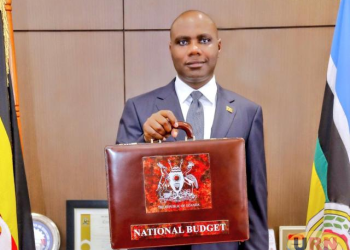
The government plans to spend 84 trillion shillings next financial year, with almost 45 trillion or 53 percent coming from domestic revenues, mainly taxes, and the rest from external sources, mainly loans. While reading the budget last week, Minister of Finance, Planning and Economic Development, Henry Musasizi said, Uganda’s debt had hit 53 percent of the country’s GDP, quite clear of the ceiling that the International Monetary Fund (IMF) agrees with the East African Community countries not to breach.
This was based on the fears that going beyond that would risk the countries going into debt distress, a situation where the country is unable to meet its obligations to lenders, let alone adequately fund the needs of the citizens. With Uganda’s debt being 34.86 billion dollars (approximately 130 trillion shillings), the minister downplayed concerns that it was going out of hand, insisting that Uganda was safe because the loans were being put into economic assets, and therefore creating value for the country.
The IMF categorises Uganda’s debt situation as moderate risk. It says ratios between 50, and 60 percent are a warning sign that a country is struggling to pay its loan obligations and could be stretched meeting the needs of the citizens, like social services and infrastructure. Other indicators used by the IMF to assess the sustainability of debt include the Debt Service-to-Revenue Ratio, where a level exceeding 20 to 30 percent signals severe danger. In highly distressed cases, this can surpass 40.

Uganda’s debt service-to-revenue ratio stands at 35.7 percent of domestic revenue for the recently concluded financial year, according to the Bank of Uganda and Ministry of Finance, and is projected to peak at 45.3 percent, before expected oil production revenues begin flowing to buffer the national treasury.
Some ministers, like Chris Baryomunsi (formerly ICT and National Guidance), have defended Uganda’s situation by comparing it with other countries like the USA, Japan, and Singapore, whose ratios go beyond 100 percent. In the region, Kenya and Rwanda have the highest ratios of 70 percent and 73 percent, while Tanzania has the lowest at 43 percent. However, Dr Fred Muhumuza, a university economics lecturer, calls this an erroneous way of determining debt sustainability, comparing a poor country with a developed country. He says, for example, that the highly indebted developed countries like Japan use debt to make money by lending to other high-value economies like the US.
The high debt servicing allocation for the year 2026/2027, amounting to 33.4 trillion, is attributed to the high debt levels, but mainly the increasingly expensive commercial debt. High debt levels lead to a squeeze where essential services are denied allocations as the government uses a big chunk to service the debt. It also means the private sector will have little available to borrow as the government resorts to domestic borrowing. In some extreme cases, governments have had to surrender assets to be managed by the lenders until the lender recovers the loan.
Avoiding debt accumulation
Uganda, like all countries around the globe, cannot avoid borrowing. In fact, Permanent Secretary and Secretary to the Treasury, Ramathan Ggoobi, has said that no country can develop without debt. However, his solution is to avoid commercial debt as much as possible. He says the government will increasingly go for long-term concessional external financing, ethical Islamic finance instruments like the sukuk bond, boost green financing, and move away from expensive, short-term commercial loans, as well as domestic bonds.
For example, Uganda is actively negotiating a new Extended Credit Facility (ECF) program with the IMF to anchor macroeconomic stability and secure highly subsidised credit. Under the Public Investment Financing Strategy (PIFS), Uganda is preparing to issue its first-ever Sovereign Sukuk, an Islamic finance structure that attracts alternative, ethical global investors who share project risks and asset yields rather than charging standard compounding interest.
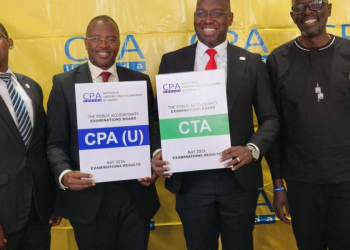
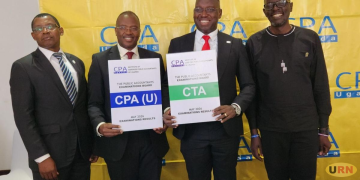
Timothy David Ediomu, the President of the Institute of Certified Public Accountants of Uganda, urged Ugandans to pay up taxes. He argues that the low tax revenue levels for Uganda are because most of the businesses operate informally, which leads to revenue leakages, as well as a lot of would-be government revenues remaining uncollected. This means that the citizens’ authority to put government accountable is limited.
The government is also focusing more on Public-Private Partnership models for financing large projects, including the tolling system for road projects, which enables projects to self-finance. Julius Mukunda, the Executive Director of the Civil Society Budget Advocacy Group (CSBAG), is worried about how debt servicing is impacting service delivery.
With debt servicing projected at about 40 percent of the budget, “this was larger than combined spending on human capital, infrastructure, and security, and a shift from development-led to debt-driven planning. This crowds out essential services and limits resources for ordinary Ugandans,” he says. He notes that expected revenue increases, mainly from new taxes, are increasingly going toward debt payments rather than development outcomes, contrary to hopes that oil revenues or higher collections would fund growth.
Replicating the Ethiopian model
Some commentators have expressed admiration for the model that the Ethiopian government used to fund the construction of the Grand Ethiopian Renaissance Dam. The 6,000-megawatt hydropower project is estimated to have cost 4.8 billion dollars, with a big share of the funds coming from the citizens.
The vast majority of the construction costs, about 91 percent, were covered by the Ethiopian government, state-owned enterprises, and the Commercial Bank of Ethiopia. Citizens living in Ethiopia and members of the Ethiopian diaspora raised over 23 billion birr (about 142 million dollars) in Public Bond Sales and Donations, while a significant portion of these domestic funds came from state-mandated deductions, where civil servants regularly contributed one month of their salary to the project over several years.
The cost of voluntary labour by citizens could not be accounted for but was given an estimated value of about 150 million dollars. All this was prompted by the international financing restrictions linked to the River Nile downstream political disputes (with Egypt and Sudan). Experts like Alex Kakande, an investment and financial analyst, have argued that there are things that the government of Uganda can learn from this model, though some aspects cannot be copied, especially cutting salaries and raising taxes.
The fear is that it could draw political implications, while accountability and transparency issues would fail the project. “It is possible, though not through our taxes, but mostly through domestic mobilization of resources like what they are doing with the Sukuk bond,” he says. Kakande is also opposed to using local savings schemes to directly finance large government projects.
For more than a year, the National Social Security Fund (NSSF) has been urging the government to allow it to contribute to the financing of the infrastructure projects, starting with the delayed Kampala-Jinja Expressway project, which is expected to cost up to 1.55 billion dollars (5.6 trillion shillings). NSSF Managing Director, Patric Ayota, says this would go a long way in saving the country many costs, including high interest rates and foreign exchange costs that come with externally acquired loans.
NSSF is the largest financial institution in Eastern Africa, worth 26 trillion shillings (7.4 billion dollars), and has invested in stocks across East Africa, real estate, and government bonds (said to be the largest holder of government bonds). The Uganda Retirement Benefits Authority regulates how much of its assets, schemes like NSSF, can invest in specific areas, with others, like infrastructure, needing approval by the regulator. Kakande says that unlike other institutions, any failure by an investment by NSSF will affect the savers, not the board or management, first.
“The fund operates under one of the most complex risk environments imaginable. It is a government‑leaning statutory entity, yet it must remain independent in practice because it manages the savings of over two million contributors. Any failure in its investment strategy does not affect executives or policymakers first. It directly affects workers’ pensions, retirement security,” he says.
He says any debate on investing the NSSF funds should consider that this is not government money, not ministerial money, and not management money, but the personal savings of millions of Ugandans. According to him, the public, who are the savers, would not be comfortable giving their money to the state. “If contributors truly had a free choice, many would likely hesitate to place their lifetime savings in an institution so closely linked to political decision‑making. This context explains why it is deeply unsettling to see the President openly calling on NSSF to fund infrastructure projects.”
But his argument is cantered around Uganda and Ugandans, and their attitude towards state trustworthiness. “Globally, it is true that many pension funds are increasing exposure to private assets such as private equity, infrastructure, and alternative investments. National pension funds in particular are gradually moving away from traditional safe assets like treasury bonds and listed equities,” he says. “Debt can support investment if used well, but poor utilization, lack of transparency in loan agreements, high costs, and weak oversight make it unsustainable,” says Mukunda-URN. Give us feedback on this story through our email: kamwokyatimes@gmail.com