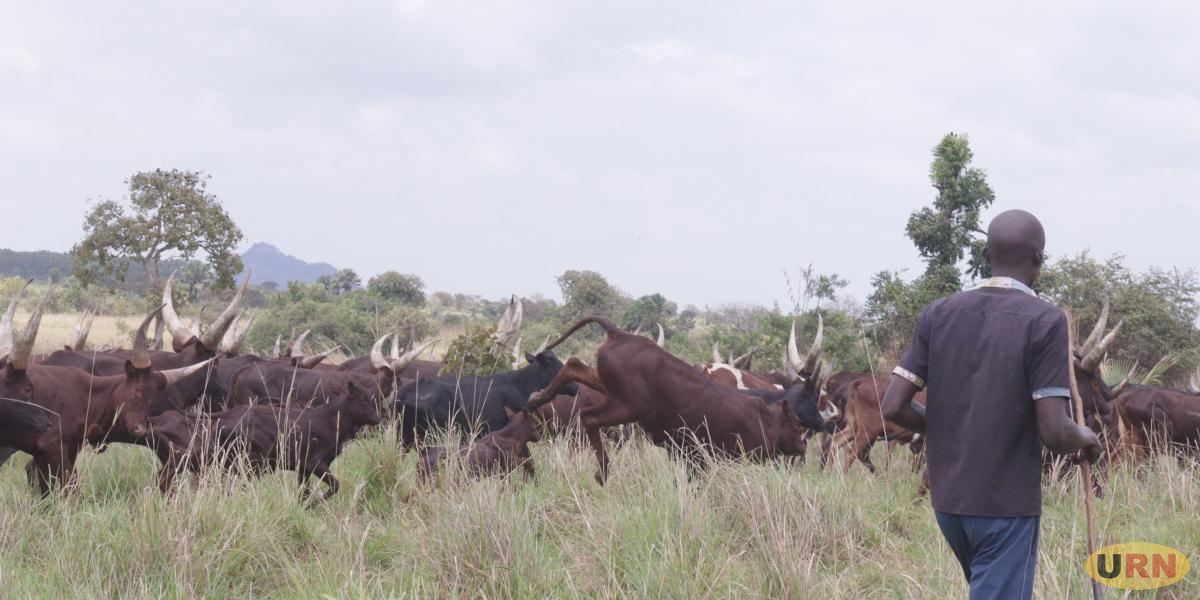
Leaders in Napak and Katakwi districts are raising concerns over an influx of Balalo herdsmen, whose cattle are destroying community gardens, sparking fears of conflict. The herdsmen are reported to have occupied parts of Poron and Apeitolim sub-counties in Napak, bordering Kapelebyong District, and Ongongoja Sub-county in Katakwi.
In Poron Sub-county, Napak, the Balalo have reportedly covered the entire Koblin Parish, an area dominated by crop farming. Authorities say brewing tensions are mounting as residents accuse local leaders of failing to evict the herdsmen despite Presidential Executive Orders No. 2 and 3 regulating their movement.
Julius Awas, a resident of Poron Sub-county, told this reporter by phone that the herdsmen began arriving in December last year. “They were moving in small groups with their cattle around the borders between Katakwi and Poron before they finally entered Napak,” Awas said. “The cattle are left to move freely, and they trample into people’s gardens, destroying crops.”

Awas said attempts to engage the herdsmen have failed. “We tried talking to them about their behaviors, but they are arrogant and do not listen to the community concerns,” he said. He added that the herdsmen have driven cattle into pasture the community had preserved for the dry season, worsening fears over scarce resources.
Napak District LC5 Chairperson John Paul Kodet said about 13 families of herdsmen have entered Napak with over 1,000 head of cattle. Kodet said investigations found the herdsmen bought 57 acres of land through a broker from Kapelebyong District identified as Bernard Okiring. “The Balalo have already settled in Poron, and I have fears that one time the community might riot against them, and it will lead to another wave of insecurity,” Kodet said.
Kodet noted that Presidential Executive Orders No. 2 and 3 outline procedures Balalo herdsmen must follow when moving to another district. “The process has not been followed. Now they forcefully invaded the area, and the cattle are destroying community gardens,” he said. He added that the herdsmen had been staying in Kapelebyong and Abim districts “while spying on better areas to settle in Napak before they entered.”
Kodet called for immediate action. “The community is not happy in the manner in which they are rearing their livestock,” he said.
Thomas Loukwae Otim, Napak District Councilor for Lokopo Sub-county, warned that the invasion could affect cattle prices in Karamoja if the herdsmen stay. “The community does not have enough pasture. They are often forced to cross over to Teso to look for water and pasture. Allowing the Balalo to stay means there will be possible conflicts in resource sharing amidst scarcity,” Otim said.
Otim said local leaders have started sensitizing the community against selling land to the Balalo. “Whoever is doing it should be considered illegal,” he said. He revealed that authorities are also following up on claims that an Indian man lured a community to sell him vast land in Apeitolim Sub-county before the Balalo moved in.
In Katakwi District, Deputy Resident District Commissioner Savior Okwii confirmed that Balalo herdsmen have occupied Ongongoja Sub-county. “We are aware of the presidential executive order on Balalo, but no implementation has been done yet,” Okwii said.
Okwii said several meetings have been held following the community outcry over crop destruction. “The tension in Ongongoja Sub-county is scaring the leaders as the community threatens to push the Balalo cattle to the district headquarters,” he said. He urged authorities to implement the executive order so the Balalo “move away to allow the community to cultivate.” Okwii added that profiling of the herdsmen is complete, and they are waiting for an order to be executed.
Presidential Executive Orders No. 2 and 3, issued in 2023, require Balalo herdsmen to obtain clearance from both the district of origin and the host district, fence off grazing land, and ensure access to water before moving cattle. The orders followed similar tensions in Northern and Eastern Uganda-URN. Give us feedback on this story through our email: kamwokyatimes@gmail.com