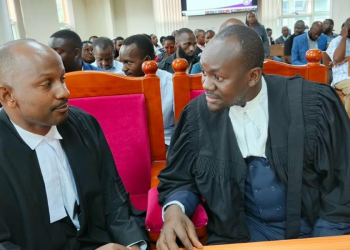
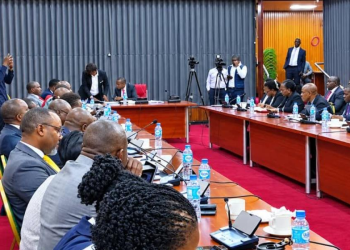
The International Crimes Division of the High Court in Kampala has ordered retired Lieutenant Colonel Stephen Aine Owomugisha to defend himself against charges of aggravated child trafficking and aggravated defilement after finding that the prosecution had established a prima facie case against him.
Lady Justice Susan Okalany made the ruling after the prosecution, led by Chief State Attorney Joseph Kyomuhendo, closed its case against the retired army officer. Owomugisha is facing two counts arising from allegations involving a girl who was 11 years old at the time of the alleged offences.
The prosecution alleges that between 2020 and 2022 in Teso Modern Ward, Lira City, Owomugisha received, maintained and harboured the child for purposes of sexual exploitation and engaged in sexual acts with her during the same period. According to the court record, the prosecution called 13 witnesses and tendered 10 exhibits in support of the charges.

The court heard that the girl, identified as Witness A, was taken into Owomugisha’s care after she reported being beaten by her mother at Lira Police Station. Witness A testified that a police officer subsequently handed her over to Owomugisha, who took her to his home in Lira, where she lived with him and other children until 2022.
The court heard that Owomugisha provided the girl with shelter, food, school fees and other necessities during her stay at his home. Another minor who lived in the household and a neighbour also testified that Witness A lived at Owomugisha’s home. Justice Okalany said the evidence was sufficient, at the stage of determining whether there was a case to answer, to establish that Owomugisha had received, maintained and harboured the child.
On the allegations of sexual exploitation, Witness A told the court that Owomugisha began having sexual intercourse with her in 2019 and threatened to beat her if she disclosed the alleged abuse. She later disclosed the allegations to another child in the household and subsequently to a women’s rights organisation, prompting a police investigation and medical examination.
A medical certificate admitted in evidence indicated that the girl’s hymen had been “ruptured sometime back”, which the judge found corroborated her account of sexual activity. The court also considered evidence on the girl’s age. Her date of birth was given as October 25, 2010, while a Police Form 3A and medical assessment were also relied upon by the prosecution to establish that she was below 18 during the material period.
Justice Okalany held that, at the prima facie stage, the prosecution had presented sufficient evidence to establish that Witness A was a child. The judge further noted that under the Prevention of Trafficking in Persons Act, where the alleged victim is a child, the prosecution is not required to prove the specific means of trafficking ordinarily associated with the offence.
The court also considered evidence concerning Owomugisha’s alleged involvement in moving the girl away from investigators. According to the ruling, Witness A testified that Owomugisha instructed her to travel with his friend, Ambrose Kibuuka, to his family home in Amolatar District, where police later traced and recovered her. Justice Okalany said the evidence, considered at the required threshold, established a connection between Owomugisha and the alleged offences.
On the aggravated defilement charge, the judge similarly found that the prosecution evidence was sufficient at this stage to establish the girl’s age, the alleged sexual acts and Owomugisha’s alleged participation. The judge therefore ruled that the prosecution had established a prima facie case on both counts and ordered Owomugisha to enter his defence.
Under Section 74 of the Trial on Indictments Act, the court is required at the close of the prosecution case to determine whether sufficient evidence exists to require an accused person to answer the charges. Justice Okalany cited the principle in Bhatt v R, under which a prima facie case exists where the prosecution evidence is such that a properly directed tribunal could convict if the accused offered no explanation or evidence.
Owomugisha, who has previously denied the charges, is expected to begin his defence on October 15, 2026. He has previously described the allegations as fabricated and linked them to a land dispute he says he won against the late Supreme Court Judge Rubby Opio Aweri. The ruling does not amount to a finding of guilt, and Owomugisha remains presumed innocent unless and until convicted by the court-URN. Give us feedback on this story through our email: kamwokyatimes@gmail.com