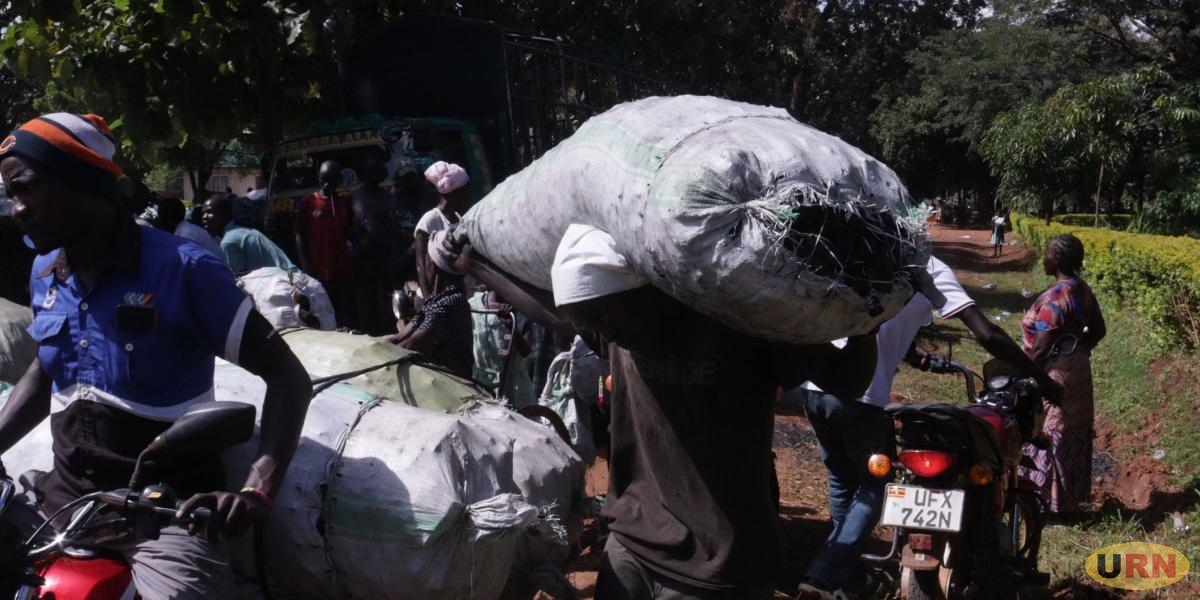
The Uganda People’s Defence Force (UPDF) has ordered an immediate ban on the cross-border transportation of charcoal by Ugandan traders from South Sudan through all border points in the West Nile.
The directive, aimed at curbing environmental degradation caused by commercial charcoal production, was issued by the Fourth Infantry Division Commander, Maj Gen Felix Busizoori, during a meeting with more than 20 charcoal traders at the Divisional Headquarters in Gulu on Tuesday.
Gen Busizoori said the transportation and commercial trade in charcoal from South Sudan through Northern Uganda was illegal and contravened Executive Order No. 3 issued by President Yoweri Museveni in May 2023.

President Museveni issued the executive order banning commercial charcoal production and trade in Northern Uganda following concerns from leaders and residents over widespread environmental destruction.
According to Gen Busizoori, after the order came into force, some Ugandan charcoal dealers allegedly began disguising charcoal produced in Uganda as imports from South Sudan to evade enforcement. The majority were allegedly operating from Fitina Mbaya and Gobiri villages in Kochi Sub-county in Yumbe district, all areas under contention between Uganda and South Sudan.
He said investigations had established that some of the charcoal being transported through West Nile was being produced locally in districts bordering South Sudan, including Yumbe, Koboko and Moyo, before being falsely declared as originating from South Sudan’s Central Equatoria region.
Gen Busizoori warned that, effective August 11, 2026, any charcoal trader found transporting charcoal from West Nile or Northern Uganda would have their truck impounded, while the charcoal would be distributed to local communities. He added that the suspects would also face prosecution.
He advised the traders engaged in the charcoal business to find alternative sources of livelihood, saying they had already been given a four-month grace period which elapsed to comply with the ban.
The directive comes barely a month after a July 24, 2026, bilateral engagement between Ugandan officials and their counterparts from Central Equatoria State in South Sudan, where the two sides reportedly agreed to immediately halt illegal cross-border charcoal trade.
However, some of the traders challenged the ban, arguing that their operations were legitimate because they source charcoal from South Sudan and pay taxes to both South Sudanese authorities and the Uganda Revenue Authority (URA).
Dorcus Okello, chairperson of Ugandan charcoal dealers operating from Fitina Mbaya, said their business was being unfairly grouped together with illegal charcoal producers operating inside Uganda.
She said the traders were aware of Uganda’s ban on commercial charcoal production and alleged that they pay revenue to South Sudanese authorities and URA when the charcoal enters Uganda through Yumbe District.
Eriya Ssenyonyi, the National Chairperson of the Uganda Charcoal Traders, also criticised enforcement of the ban, alleging that some security personnel and officials from the National Forestry Authority (NFA) have been taking bribes from charcoal traders.
Ssenyonyi claimed that despite the government ban, some traders have continued operating after allegedly paying money to officials and security personnel to facilitate the movement of charcoal. He called for investigations into the alleged corruption, arguing that enforcement agencies should not selectively target charcoal traders while some officials allegedly facilitate the illegal trade.
Simon Tumwesigye, the Uganda Revenue Authority (URA) Manager of Customs in Northern Uganda, clarified that Uganda’s customs laws allow the importation of charcoal but prohibit its exportation.
Tumwesigye said charcoal is classified under the East African Community Customs framework and can legally be imported into Uganda under the applicable customs tariff but cannot be exported from Uganda.
“We do not allow export of charcoal. The import is open. It is allowed to enter but it is not allowed to be exported,” Tumwesigye said. He called for joint enforcement by the UPDF, URA, Police and the Ministry of Water and Environment, saying failure by any agency to implement agreed decisions undermines enforcement efforts.
During the meeting, security personnel exchanged counteraccusations over the entry of illegal charcoal through West Nile border districts, including the alleged use of documents purportedly signed by South Sudanese government officials.
Capt. David Drichi, the Regional Intelligence Officer (RISO) in charge of the Acholi Sub-region, faulted security personnel in Koboko and Yumbe districts, whom he accused of causing confusion over the entry of illegal charcoal into Uganda.
He particularly pointed to alleged negligence at Ombachi Parish in Ramogi Sub-county, Yumbe District, where several trucks loaded with charcoal reportedly park and are cleared using documents obtained from Oraba border town in Koboko district. Capt. Drichi dismissed claims that South Sudanese authorities were permitting the issuance of export permits for charcoal, alleging instead that individuals within the security system were benefiting from the illegal trade.
Following the ban, Gen Busizoori directed Fred Ahimbisibwe, the Regional Police Commander in charge of the Aswa West River Region, to investigate the traders and record their statements over what he described as defiance of the presidential directive banning charcoal trade in Northern Uganda. The traders were still being held at the Fourth Infantry Division barracks by the time of filing this report-URN. Give us feedback on this story through our email: kamwokyatimes@gmail.com