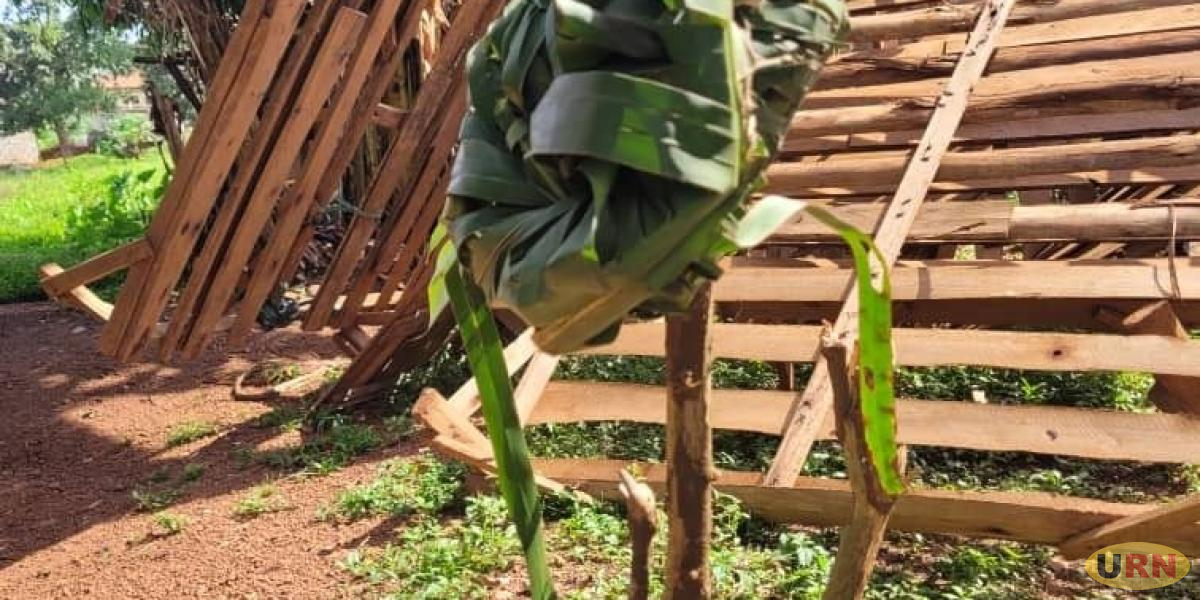
On a quiet Saturday morning in Bukomansimbi, finding a burial venue was as simple as following the banana stems planted at road junctions. Mourners did not need Google Maps or phone calls to find their way; the familiar green markers led them to the bereaved family’s home.
For Ssalongo Anthony Muguluma, this is part of a long-standing tradition in which Ugandans communicate without saying a word, using banana stems to direct visitors, announce ceremonies and even advertise goods.
“Made from banana stems, sticks, bricks, bottles and leaves, the signs rely on a shared cultural knowledge rather than printed instructions. A banana stem might guide mourners…Even a leaf left at someone’s doorstep could tell the homeowner that a visitor had called in their absence,” he said.

Muguluma says the practice persists in rural and urban areas, guiding people to places and customers to businesses. Yet as digital technology changes how people communicate, some younger people are becoming less familiar with the meanings behind these everyday signs.
Vincent Luwaga, the local chief in charge of culture, tradition and tourism at Busega-Mituba III in Kyadondo County, says the system was dependable because people knew how to interpret the signs.
“One could not get lost,” he says.
In Buganda, even the choice of banana stem mattered. According to Luwaga, an apple banana stem, locally known as sukali ndiizi, was traditionally planted at junctions to direct mourners to a burial. For a wedding or another celebration, people used a relatively mature East African highland banana stem, known as nakitembe, sometimes decorated with flowers.
The stem did more than point towards a homestead. It told travellers what kind of occasion they were approaching. A visitor who knew the custom could read the message before reaching the venue; those who did not had to depend on someone who did.
When a banana stem speaks
The banana plant holds an important place in Buganda’s cultural and social life. Beyond food and household materials, different varieties carry ceremonial meanings. Nakitembe, for example, features in some marriage preparations and cultural rites.
The use of banana stems along roads also has historical roots. Accounts of Buganda’s past describe stems arranged along routes to welcome important visitors. Today, a banana stem beside a village road is still a familiar landmark for people travelling to a traditional introduction ceremony, or a burial.
Yet the system depends on people knowing the difference between signs. Luwaga warns that confusion over the type or maturity of a stem threatens its reliability, particularly when those placing the markers lack a firm grasp of the cultural codes.
“A wrong choice risks sending mourners towards a celebration or directing wedding guests towards a burial. Such a mistake might appear amusing to an outsider, but for a family preparing to receive visitors during an important occasion, the confusion could be costly,” he added. Unlike a conventional road sign, whose meaning is printed or illustrated, the banana stem must be learnt before it can be read.
A stick that sells local brew
Twaha Kalungi, one of the Buganda Kingdom leaders at Nabweru Sub-county, points to another example. A stick topped with an enkatta, the traditional head-pad used to cushion the head when carrying heavy loads, signals that locally brewed alcohol is on sale.
Kalungi, a Muslim who does not drink alcohol, added that the head pad serves as a simple but effective advertisement for local brew sellers. Once displayed, the sign communicates the nature of the business without requiring the seller to list the products, indicate prices or identify themselves by name.
“It announces the commodity and attracts those who know what it means. If the exact location is unclear, the traveller simply asks someone in the neighbourhood,” Kalungi said. He added that the head pad remains a common sign among local brew sellers in both rural and urban areas, demonstrating how traditional symbols continue to serve commercial purposes despite changes in the way people advertise their products.
Bricks that tell a business story
The same practical thinking appears in the building materials trade. Derick Lwanga explains that brickmakers sometimes arrange bricks in the shape of a plus sign beside the road to show that bricks, ventilators, or other moulded construction materials are for sale. An ordinary roadside pile becomes a commercial message.
The absence of the marker also carries meaning. If the sign is missing, the makers might not be selling at the time, sparing a buyer a wasted journey.
When an empty bottle becomes a petrol station
In some areas, even an empty bottle serves a commercial purpose. Dan Mugula, a resident of Butambala, explains that a large bottle placed beside the road signals the availability of petrol for sale nearby.
In trading centres and villages without modern filling stations, such bottles act as informal advertisements for fuel sold in small quantities to motorists and motorcycle riders.
Mugula says the sign is particularly useful in places where fuel sellers operate from homes, small roadside shops or temporary points rather than established service stations. Instead of erecting a signboard or displaying a price list, the seller places a bottle in a visible spot to alert potential customers. Those familiar with the practice recognise the signal and know where to begin their search.
Banana leaves and changing trades
The roadside vocabulary has also evolved with new products and trades. Alex Mukooza says banana leaves, sometimes hung together like a curtain, are used in some areas to signal the sale of khat, a stimulant leaf consumed by some people.
“Those who chew khat easily recognise the meaning of these leaves. If you do not know what the sign means, you will simply pass by, perhaps wondering why someone has hung banana leaves by the roadside,” Mukooza says.
While some signs are rooted in traditional culture, he said, others have emerged in response to changing social and commercial activity. Such signs work as coded communication, understood by a particular group but easily overlooked by outsiders. He said some traders in illegal businesses also use them to advertise openly without attracting the attention of authorities.
“Illegal businesses and trades thrive on such signs. People advertise in broad daylight, yet the authorities might not even know what the signs mean. Those selling drugs have their own signs, understood within their circles,” Mukooza said.
Reading the road
Whether it marks a funeral, a wedding, a brew or a pile of bricks, each sign works the same way: it says nothing to those who do not know the code, and everything to those who do. That is both its charm and its weakness.
The knowledge lives in the specific communities passed on by watching and asking rather than by any written manual. As phones and maps take over the work of finding the way, fewer people may learn to read these markers, and a banana stem at a junction will become just a banana stem-URN. Give us feedback on this story through our email: kamwokyatimes@gmail.com