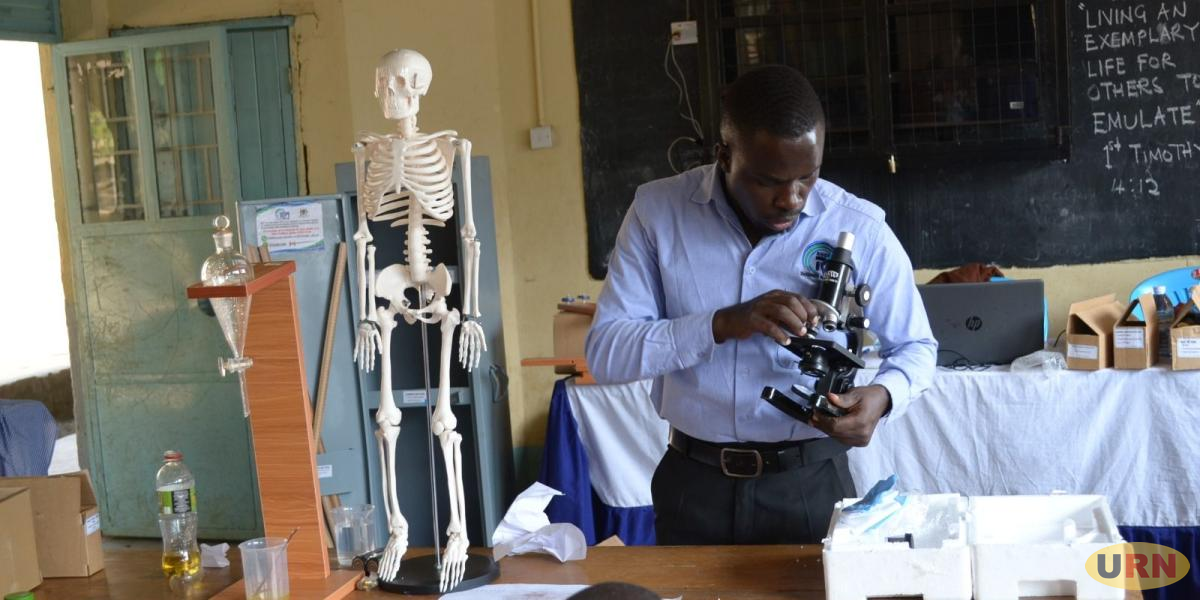
The number of students taking up science subjects in Uganda has been rising steadily for years, but this year that growth has surged well beyond the usual trend, according to fresh data from the Uganda National Examinations Board (UNEB).
Figures from the board show a sharp jump in candidature for the traditional science subjects at UACE between 2025 and 2026. Physics candidates rose from 21,302 to 35,029, an increase of 64.4 percent. Chemistry candidates climbed from 37,134 to 64,501, up 73.7 percent.Biology recorded the steepest rise of all, from 35,660 to 64,288 candidates, a jump of 80.3 percent.
The surge builds on an upward trend that UNEB data shows stretching back to around 2019, though education stakeholders say this year’s figures stand out for how sharply they have accelerated. It is worth noting, too, that the increase comes at a time when the overall number of candidates sitting UACE each year has also been growing, meaning part of the jump reflects a larger candidate pool overall, not science alone pulling students away from other subjects.

Teachers and Parents Weigh In
Aron Mugaiga, secretary general of the Uganda Professional Science Teachers’ Union (UPSTU), said a combination of factors is behind the growing appetite for science subjects at secondary level.
A science teacher himself, teaching physics and ICT, he pointed to recent enhancements in science teachers’ salaries and sustained government efforts to promote science education as key drivers.
He explained that improved pay has changed how much time teachers are able to give their students. Science teachers, he said, are no longer forced to moonlight the way they used to when pay was low, leaving them more time and energy to devote to learners in the classroom.
He also credited the new curriculum, arguing that it has made science teaching considerably more practical than in the past, when lessons leaned heavily on theory. As a result, he said, students find science subjects easier to grasp, contrary to the old perception that they are inherently difficult.
Mugaiga, added, however, that more still needs to be done to improve the supply of laboratory equipment and apparatus in schools, and urged government to double its efforts in that area to give students access to better-equipped labs.
That shift in classroom experience is echoed by parents. Annet Nakubulwa, comparing her child’s experience in school today with how things were done in the past, said the teaching of science has visibly improved.
“In our days, it was the teachers who could even discourage you, saying Maths is difficult, you cannot handle it, Biology is hard,” she said. “Schools also used to lack teachers, but I think this is changing, and that is why our learners are taking up these subjects,” she said.
Martha Nakanyike, a student taking science subjects, says she finds science easier to pass than the arts and believes the career prospects are better in science than in arts or social sciences.
A Longer Trend, Backed by the Numbers
The current surge sits within a broader pattern that has been building for years. An analysis of UNEB data from the past six UACE examination cycles shows a steady upward trend in science candidature, with mathematics recording the largest increase over that period.
The number of candidates taking Mathematics nearly doubled, from 31,729 in 2019 to 58,495 in 2024. Physics rose from 11,270 to 23,679 candidates over the same period, chemistry increased from 16,772 to 29,283, and biology grew from 14,496 to 24,853.
The shift has been pronounced enough that some traditional schools have felt its effects directly. Recent media reports, including coverage by New Vision, note that St. Henry’s College Kitovu did not register a single Arts student in some of its recent Senior Five intakes. Even so, despite the positive enrolment trend, science candidates still make up less than half of total UACE candidature nationally.
In a past interview, UNEB Executive Director Dan Odongo said that poor performance in science subjects at O-level continues to weigh on enrolment at A-level. He noted that as efforts to improve science performance at the lower level take hold, more students are likely to take up sciences going forward, subjects he says have long been neglected in favour of arts and humanities.
That concern is borne out in the O-level data, where science subjects consistently post higher failure rates than humanities, often ranging between 40 and 60 percent, a pattern that significantly limits the pool of students progressing to study sciences at A-level.
Gender gaps in science enrolment persist as well, though they are narrowing. Female candidates in Mathematics rose from 8,942 in 2019 to 19,863 in 2024. In Physics, females increased from 2,058 to 5,836 over the same period, in Chemistry from 5,150 to 10,533, and in Biology from 4,880 to 9,619.
Odongo noted that a particularly encouraging development is the improving performance of the smaller number of female candidates who do choose science subjects, with many outperforming their male counterparts in subjects such as Physics.
The push towards science education has deep roots in national policy.Since 2005, science subjects have been compulsory at O-level, part of a deliberate government strategy to build a critical mass of scientists and engineers to support national development.
The said strategy has since been backed by sustained investment, including funding for laboratory construction and equipment, scholarships for science and technology students, and support for science teachers. Most recently, government raised science teachers’ pay by 300 percent, a move several stakeholders, including Mugaiga, credit as a turning point in classroom quality-URN. Give us feedback on this story through our email: kamwokyatimes@gmail.com