The Greater Horn of Africa is facing contrasting climate risks in the coming months, with a strengthening El Niño expected to bring above-normal rainfall and heightened flood risks to the eastern parts of the region. The forecast warns of worsening dry conditions and food insecurity in some western areas.
The IGAD Climate Prediction and Applications Centre (ICPAC), together with National Meteorological and Hydrological Services, has forecast wetter-than-normal conditions across much of the region during the October-December 2026 rainfall season.

The ongoing El Niño episode is expected to strengthen over the coming months and persist through early 2027, with a 95 percent probability of being classified as strong or very strong by the end of 2026.
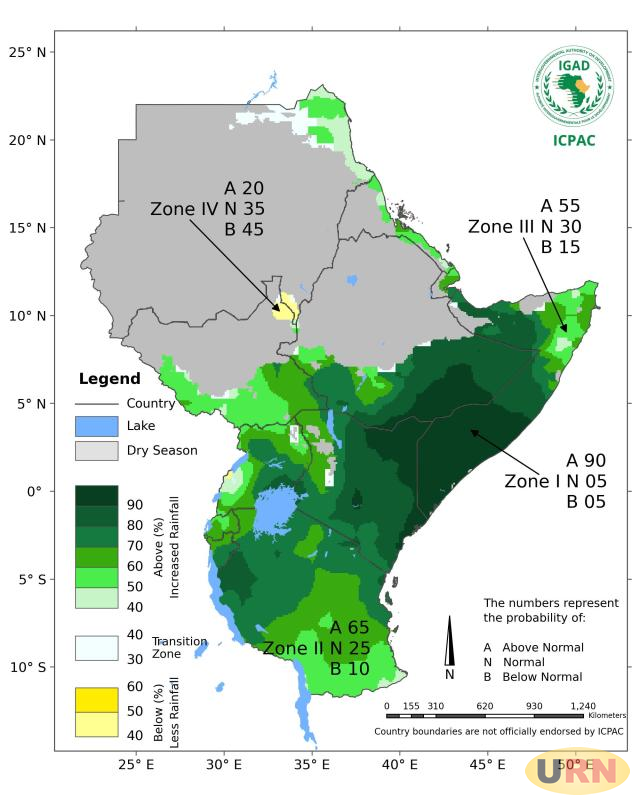
ICPAC says the impacts will vary significantly depending on location, making early preparedness critical for both drought- and flood-prone communities. The regional downscaled rainfall forecast gives a 90 percent likelihood of enhanced rainfall over southern Ethiopia, central and southern Somalia and northeastern Kenya.
There is also a more than 90 percent probability of seasonal rainfall exceeding 400 millimetres in parts of central and southern Somalia, central Kenya, the Lake Victoria Basin, Burundi, western Rwanda and western Tanzania.
Central Tanzania, parts of southeastern Ethiopia and some areas of southern South Sudan have up to a 30 percent probability of receiving more than 400 millimetres during the season.
Compared with historical climatology, the likelihood of receiving 400 millimetres of rainfall is higher across most of the region, with probabilities of up to 50 percent in parts of Somalia, eastern Kenya, the Lake Victoria region and western Tanzania.
The October-December season is particularly important for the equatorial and southern parts of the Greater Horn. It contributes up to 70 percent of annual rainfall in some parts of Ethiopia, Kenya and Somalia and up to 40 percent in parts of Rwanda, Burundi, Tanzania and Uganda.
ICPAC attributes the expected enhanced rainfall partly to the strengthening El Niño and a likely positive Indian Ocean Dipole (IOD), climate patterns that are normally associated with wetter conditions in the eastern parts of the Greater Horn during the October- November- December (OND)season.
The rains are expected to have an early to normal onset across much of the eastern and southern parts of the region, including Somalia, central and eastern Kenya, southern Ethiopia and most of Tanzania.
While the expected rainfall could improve pasture and water availability for livestock and support agricultural production, ICPAC warns that excessive rainfall could create serious humanitarian risks. The anticipated rains could increase flooding, resulting in loss of life, destruction of crops and damage to roads, bridges and other critical infrastructure.
Flooding could also increase the risk of waterborne and vector-borne disease outbreaks and disrupt access to health and nutrition services.
ICPAC is therefore calling for preparedness and anticipatory action in the eastern parts of the region before the peak of the rainfall season. This includes informing communities about potential flood risks and supporting them to take measures to protect lives, property and livelihoods.
At the same time, communities are being encouraged to take advantage of the potential benefits of the rains, including improved water availability and pasture conditions.
The climate outlook is markedly different in the western parts of the Greater Horn, where El Niño is associated with below-average rainfall during the June-September season.
ICPAC says parts of central and northern Ethiopia, the pastoral belt of Sudan, most of Eritrea and Djibouti, Karamoja in Uganda, and western and northwestern Kenya have already experienced a very poor start to the season.
The poor rainfall has raised concerns about reduced agricultural production and productivity in areas that depend heavily on rain-fed agriculture and pastoralism.
The situation could worsen in the western unimodal areas, where meagre harvests are expected to result in food stocks being depleted earlier than usual. ICPAC says humanitarian actors should therefore prepare for increased humanitarian needs in the coming months, particularly during the first half of 2027.
The contrasting impacts mean that countries in the Greater Horn cannot adopt a single regional response to the strengthening El Niño. While communities in the east need to prepare for floods and excessive rainfall, those in parts of the west face the prospect of poor harvests, reduced food availability and increased humanitarian needs.
The temperature outlook also indicates an increased likelihood of warmer-than-average conditions across most parts of the Greater Horn of Africa. The highest probabilities are forecast in the eastern parts of the region, particularly eastern Kenya, Ethiopia, Eritrea, Djibouti and much of Somalia.
The combination of warmer temperatures, changing rainfall patterns and extreme weather events could place additional pressure on agriculture, livestock, water resources and public health. ICPAC has identified 1997 and 2023 as relevant analogue years because the climate conditions observed during those years were similar to the current outlook.
Both years experienced wetter-than-normal conditions across much of the Greater Horn during the October-November-December season. However, ICPAC cautions that analogue years are intended to provide context for preparedness and planning and should not replace the current forecast as the basis for decision-making.
The climate centre will continue issuing regular regional updates, while national meteorological and hydrological services are expected to provide more detailed country-specific forecasts and advisories. ICPAC is also encouraging governments, humanitarian agencies, communities and other stakeholders to monitor weekly, sub-seasonal and monthly forecasts as the season progresses.
The outlook was released following the 74th Greater Horn of Africa Climate Outlook Forum (GHACOF74), held on August 17 and 18, 2026.
The forum brought together representatives from Burundi, Djibouti, Ethiopia, Kenya, Rwanda, Somalia, South Sudan, Sudan, Tanzania and Uganda, alongside experts and representatives from agriculture and food security, livestock, water, health, disaster risk management, climate change, conflict, energy, the blue economy, humanitarian agencies, NGOs, development partners and the media.
The forecast places governments and humanitarian agencies at a critical point for early action, with ICPAC urging authorities to prepare simultaneously for flooding in the wetter eastern areas and worsening food insecurity in parts of the western region as El Niño strengthens. While the rains could improve water and pasture availability in the east, they also raise flood and disease risks.
In western areas including Karamoja, parts of Ethiopia, Sudan, Eritrea, Djibouti and western Kenya, poor rainfall is threatening agricultural production and could increase humanitarian needs in early 2027-URN. Give us feedback on this story through our email: kamwokyatimes@gmail.com