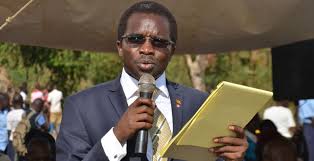
Outgoing State Minister for Northern Uganda Rehabilitation, Kenneth Omona, has defended his two-year tenure, saying he leaves office satisfied that he successfully tackled some of the region’s most pressing challenges, including land conflicts, Balaalo evictions and the livestock restocking programme. Dr. Omona, who was appointed to the docket in March 2024, was dropped in President Yoweri Museveni’s recent cabinet reshuffle and replaced by Beatrice Akello. He has since been appointed to serve as Uganda’s ambassador.
Speaking in an exclusive interview reflecting on his tenure, Omona described his assignment in Northern Uganda as “an incredible two years of service,” noting that he assumed office at a time when the region was grappling with major security, environmental, and economic challenges. “I came at a time of crisis. There were conflicts between communities and migrant cattle keepers, land disputes, poverty, food insecurity, and environmental degradation that needed urgent intervention,” said Omona.
The former minister said one of his biggest achievements was overseeing the implementation of presidential executive orders aimed at addressing uncontrolled charcoal burning, land conflicts, and the contentious presence of migrant cattle keepers, commonly known as Balaalo. According to Omona, government successfully evicted about 70,000 head of cattle from Northern Uganda during the operation jointly handled by the police and Uganda People’s Defence Forces (UPDF) personnel.

“As I speak now, government has already evicted about 70,000 head of cattle from Northern Uganda. The population is now more peaceful, settled and able to farm,” he said.
He acknowledged that challenges remain, particularly in hotspots such as Apaa, where communities continue to raise concerns over land ownership disputes and alleged collusion between some security personnel and land grabbers.
Omona, however, said substantial progress had been registered in implementing President Museveni’s directives, estimating that government had achieved between 60 and 70 percent of the objectives outlined in the executive orders. He also cited significant gains in environmental protection, claiming that uncontrolled charcoal burning had reduced by nearly 80 percent in parts of Northern Uganda.
On security, Omona said cattle raids that once plagued the Acholi sub-region had largely been brought under control albeit few isolated cases of theft conducted by armed suspects from the Karamoja sub-region.
Omona however said, perhaps his most celebrated achievement was mobilizing government support for coffee growing as a strategy to combat poverty and boost household incomes in Northern Uganda. He revealed that through engagements with government agencies and agricultural stakeholders, the region secured 65 billion shillings to support coffee production, including farmer training, distribution of seedlings, micro-irrigation systems, and value chain development.
Omona argued that coffee farming, alongside livestock production, could transform the region’s economy by providing sustainable income opportunities for households. Asked about his removal from cabinet and appointment to diplomatic service, Omona expressed gratitude to President Museveni, describing the redeployment as a vote of confidence.
“The President knows what he is doing. His choices are never haphazard. Wherever I am deployed, I serve diligently,” he said.
Omona said he is optimistic that the new minister and the incoming cabinet team will continue building on the progress made in Northern Uganda. To his successor, Beatrice Akello Akori, Omona offered simple advice: “Work with everybody, focus on the people’s interests, and continue the transformation and pacification of Northern Uganda.”
Peter Opika Opoka the coordinator for grassroot transitional justice working group in kitgum Municipality credited Omona for maintaining close contact with communities across Northern Uganda and ensuring local concerns reached the highest levels of government.
Opoka described Omona as “a natural diplomat,” arguing that the outgoing minister distinguished himself by regularly engaging communities and understanding the challenges they faced firsthand.
“Omona worked very hard, particularly in going down to learn how people suffered in Northern Uganda and how they could get solutions to their problems,” Opoka said. According to Opoka, Omona’s previous roles within the ruling National Resistance Movement and State House enabled him to effectively communicate regional concerns directly to President Museveni.
“I commend him for his hard work going down to the people. Being a diplomat by nature, he was able to gather firsthand information and push for solutions.” said Opoka. Omona is among the two ministers from the Acholi Sub-region who were dropped in President Yoweri Museveni’s recent cabinet reshuffle. The other is Henry Okello Oryem, who had served in the Foreign Affairs docket since 2004 and was one of the longest-serving ministers in government-URN. Give us feedback on this story through our email: kamwokyatimes@gmail.com