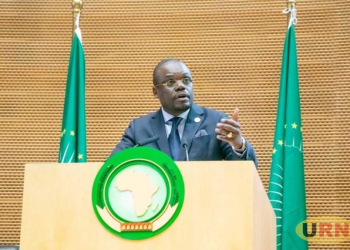
President Yoweri Kaguta Museveni made a rare appearance in Parliament this morning to pay tribute to the late Gen. Moses Ali, breaking with the long-standing tradition of sending written condolence messages whenever Parliament honours deceased legislators. His presence showed the unique place Gen. Ali occupied in Uganda’s political and military history as a former adversary who became a trusted ally, a soldier who embraced reconciliation, and one of the country’s longest-serving public servants.
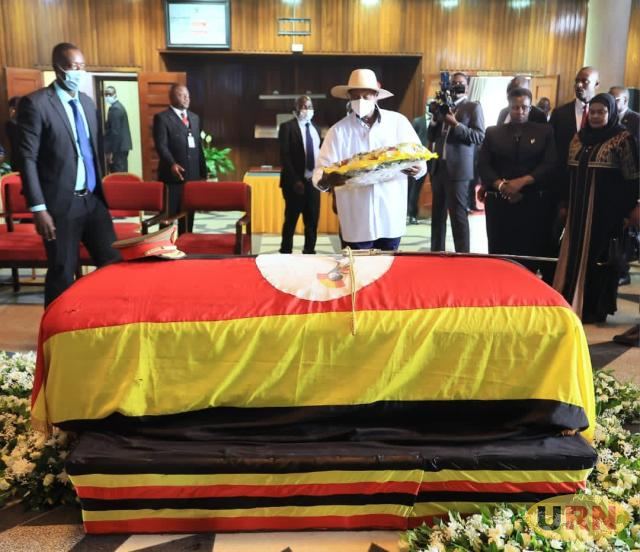
Upon arriving at Parliament, Museveni walked solemnly to the casket, laid a wreath and signed the condolence book. He carefully reread what he had written, pausing several times before briefly holding his pen in silence in what appeared to be a moment of reflection before leaving the table. Addressing Parliament, Museveni described the former Second Deputy Prime Minister and Adjumani West MP as a man whose life was defined by three enduring qualities: his love for freedom, his commitment to peace, and his unwavering dedication to the development of West Nile.
Museveni traced Ali’s political journey to his fallout with former President Idi Amin. “He was a lover of freedom. That’s why he fell apart with Idi Amin,” Museveni said, recalling that Ali was dismissed from Amin’s government in 1978. “I am the first Ugandan to oppose Idi Amin,” Museveni added as he narrated the events that eventually placed both men on separate paths resisting dictatorship.

The President reflected on the violence that followed Amin’s overthrow, saying revenge attacks against West Nile communities during the Uganda People’s Congress (UPC) government forced hundreds of thousands into exile. “There were mistakes in the UPC government. West Nilers were killed in revenge. That is when the refugee situation started. Most people fled to Congo and South Sudan,” he said, estimating that about 500,000 Ugandans became refugees.
Museveni then invited Ugandans born in exile, particularly in the Democratic Republic of Congo and South Sudan, to stand for recognition before posing for a group photograph with them. The President recounted how Uganda’s various armed groups operated separately during the early 1980s. After launching the National Resistance Army (NRA) rebellion on February 6, 1981, he travelled to Libya in June that year, where Libyan leader Muammar Gaddafi encouraged the different anti-government groups to continue their struggles independently.
It was during those engagements, Museveni said, that he first met Moses Ali, then leading the Uganda National Rescue Front (UNRF). He later returned to Libya in 1985 after concluding that although the NRA had accumulated enough weapons to defeat the Obote government, it still required broader political cooperation to stabilise the country.
Following the collapse of Obote’s government on July 27, 1985, Museveni said he contacted Gen. Bazilio Olara-Okello, Gen. Tito Okello, Paul Ssemogerere and other political leaders to encourage the formation of a united government. Museveni said Ali distinguished himself not only as a military commander but also as a leader committed to dialogue. He recalled hearing Ali frequently mentioned alongside Dr. Amos Adriko and initially assuming that Adriko was a medical doctor.
The President narrated another meeting in Libya after receiving reports that several armed groups planned to unite while excluding the NRA. “We said that was wrong,” Museveni said, crediting Ali for supporting dialogue instead of deepening divisions. “He was a peacemaker.” That commitment to reconciliation would later define one of Uganda’s most remarkable political transformations.
Although Ali had once fought against Museveni’s government as chairman of the Uganda National Rescue Front, he later joined the National Resistance Movement following peace negotiations. Ironically, Ali’s own curriculum vitae shows that reconciliation came only after a difficult period under the NRM government. According to the document, he was arrested at State House, Entebbe, on April 7, 1990, charged with treason, terrorism and illegal possession of firearms, and remanded to Luzira Prison.
He was convicted on the firearms charge and sentenced to two-and-a-half years’ imprisonment before the High Court acquitted him. He was later acquitted of treason and released, paving the way for his eventual return to public service. His political comeback saw him serve in successive NRM governments, eventually becoming Second Deputy Prime Minister, Deputy Leader of Government Business and a four-star General- one of Uganda’s most enduring examples of political reconciliation.
Museveni said Ali never abandoned his commitment to the people of West Nile. “He was a lover of West Nile,” the President said. “He was always pushing for the problems of West Nile- roads, the railway, electricity and others,” Museveni noted that many of the infrastructure projects Ali persistently lobbied for had already been delivered, while others remain under implementation.
He urged the people of West Nile to honour Ali’s legacy by embracing household wealth creation and making full use of the development opportunities he had championed. “He was a development person,” Museveni said. The President also praised Ali’s role in promoting unity within the Muslim community.
“I hear that even in the Muslim groups, he was instrumental in development. That’s why his body was taken to different mosques.” As the President concluded his tribute, Parliament continued receiving eulogies from legislators across the political divide, many describing Gen. Moses Ali as the” lion” and” cock” of West Nile- tributes reflecting his commanding political presence and decades of influence in the region-URN. Give us feedback on this story through our email: kamwokyatimes@gmail.com