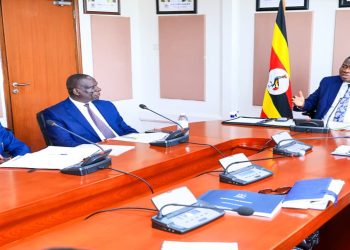
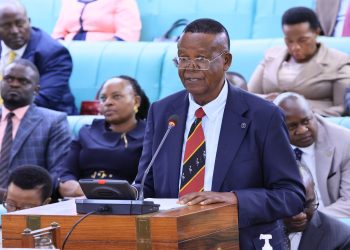
Uganda’s inaugural National Cleaning Day (NCD) on Saturday brought major towns and cities to an unusual standstill, with heavy security deployment, restricted movement and compulsory participation dominating the first nationwide sanitation exercise.
URN correspondents observed deserted streets, closed businesses and disrupted transport services across several urban centres as police, the Uganda People’s Defence Forces (UPDF) and local leaders supervised the exercise, which officially ran from 7:00 a.m. to 10:00 a.m.
The exercise was officially launched in Kampala’s Kisenyi suburb, where Vice President Jessica Alupo represented President Yoweri Museveni. Prime Minister Robinah Nabbanja said the initiative had been under preparation for some time under President Museveni’s guidance and would now be observed on the last Saturday of every month. Ministers, technocrats and other government officials joined residents in the launch.

Hours before the official launch, Kampala had already come to a standstill. Uganda Radio Network observed heavy deployments of police, Military Police, Field Force Unit personnel and newly recruited Special Police Constables armed with batons at major junctions, including the Northern Bypass flyovers, Mulago Roundabout, Jinja Road, Clock Tower, Kibuye and Ndeeba.
By 6:00 a.m., traffic police were intercepting boda boda riders attempting to make final trips before movement restrictions took effect. Streets across the city centre were largely deserted, with some residents remaining indoors while others hurried to join the cleaning exercise.
On Friday, police announced COVID-19-style enforcement measures, prohibiting the movement of motorcycles, private vehicles, bicycles and boats during the exercise, except for emergency services. People seeking medical care were required to present supporting documentation, while medical personnel were instructed to carry official identification.
Usually busy suburbs such as Kyebando, Kamwokya and Mulago were unusually quiet as residents participated in clearing clogged drainage channels, removing garbage and cleaning trenches. Several schools joined the exercise, although some institutions continued with their normal Saturday classes.
Quinto Okethwengu, chairperson of the Alur Business Community, mobilised residents to clean some of the dirtiest sections of Kisalosalo. He said although the community regularly conducts clean-up exercises on Saturdays, the declaration of the NCD had strengthened community participation. Despite the restrictions, a section of boda boda riders and business operators continued with their routine activities.
One boda boda rider, who identified himself only as Michael, said he had not expected the restrictions to be enforced on the launch day.
Across Kampala Metropolitan Area, security personnel mounted roadblocks, directing motorists, cyclists and pedestrians to pick litter or clear drainage channels before proceeding. Public taxis were largely absent from the roads, forcing many commuters to walk, while motorists travelling to health facilities were required to justify their movements.
Although many residents welcomed the objective of improving sanitation, several criticised what they described as inadequate public sensitisation before implementation.
By mid-morning, police were still enforcing the restrictions along Mityana Road, where some people who initially defied the directive were briefly detained before agreeing to participate in the clean-up.
In Luwero District, transport services ground to a halt as vehicles were parked and residents joined local leaders in cleaning public spaces.
The exercise was led by District Chairperson Erastus Kibirango, who described the initiative as long overdue, saying sanitation standards had declined significantly in many communities.
Police mounted roadblocks in Wobulenzi and along the Kampala-Gulu Highway to enforce compliance, while in neighbouring Kiwoko Town, State Minister for Kampala Metropolitan Affairs Kabuye Kyofatogabye led residents in the exercise.
Residents nevertheless appealed to government to provide more public dustbins to sustain cleanliness beyond the monthly exercise. In Arua City, security agencies adopted one of the toughest enforcement approaches. Vehicles were impounded, motorists ordered to clean streets and numerous roadblocks erected from early morning.
Some participants criticised what they described as excessive force, although Resident City Commissioner Maj. (Rtd.) Betty Otekat insisted participation was mandatory for every citizen.
The enforcement left most streets in the city unusually free of traffic. Business activities were similarly disrupted in Gulu City, where police sealed off access roads into the central business district, leaving traders and passengers stranded outside markets and transport terminals until the exercise ended.
Mayor Julius Acire Labeja led the clean-up, although several traders argued that the restrictions disproportionately affected people who depend on early morning business for their livelihoods.
The situation was markedly different in Soroti City, where enforcement appeared considerably weaker. Former State Minister for Works Musa Francis Ecweru joined residents in cleaning parts of the city centre, but many shops, salons and boda boda operators continued operating normally.
Residents blamed the low turnout on inadequate mobilisation by local leaders and called for stronger public sensitisation and enforcement if the initiative is to succeed. Some boda boda riders said daily motorcycle loan repayments made it difficult to suspend work.
In Fort Portal City, the exercise attracted mainly students, civil servants and government officials, while relatively few residents participated. Most shops in the city centre remained closed, although some vehicles and motorcycles continued operating.
Several residents told URN they had not been adequately informed about the exercise beforehand. The official launch in Fort Portal was expected to be presided over by Local Government Minister Balaam Barugahara.
Meanwhile, essential services remained operational at Lira Regional Referral Hospital, where off-duty staff cleaned the hospital compound while healthcare workers on duty werebattending to patients. The nationwide exercise forms part of government’s campaign to improve sanitation and environmental health.
Article 39 of the Constitution guarantees every Ugandan the right to a clean and healthy environment, while the National Environment Act, the Public Health Act and the National Environment (Waste Management) Regulation’s place obligations on both citizens and public authorities to maintain proper sanitation and waste management.
While the inaugural National Cleaning Day demonstrated government’s commitment to improving environmental sanitation, there is inconsistent public awareness, uneven enforcement and concerns over economic disruption-URN. Give us feedback on this story through our email: kamwokyatimes@gmail.com