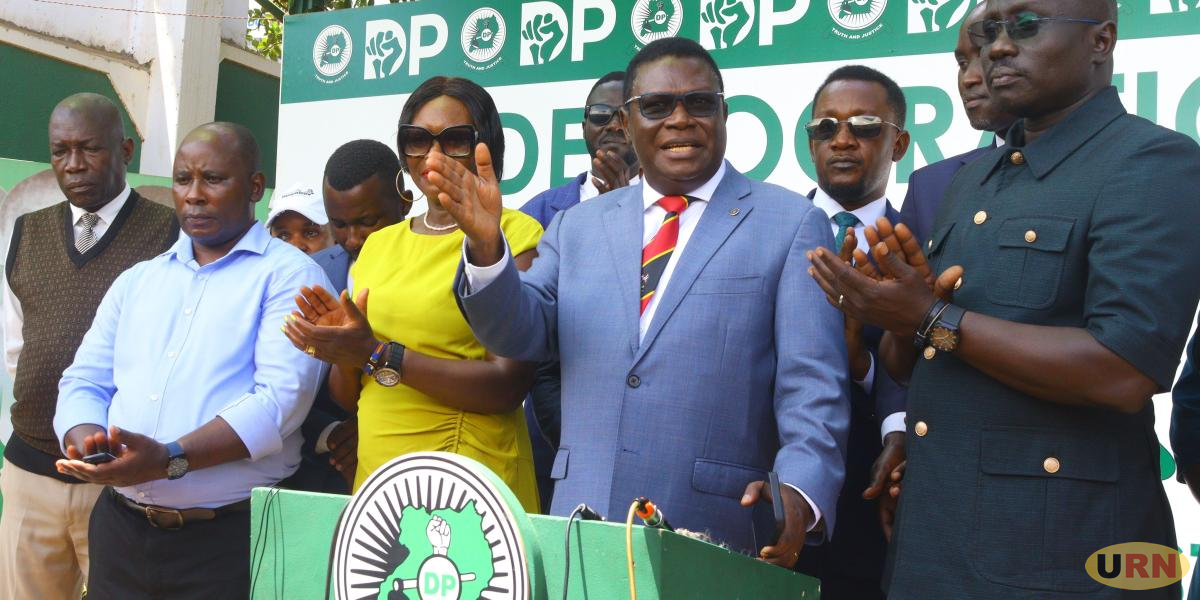
The Democratic Party (DP) President, Norbert Mao, has insisted on his bid for the post of Speaker of the 12th Parliament, saying he wants to rescue Parliament from what he described as a “crisis of confidence” and restore institutional integrity. He denied that it’s about political arithmetic.
Addressing journalists at the party headquarters in Kampala on Tuesday, Mao said that speakership should be leadership with purpose, not projects.
“This time, Mao,” he repeatedly declared before supporters and reporters, framing himself as the only candidate capable of rebuilding public trust in Parliament after months of criticism over corruption, extravagance, and abuse of office.

Mao’s remarks come at a politically sensitive moment following the withdrawal of former Speaker Anita Among from the race and the rapid consolidation of support around Jacob Markson Oboth-Oboth, whose endorsement by PLU significantly altered the dynamics of the contest.
The developments have left Mao politically isolated, with his Democratic Party commanding only a handful of MPs in the incoming Parliament and uncertain support from opposition legislators, many of whom remain deeply suspicious of his cooperation agreement with the ruling NRM government.
Yet Mao argued that his bid was never meant to be judged by numbers alone.
“When people ask how I will become Speaker, the only thing in their minds that disqualifies me is that I am not NRM,” Mao said.
“They have doubts of my victory not because of what I am, but because of what I am not.”
Mao projected himself as a reformist outsider challenging a compromised political establishment.
He repeatedly invoked themes of courage, destiny, and institutional renewal, comparing himself to biblical figures and liberation movements that prevailed against overwhelming odds.
He argued that his candidature had already achieved its central objective by shaking what he described as “inertia” within Parliament and forcing national debate about corruption and accountability.
“Nobody threatened that office more than Mao,” he said, referring to the speakership race and the eventual withdrawal of Anita Among.
“There was inertia. My candidature rallied Ugandans, created momentum, and overcame the inertia.”
Mao portrayed himself as the political actor who transformed public anger into a credible challenge to parliamentary leadership, likening his role to the NRA bush war fighters who moved beyond mere condemnation into action.
“Action is what makes a difference, not commentators,” he said.
The DP leader also used the platform to defend his controversial cooperation agreement with the NRM, insisting the arrangement was built around national unity rather than personal gain.
Quoting extensively from the agreement signed between DP and NRM in 2022, Mao argued that cooperation between political rivals was necessary to solve Uganda’s deeper national problems.
“To our allies in the NRM, the speakership is not just a matter for the NRM. It is a matter for all citizens,” he said.
Mao further suggested that some politicians who are now aligning themselves with the emerging consensus around Oboth-Oboth were merely “scavengers” benefiting from a political struggle they did not initiate.
“Even if a hyena eats the food of the lion, it does not become a lion,” he remarked in one of several pointed metaphors directed at rival politicians.
However, the realities confronting Mao remain stark.
With DP holding minimal numerical strength in Parliament and most NRM MPs expected to rally behind the officially backed candidate, Mao’s path to victory appears dependent on a highly unlikely coalition of dissenting ruling party legislators, opposition MPs, and independents.
Even within sections of the opposition, Mao’s relationship with President Yoweri Museveni and his service in the Cabinet have eroded trust among anti-government politicians who view him as politically compromised.
Some opposition figures have also privately questioned whether Mao’s candidature is a genuine bid for the speakership or a strategic pressure tactic aimed at strengthening DP’s bargaining power within government.
But Mao dismissed suggestions that he was merely negotiating for another political appointment.
“The best way to negotiate for a position would have been to be one of the endorsers,” he said.
“I had a choice to be a chief endorser. But I stuck my neck out.”
In one of the more dramatic moments of the press conference, Mao predicted that divine intervention and political destiny could still alter the outcome of the race.
“What is truly mine will come to me in due course,” he said.
“God still has something to say about this speakership.”
He then promised journalists that he would return to the same venue another Tuesday “as Speaker of Parliament.”-URN. Give us feedback on this story through our email: kamwokyatimes@gmail.com