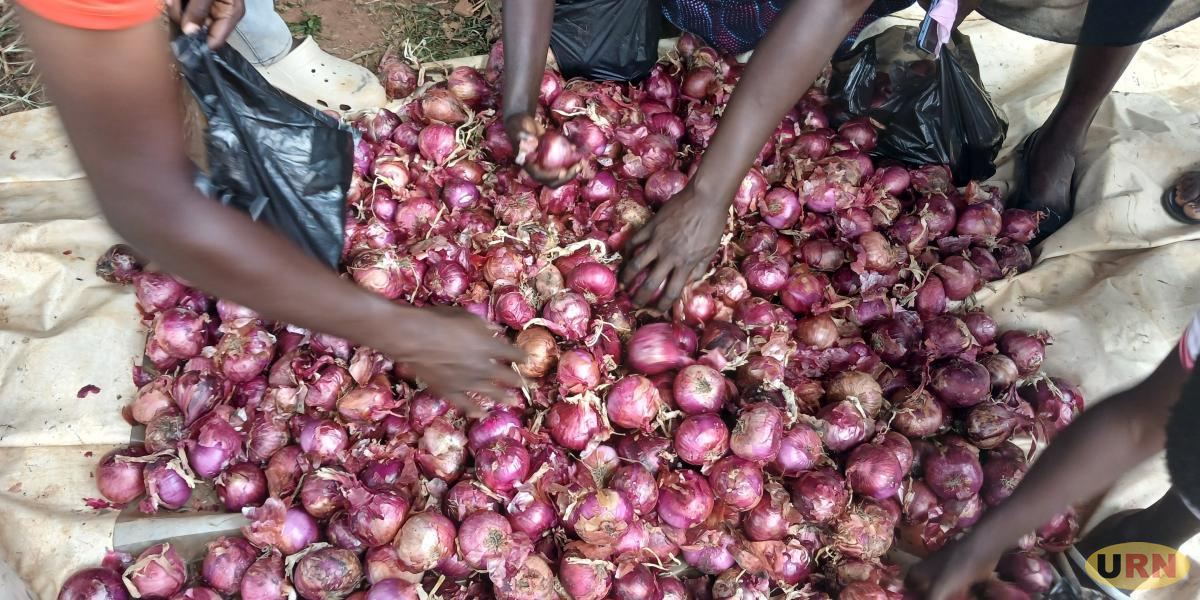
Yusufu Ali, a farmer from Namukora Sub-county, says the success of onion farming has demonstrated the potential of horticulture as a profitable venture in northern Uganda, but poor post-harvest handling and limited market access are threatening farmers’ earnings. Ali harvested 18 sacks of Red Creole onions in his first season before increasing production to 40 sacks in the second season after investing in quality seed, labour, and a microscale irrigation system under the Uganda Intergovernmental Fiscal Transfers (UGIFT) programme.
However, despite the increased production, Ali says the lack of proper storage facilities has forced him to keep the onions in unsuitable conditions, exposing them to rotting, sprouting, and theft as he waits for buyers. “I have managed to produce enough onions, but the biggest challenge now is where to store them and who to sell them to. Without proper storage, I am forced to sell immediately after harvest at very low prices,” Ali said.
He says, although onions are currently retailing at about 3,500 shillings per kilogram, he has been selling his produce at 2,500 shillings per kilogram to avoid losses. Ali says buyers often use the size of his onions to negotiate lower prices despite their quality. “There is no organised market. Buyers prefer the smaller onions because about 10 of them make a kilogram, but mine are bigger and only about five onions weigh a kilogram. Instead of paying for quality, they use the size to negotiate lower prices,” he said.

He has appealed to government and development partners to invest in onion curing sheds, storage facilities, and market linkages, saying farmers have already demonstrated that the crop can thrive in Kitgum. “What we need now is not more production training. We have proved that onions can do well in Kitgum. We need storage facilities and buyers who can purchase our produce in bulk,” Ali said.
James Odoki, another vegetable farmer in Mucwini Sub-county, says the high yields being achieved by local farmers show that Kitgum has the potential to become a major onion-producing area and reduce dependence on supplies from Mbale District. For years, traders in the Acholi sub-region have relied on onions from Mbale and other producing districts because local production has remained low and inconsistent.
“Traders depend on Mbale because that is where they get onions throughout the year. The few farmers growing onions here harvest only occasionally, and their volumes are too small,” Odoki said. He says strengthening local onion production would reduce transport costs, stabilize prices, and create more income opportunities for farmers. Jacob Okema, the Agricultural Officer for Labongo Amida and Labongo Akwang sub-counties, says Red Creole onions are emerging as a promising commercial crop in northern Uganda because of their high yields and relatively long shelf life.
Okema says Ali’s success using microscale irrigation during the dry season demonstrates that farmers can produce high-value crops throughout the year despite changing weather patterns. “I did not know Red Creole onions could perform this well in Kitgum until Ali grew them during the dry season using microscale irrigation. His success shows that farmers can produce high-value crops throughout the year despite changing weather patterns,” Okema said.
He encouraged more farmers to embrace horticulture, saying irrigation is creating new opportunities for commercial agriculture in the district. Kitgum Resident District Commissioner Jimmy Segawa Ebil challenged the district production and communications departments to profile successful farmers and promote the products grown in the district to attract buyers and investors.
He said information about what Kitgum produces should be made available online to create market opportunities for farmers. “There is a lot we can do to help our farmers. If journalists do not write these stories and publish them online, no one will know that Kitgum is producing apples, Hass avocados and Red Creole onions,” Ebil said-URN. Give us feedback on this story through our email: kamwokyatimes@gmail.com